


Blog / Chevrolet Service in El Reno Oklahoma

Why Won’t My Chevrolet Start? 7 Signs Your Battery May Be Failing

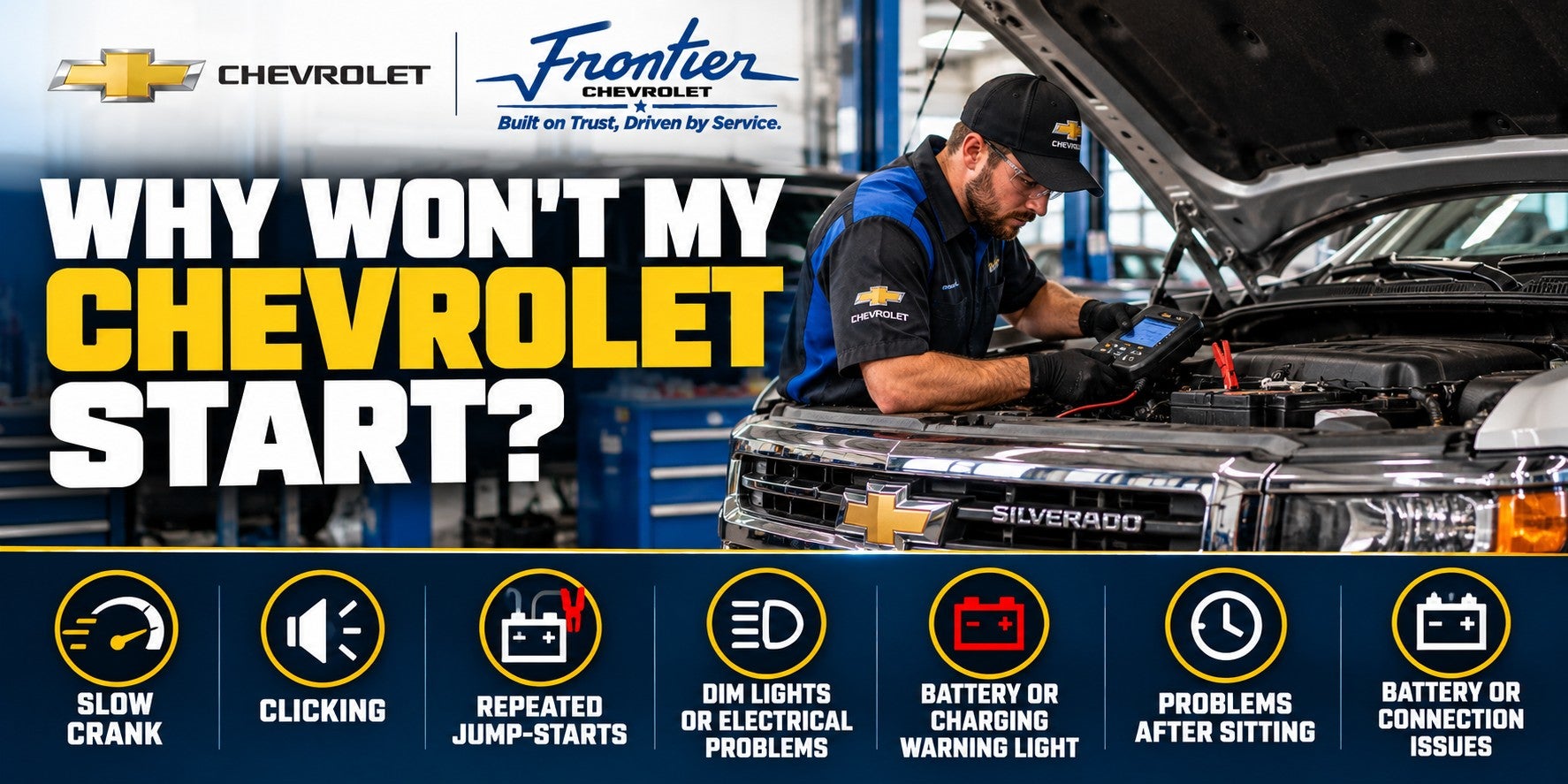
Chevrolet Silverado receiving battery and starting-system testing for slow cranking, clicking, repeated jump-starts and charging problems at Frontier Chevrolet in El Reno, Oklahoma

Why Won’t My Chevrolet Start? 7 Signs Your Battery May Be Failing


You turn the key or press the start button—and your Chevrolet doesn't start.

Maybe the engine cranks slowly. Maybe you hear clicking. Maybe the lights come on but the engine doesn't. Or maybe a jump-start gets you going, only for the same problem to return a few days later.

It's easy to blame the battery.

But a Chevrolet that won't start doesn't automatically need a new battery.

At Frontier Chevrolet in El Reno, Oklahoma, we recommend looking at the entire starting and charging system before assuming one component is responsible.

Understanding the symptoms can help you know what to do next.


Quick Answer: Why Won't My Chevrolet Start?


A Chevrolet that won't start may have a weak or discharged battery, poor battery connections, a starter problem, a charging-system issue or another electrical or mechanical condition. Slow cranking, clicking, repeated jump-starts and unusual electrical behavior can point toward a battery-related problem, but proper testing is the best way to determine the actual cause.

Don't replace a battery simply because the vehicle didn't start once.

Find out why it didn't start.


1. Why Is My Chevrolet Cranking Slowly?


A healthy starting system should normally turn the engine over with enough speed to start it.

If your Chevrolet suddenly sounds slower or weaker while cranking, pay attention.

A slow crank can potentially involve:
  • A weak battery
  • Low battery charge
  • Battery connections
  • Starting-system components
  • Cold temperatures
  • Other electrical or mechanical conditions

A battery that still starts the vehicle today may be showing early signs that its performance is declining.

If cranking speed has noticeably changed, testing the battery and starting system can provide more useful information than waiting until the vehicle won't start at all.


2. Why Does My Chevrolet Click but Not Start?


Clicking when you attempt to start your Chevrolet can have several possible causes.

The battery may not have enough available power to operate the starting system properly.

But clicking can also be associated with:
  • Battery connections
  • Cables
  • Starter components
  • Electrical-system conditions
  • Other starting-system problems

Clicking doesn't automatically mean the starter is bad, and it doesn't automatically mean the battery needs replacement.

Testing helps separate the symptom from the actual cause.


3. Why Does My Chevrolet Keep Needing a Jump-Start?


If your Chevrolet needs one jump-start after something obvious happened—such as lights being left on—the cause may be relatively straightforward.

Repeated jump-starts are different.

If the battery keeps losing enough charge that the vehicle won't start, possible areas to investigate include:
  • Battery condition
  • Charging system
  • Battery connections
  • Electrical draw while parked
  • Driving patterns
  • Other electrical conditions

A jump-start gets the vehicle running.

It doesn't explain why the battery lost its charge.

If the problem keeps returning, diagnose the reason instead of making jump-starting part of your routine.


4. Can a Weak Battery Cause Electrical Problems?


A vehicle's electrical systems depend on stable electrical power.

When battery voltage or system voltage isn't where it should be, you may notice unusual behavior.

Depending on the vehicle and condition, symptoms could include:
  • Dim lighting
  • Slow power accessories
  • Starting problems
  • Warning messages
  • Electronic systems behaving differently than normal

Modern Chevrolet vehicles contain numerous electronic modules and systems, so electrical symptoms shouldn't automatically be traced to one component without testing.

A weak battery is one possibility.

It isn't the only possibility.


5. What Does the Battery Warning Light Mean?


This is an important distinction:
A battery-shaped warning light does not necessarily mean you need a new battery.

Depending on the Chevrolet and condition, a battery or charging-system warning can indicate that the vehicle's electrical system isn't operating as expected.

The battery is only one part of that system.

Other components and connections are involved in maintaining electrical power while the vehicle operates.

If a battery or charging warning appears while you're driving, don't simply purchase a battery based on the symbol.
Have the charging and electrical system evaluated.


6. Why Won't My Chevrolet Start After Sitting?


Vehicles that sit for extended periods can sometimes develop battery-related problems.

Even when a vehicle is turned off, certain systems may continue to use small amounts of electrical power.

How quickly a battery loses charge can depend on factors such as:
  • Battery condition
  • Length of time parked
  • Temperature
  • Electrical accessories
  • Vehicle systems
  • Previous state of charge
  • Possible abnormal electrical draw

Short, infrequent trips may also make it more difficult for the charging system to replenish energy used during starting.

If your Chevrolet regularly sits for extended periods and repeatedly has a discharged battery afterward, it's worth determining why.


7. What Should I Look for Around My Chevrolet Battery?


You don't need to disassemble anything to notice that something around the battery doesn't look normal.

Visible conditions worth having inspected may include:
  • Corrosion around battery connections
  • Loose or damaged-looking connections
  • Damaged cables
  • An unusual-looking battery case
  • Other visible deterioration

Avoid attempting repairs you're not comfortable performing, particularly around electrical systems.

A visual inspection can identify obvious concerns, but battery and charging-system testing provides more useful information about what's happening electrically.


Is It My Battery, Alternator or Starter?


Several starting-system problems can produce similar symptoms.

Here's a simplified starting point:
SymptomPossible Area to Check
Slow or weak crankingBattery, connections or starting system
Clicking but engine won't crankBattery, connections or starter system
Battery repeatedly loses chargeBattery, charging system or electrical draw
Battery/charging warning while drivingCharging or electrical system
Vehicle starts after a jump but problem returnsBattery and charging system should be tested
Lights work but engine won't crankStarting/electrical system requires diagnosis

This table is not a diagnosis.

Symptoms overlap.

Testing the battery, charging system and starting system can help identify which component or condition is actually responsible.


Can a Battery Test Good and Still Cause Problems?


Battery testing needs to be interpreted in the context of the symptoms and the entire electrical system.

A starting problem may involve the battery, but it can also involve:
  • Connections
  • Cables
  • Charging system
  • Starter
  • Electrical draw
  • Other vehicle systems

This is why replacing parts based on a single symptom isn't always the best approach.

If the problem is intermittent, tell the technician exactly what happens and under what conditions.

For example:
“It only struggles to start first thing in the morning.”

is more useful than:
“Sometimes it doesn't start.”

Details help diagnosis.


How Long Does a Chevrolet Battery Last?


There isn't one exact lifespan that applies to every Chevrolet battery.

Battery life can be influenced by:
  • Climate
  • Under-hood temperatures
  • Driving habits
  • Vehicle usage
  • Battery type
  • Electrical demands
  • Time spent parked
  • Charging-system performance
  • Battery condition

Rather than replacing a battery based only on age, consider its age together with testing results and vehicle symptoms.

An older battery showing declining performance deserves more attention than one operating normally.


Does Oklahoma Heat Damage Car Batteries?


Oklahoma summer heat can be hard on automotive batteries.
High temperatures can contribute to the chemical processes and deterioration that occur inside a battery over time.

The frustrating part is that the driver may not notice the effect immediately.

A battery can lose capacity during hot weather and continue starting the vehicle until another condition exposes the weakness.

That's one reason battery health matters before extreme weather arrives.


Why Do Battery Problems Show Up When It Gets Cold?


Cold weather can expose a battery that was already losing performance.

Starting an engine requires significant electrical power, and colder conditions can increase starting demands while battery performance may also be reduced.

That means the first cold morning of the season may appear to have "killed" the battery.

In reality, the battery may already have been weakened.

Cold weather often reveals battery problems rather than creating them overnight.


Why Won't My Silverado Start?


A Silverado that won't start can experience many of the same battery, charging and starting-system conditions as other vehicles.

But how the truck is used can also matter.

Consider whether your Silverado:
  • Sits for extended periods
  • Makes mostly short trips
  • Operates additional electrical accessories
  • Is used commercially
  • Tows regularly
  • Experiences extreme temperatures
  • Has recently shown slower cranking

Don't automatically assume a Silverado no-start condition means the battery needs replacement.
Start with testing.


Why Does My Silverado Click but Not Start?


If your Silverado clicks when you attempt to start it but the engine doesn't crank normally, the battery and battery connections are reasonable areas to investigate.

However, the starter and other starting-system components can produce similar symptoms.

Repeatedly attempting to start the truck usually doesn't provide much additional information.

Testing does.


What About Silverado 2500 HD and 3500 HD Trucks?


Heavy-duty Silverado trucks may be used differently than typical passenger vehicles.

Many operate as:
  • Work trucks
  • Tow vehicles
  • Farm and ranch trucks
  • Commercial vehicles
  • Equipment haulers
  • Fifth-wheel tow vehicles

Some may also sit between periods of heavy use.

For these trucks, reliable starting isn't just a convenience—it can affect work schedules and towing plans.

Periodic battery and charging-system checks can be particularly valuable before long trips, towing season or extreme weather.


Are Duramax Diesel Starting Problems Different?


Diesel engines have operating and starting characteristics that differ from gasoline engines.

If a Duramax-powered Silverado develops a starting problem, don't automatically assume the issue is identical to a gasoline truck.

Depending on the truck and symptoms, diagnosis may involve evaluating the applicable battery, starting, charging, fuel, engine-management or other systems.

The important point is the same:
Diagnose the actual condition before replacing parts.

This is especially important with diesel trucks where several systems may contribute to a hard-start or no-start complaint.


Can Short Trips Affect My Chevrolet Battery?


They can.

Starting the engine requires energy from the battery.

Once the engine is running, the charging system helps replenish that energy while also supporting the vehicle's electrical needs.

If a Chevrolet is repeatedly driven only very short distances, operating conditions may not always allow the battery to recover in the same way it would during longer drives.

That doesn't mean every short-trip driver will have battery problems.

It means driving patterns are worth considering when diagnosing repeated low-charge conditions.


Can Accessories Drain My Silverado Battery?


Additional electrical equipment can increase electrical demands.

Depending on the truck, aftermarket or added equipment might include:
  • Work lights
  • Auxiliary lighting
  • Audio equipment
  • Trailer equipment
  • Cameras
  • Communication equipment
  • Inverters
  • Other work accessories

Proper installation matters.

If a Silverado begins experiencing battery problems after electrical equipment is added, that information should be included when the vehicle is diagnosed.


Why Is My Newer Chevrolet Battery Dead?


Vehicle age alone doesn't determine why a battery becomes discharged.

A newer Chevrolet can still experience a discharged battery because of:
  • Something being left on
  • Extended parking
  • Battery condition
  • Electrical-system issues
  • Charging-system issues
  • Electrical draw
  • Other operating conditions

A dead battery and a failed battery aren't necessarily the same thing.

The question isn't only whether the battery is discharged. It's why it became discharged.


Should I Replace My Battery Before a Long Trip?


If your battery is showing warning signs, has questionable test results or you've experienced recent starting problems, having it checked before a long trip makes sense.

The same applies before:
  • A long towing trip
  • Vacation travel
  • Extreme summer heat
  • Cold-weather travel
  • Remote driving

A few minutes spent checking the vehicle before leaving can be much easier than dealing with a no-start condition far from home.


What Should I Do if My Chevrolet Won't Start?


If the vehicle won't start, first consider the circumstances.

Did you leave lights or accessories on?

Does the engine crank?

Does it crank slowly?

Do you hear clicking?

Are the dashboard lights operating?

Is there a warning message?

Did the vehicle have starting problems recently?

If you aren't comfortable diagnosing or jump-starting the vehicle safely, seek assistance.

If a jump-start gets the vehicle running but the problem returns, have the battery and electrical system checked.

Don't assume the problem has been solved simply because the engine is running again.


Chevrolet Battery Service Near El Reno and Oklahoma City


Frontier Chevrolet is located in El Reno, Oklahoma, west of the Oklahoma City metro.

Our service department works with Chevrolet owners from El Reno and surrounding communities, including Yukon, Mustang, Piedmont, Kingfisher, Weatherford and western Oklahoma City.

Whether you drive a Silverado, Tahoe, Suburban, Traverse, Equinox, Trax, Colorado or another Chevrolet, starting problems are easier to address when they're diagnosed before you're stranded.

If your Chevrolet is cranking slowly, clicking, repeatedly needing a jump-start or displaying an electrical warning, consider having the system tested.


Chevrolet Battery & Starting FAQs


Why won't my Chevrolet start?

A no-start condition can potentially involve the battery, battery connections, starter, charging system, electrical system or another vehicle condition. Diagnosis depends on exactly what the vehicle does when you attempt to start it.


Does clicking mean my Chevrolet battery is dead?

Not necessarily. A weak or discharged battery is one possibility, but connections, the starter and other electrical conditions can produce similar symptoms.


Why does my Chevrolet start after a jump but die again later?

The battery may not be holding sufficient charge, the charging system may not be replenishing it properly, or another electrical condition may be involved. Battery and charging-system testing can help determine the cause.


Does the battery warning light mean I need a battery?

Not automatically. A battery-shaped warning can relate to the charging or electrical system rather than simply indicating that the battery itself needs replacement.


How long should a Chevrolet battery last?

There isn't one exact lifespan for every battery. Climate, driving patterns, electrical demands, battery type, vehicle use and other factors can affect battery life.


Can Oklahoma heat shorten battery life?

High temperatures can contribute to battery deterioration over time, making Oklahoma summer conditions an important consideration in battery health.


Why does my Silverado crank slowly in cold weather?

Cold conditions can increase starting demands while reducing available battery performance. Cold weather can expose a battery that was already losing capacity.


Can Frontier Chevrolet test my battery if I didn't buy my vehicle there?

Yes. You don't have to have purchased your Chevrolet from Frontier Chevrolet to request battery, starting or charging-system service.


Schedule Chevrolet Battery & Starting System Service in El Reno


If your Chevrolet won't start, don't automatically ask:
“How much is a battery?”

Start with a better question:
“Why didn't my Chevrolet start?”

Sometimes the answer is the battery.

Sometimes it isn't.

If your Chevrolet is cranking slowly, clicking, repeatedly requiring a jump-start or showing other unusual electrical behavior, schedule an inspection with Frontier Chevrolet in El Reno.

Our goal is to identify the cause of the problem so you can make an informed decision about what your Chevrolet actually needs.

Frontier Chevrolet
1640 E. Highway 66
El Reno, Oklahoma 73036
Built on Trust, Driven by Service.
Schedule your Chevrolet battery and starting-system service today.
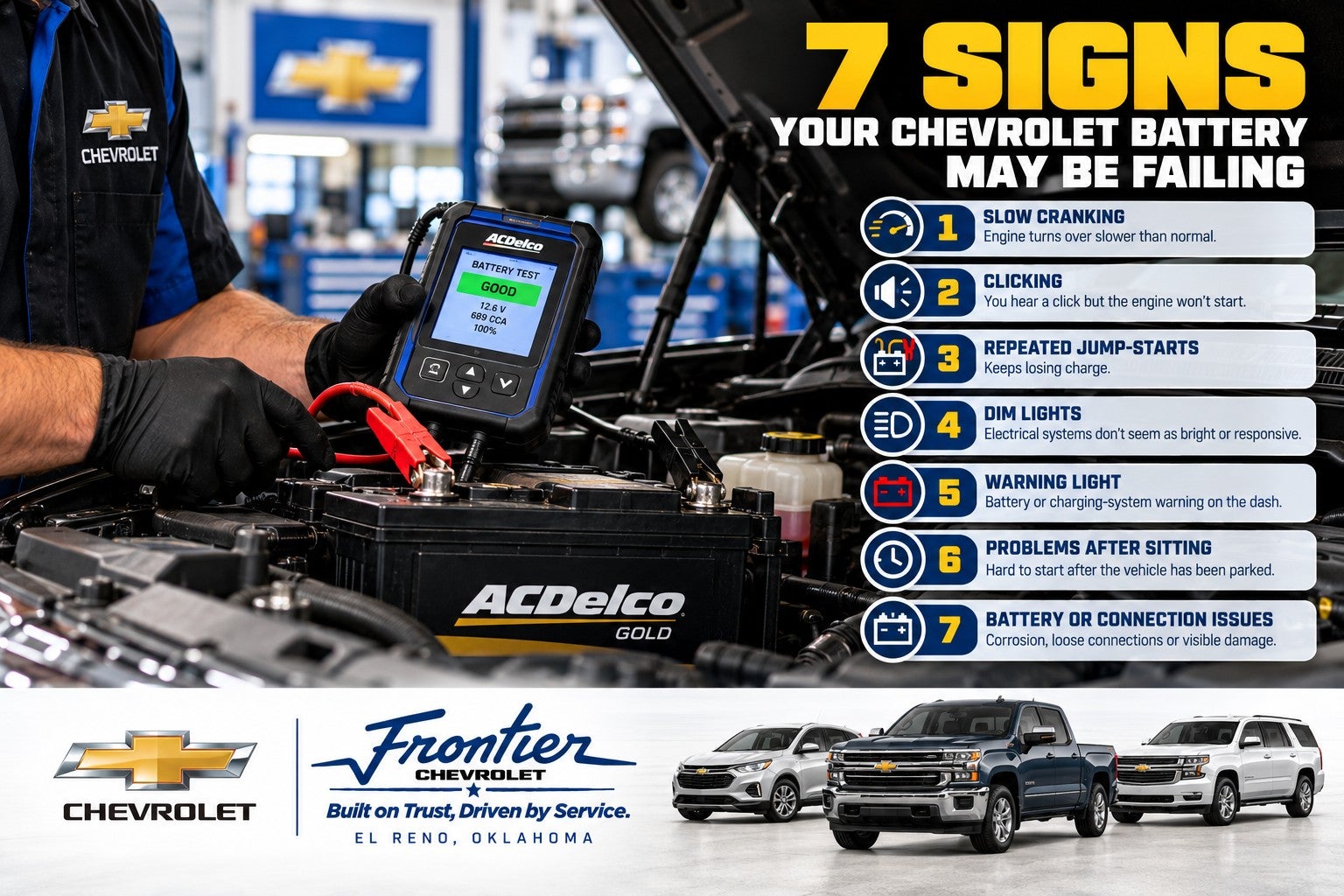
Chevrolet battery testing showing seven warning signs of a failing battery including slow cranking, clicking, repeated jump-starts, dim lights and charging-system warnings at Frontier Chevrolet in El Reno, Oklahoma
Posted in:

Related Posts

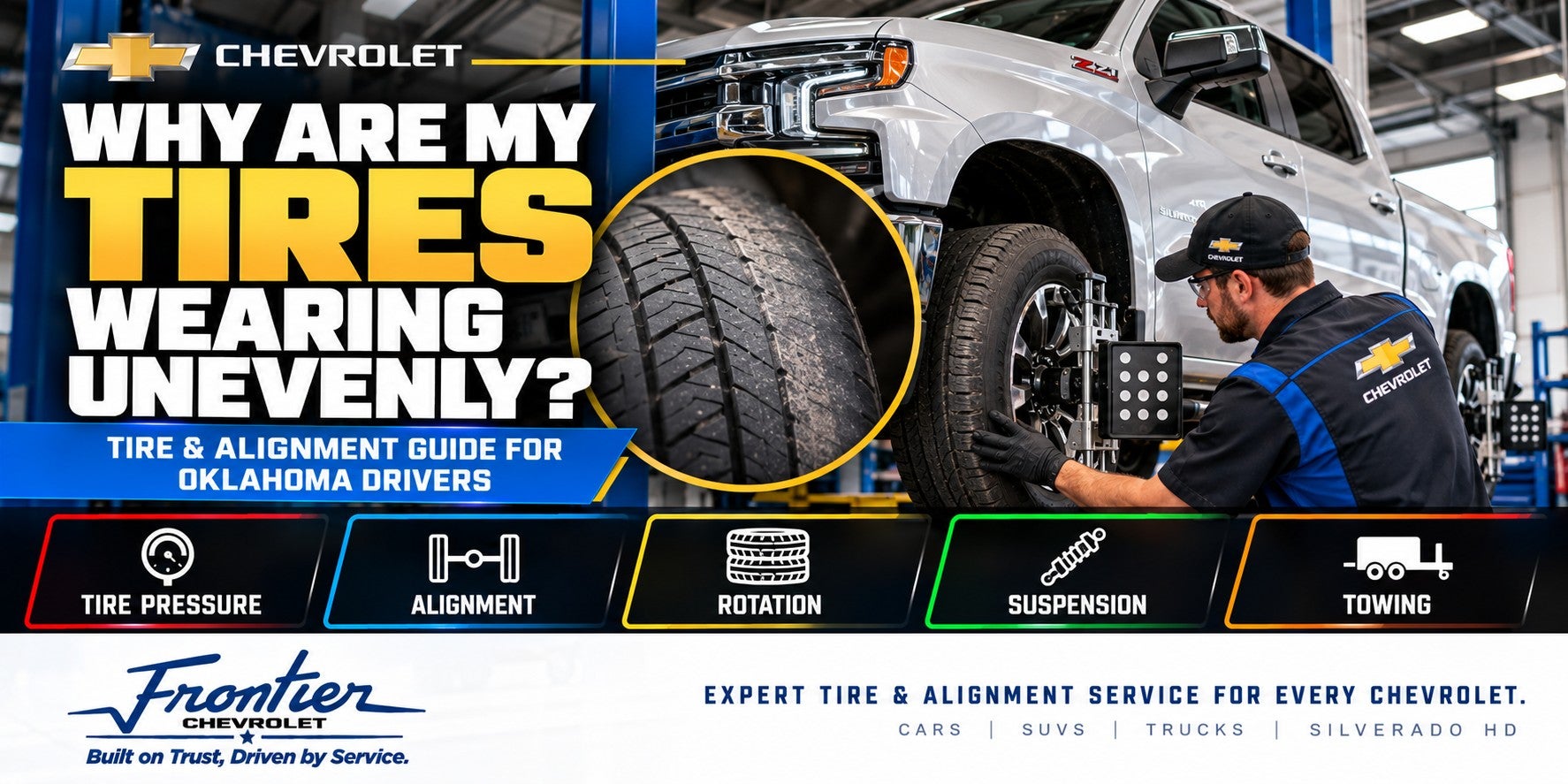
Chevrolet Silverado receiving a tire and alignment inspection for uneven tire wear at Frontier Chevrolet in El Reno, Oklahoma

Why Is My Chevrolet Wearing Tires Unevenly? Tire & Alignment Guide for Oklahoma Drivers

Why Is My Chevrolet Wearing Tires Unevenly? Tire & Alignment Guide for Oklahoma Drivers Your tires can tell you a lot about what's happening with your Chevrolet. Wear on one edge. A steering wheel that no longer sits straight. A vehicle that seems to pull left or right. One tire wearing noticeably faster than the others. Those aren't things you should automatically dismiss as normal tire wear. For Oklahoma drivers, tire condition can also be affected by potholes, rough pavement, gravel roads, temperature changes, towing and the way a vehicle is driven every day. At Frontier Chevrolet in El Reno, we recommend paying attention to how your tires are wearing—not just how much tread they have left. Quick Answer: Why Are My Chevrolet Tires Wearing Unevenly? Uneven tire wear can be caused by incorrect tire pressure, alignment issues, worn or damaged steering and suspension components, missed tire rotations or the way the vehicle is being used. If your Chevrolet is pulling, the steering wheel is off-center or the tires are developing unusual wear patterns, an inspection can help identify the cause before additional tire wear occurs. An alignment may be part of the solution, but it isn't the answer to every tire-wear problem. The first step is determining why the tire is wearing abnormally. What Does Uneven Tire Wear Look Like? Don't only look at the center of the tire. Look across the entire tread surface. Depending on the condition, you may notice: More wear on the inside edge More wear on the outside edge Excessive wear in the center Wear on both outer edges Irregular or patchy wear One tire wearing differently from the others Different wear between the front and rear tires Different wear patterns can have different causes. That's why simply replacing the tire without identifying the underlying issue may not solve the problem. Why Are My Tires Wearing on the Inside Edge? Excessive wear along the inside portion of a tire can be associated with alignment or steering and suspension conditions. The important point is that the tire itself may not be the only problem. If you install a new tire without addressing the condition responsible for the abnormal wear, the replacement tire could eventually develop a similar pattern. A tire and vehicle inspection can help determine what needs attention. Why Are My Tires Wearing on the Outside Edge? Outside-edge wear can also have several possible causes. Depending on the wear pattern and vehicle, factors may include: Tire pressure Alignment Driving conditions Steering or suspension components Vehicle loading Tire rotation history One unusual wear pattern doesn't automatically diagnose the problem. The entire tire and related vehicle systems should be considered. Can Incorrect Tire Pressure Cause Uneven Tire Wear? Yes. Tire pressure affects how the tire contacts the road. Operating with incorrect pressure can contribute to abnormal tire wear and may also affect: Handling Ride quality Fuel economy Traction Tire temperature Overall tire performance That's one reason tire pressure should be checked regularly rather than only when the Tire Pressure Monitoring System warns you. Should I Use the PSI Printed on the Side of the Tire? Use the vehicle manufacturer's recommended cold tire pressure for your specific Chevrolet rather than assuming the maximum pressure molded into the tire sidewall is the correct operating pressure. Recommended tire-pressure information can typically be found on the vehicle's tire information label. Requirements can vary by vehicle, tire and configuration, so use the information provided for your specific Chevrolet. Why Does Tire Pressure Change When Oklahoma Weather Changes? Tire pressure can change as outside temperatures change. That's why Oklahoma's seasonal temperature swings can sometimes trigger a low-tire-pressure warning even when there isn't an obvious tire puncture. If a warning appears, check the tire pressures rather than simply assuming weather is the only cause. A tire may also be losing air because of a puncture, wheel issue, valve-related condition or another problem. How Do I Know if My Chevrolet Needs an Alignment? Several symptoms can indicate that your vehicle deserves an alignment or steering and suspension inspection. These may include: Uneven tire wear Vehicle pulling An off-center steering wheel Changes in steering feel Abnormal tire wear after hitting a pothole Handling that feels different than normal However, these symptoms don't automatically prove that alignment is the cause. Tires, brakes, steering and suspension components can produce similar symptoms. An alignment check helps determine whether the vehicle's wheel angles are within specification. Why Is My Chevrolet Pulling to One Side? A vehicle that pulls left or right can be frustrating, but alignment isn't the only possible explanation. Pulling may potentially involve: Tire pressure Tire condition Alignment Brakes Steering components Suspension components Road crown Other vehicle conditions If your Chevrolet consistently pulls in the same direction on different roads, it's worth having the vehicle inspected. This is also why replacing parts based solely on a symptom isn't the best approach. Diagnose first. Repair what the vehicle actually needs. Why Is My Steering Wheel Off-Center? When you're traveling straight down a reasonably level road, your steering wheel should generally appear appropriately centered. If you notice that the wheel must consistently be held at an unusual angle to keep the vehicle traveling straight, alignment may be one of the conditions worth checking. An off-center steering wheel can sometimes appear after: Hitting a pothole Striking a curb Suspension or steering repairs Tire or wheel damage Changes in alignment If the condition suddenly appears after a significant impact, have the vehicle inspected. Can Oklahoma Potholes Knock My Chevrolet Out of Alignment? A hard impact with a pothole can potentially affect tires, wheels, steering, suspension or alignment. Not every pothole automatically creates an alignment problem. But after a significant impact, pay attention to changes such as: New vibration Vehicle pulling Off-center steering wheel Tire-pressure loss New tire or wheel damage Changes in handling If the vehicle feels different afterward, an inspection is a better strategy than waiting to see whether the problem becomes worse. Do Gravel Roads Affect Tires and Alignment? Driving on gravel doesn't automatically mean your Chevrolet needs frequent alignments. However, vehicles regularly driven on rough rural roads can experience operating conditions that are very different from vehicles spending most of their lives on smooth highways. Rough surfaces can increase exposure to: Potholes Washboarding Loose rocks Road debris Uneven surfaces For Oklahoma truck owners who regularly travel ranch, farm or rural roads, periodic tire and suspension inspections can be especially useful. How Often Should I Rotate My Chevrolet Tires? The correct tire-rotation schedule depends on the vehicle, tires and manufacturer's maintenance recommendations. Rather than assuming every Chevrolet should follow one universal mileage interval, consult the maintenance information for your specific vehicle. Regular tire rotations can help distribute wear more evenly among the tires. They also create a useful opportunity to inspect: Tread depth Wear patterns Tire pressure Visible tire damage Wheels Brakes The goal isn't simply moving tires from one position to another. It's monitoring how the tires are performing over time. Will Tire Rotation Fix Uneven Tire Wear? Rotation can help manage normal tire wear, but it doesn't correct the mechanical cause of abnormal wear. For example, if an alignment, tire-pressure or suspension condition is causing a tire to wear abnormally, rotating that tire doesn't eliminate the underlying problem. It simply moves the tire to another position. If abnormal wear is already present, identify the cause before assuming rotation alone will fix it. Will an Alignment Fix Uneven Tire Wear? An alignment can correct certain wheel-angle conditions that contribute to abnormal tire wear, but it cannot restore tread that has already worn away. This distinction matters. Correcting the alignment can help prevent the same condition from continuing, but an already damaged or severely worn tire may still require replacement. And alignment isn't responsible for every tire-wear problem. That's why the tire, alignment, steering and suspension systems should be evaluated together when necessary. Do I Need an Alignment When I Buy New Tires? Not automatically. But if the old tires show abnormal wear, the vehicle pulls, the steering wheel is off-center or there are other indications of an alignment issue, checking alignment before allowing the new tires to develop the same wear pattern makes sense. New tires don't correct an existing alignment problem. If you're investing in a new set of tires, it's worth understanding why the previous set wore the way it did. Why Is My Silverado Wearing Tires Unevenly? Silverado tire wear can be influenced by how the truck is actually used. Two identical trucks can experience very different tire life if one spends most of its time commuting while the other regularly pulls a trailer or operates on rough roads. Factors worth considering include: Tire pressure Tire rotation Alignment Towing Payload Driving conditions Steering and suspension condition Tire type Highway versus city driving For Silverado owners, usage matters. Does Towing Affect Silverado Tire Wear? Towing changes the workload placed on the truck. The amount of additional tire stress depends on factors such as: Trailer weight Tongue or pin weight Truck configuration Payload Tire condition Tire pressure Road conditions Frequency of towing That's why tire inspection should be part of preparing a Silverado for regular towing. Before a longer towing trip, inspect the truck's tires as well as the trailer's tires. What Should I Check Before Towing With My Silverado? Before leaving with a trailer, consider checking: Tire condition Tread Tire pressure Trailer tires Spare tires Wheels Trailer connections Brakes Trailer brakes when equipped Lights Hitch equipment Applicable fluid levels A truck's ability to pull the trailer is important. So is the condition of the equipment connecting that truck to the road. Do Silverado 2500 HD and 3500 HD Tires Need Different Attention? Heavy-duty trucks may operate under significantly different conditions than light-duty vehicles. Silverado HD owners may regularly use their trucks for: Fifth-wheel towing Gooseneck trailers Equipment trailers Livestock trailers Commercial work Farm and ranch use Heavy payloads That makes correct tire selection, pressure, loading and inspection particularly important. Don't assume the requirements for a Silverado HD are identical to those of a passenger car or light crossover. Use the specifications and recommendations for your particular truck and tire configuration. Why Does My Silverado Steering Wheel Shake? A steering-wheel vibration can have several possible causes. Tires and wheels are among the possibilities, but they're not the only ones. Potential areas that may need inspection include: Tires Wheel balance Wheels Steering components Suspension components Brakes Other vehicle systems Pay attention to when the vibration occurs. Does it happen at a particular speed? Only while braking? After hitting a pothole? While towing? Those details can help a technician diagnose the problem. Can Bad Alignment Cause My Steering Wheel to Shake? Alignment and steering geometry can affect how a vehicle drives, but a shaking steering wheel shouldn't automatically be diagnosed as an alignment problem. Wheel balance, tires, wheels, brakes and suspension components can also contribute to vibration. Again, diagnosis matters. A symptom tells you where to start looking. It doesn't always tell you which part to replace. Can Worn Tires Affect Braking? Yes. Your brakes create the force needed to slow the vehicle, but your tires are what connect that vehicle to the road. Tire condition can affect: Traction Wet-weather performance Stopping performance Steering Vehicle stability This is particularly important during Oklahoma thunderstorms and other conditions where the road surface may provide less traction. Good brakes and poor tires are not a good combination. Should I Replace All Four Tires at Once? The correct answer depends on the vehicle, drivetrain, existing tire condition and the replacement tire being considered. There isn't one answer that applies to every Chevrolet. If you're replacing fewer than four tires, proper tire matching and placement should be considered for the specific vehicle. This is another area where recommendations should be based on the actual Chevrolet rather than a generic rule. What Should I Do if My Tire Pressure Warning Light Comes On? A Tire Pressure Monitoring System warning means you should check the tires. Don't assume the warning automatically means you have a flat tire. And don't assume it's automatically caused by cold weather. Check the tire pressures and inspect for visible problems. If one tire repeatedly loses pressure after being properly inflated, have it inspected to determine why. Chevrolet Tire and Alignment Service Near El Reno and Oklahoma City Frontier Chevrolet is located in El Reno, Oklahoma, west of the Oklahoma City metro. Our service department works with Chevrolet owners from El Reno and surrounding communities, including Yukon, Mustang, Piedmont, Kingfisher, Weatherford and western Oklahoma City. Whether you drive a Silverado, Tahoe, Suburban, Traverse, Equinox, Trax, Colorado or another Chevrolet, unusual tire wear deserves attention. Don't just replace a worn tire without asking why it wore that way. Finding the cause can help protect the replacement tire and improve the way your Chevrolet drives. Chevrolet Tire & Alignment FAQs Why are my Chevrolet tires wearing unevenly? Possible causes include incorrect tire pressure, alignment issues, missed tire rotations, steering or suspension conditions and how the vehicle is being used. How do I know if my Chevrolet needs an alignment? Uneven tire wear, pulling, an off-center steering wheel or changes in handling can indicate that an alignment check or vehicle inspection is appropriate. Will an alignment fix tires that are already worn unevenly? No. An alignment may correct a condition contributing to future wear, but it cannot replace tread that has already worn away. Why does my Silverado pull to one side? Tire pressure, tire condition, alignment, brakes, steering, suspension and even road conditions can contribute to pulling. The vehicle should be inspected to determine the cause. Does towing affect Silverado tires? Towing can increase the load placed on the truck and its tires. Tire condition, pressure, truck configuration, payload and trailer weight should all be considered. Should I get an alignment when I buy new tires? Not automatically, but checking alignment makes sense if the previous tires had abnormal wear, the vehicle pulls or there are other signs of an alignment problem. Can a pothole affect my alignment? A significant pothole impact can potentially affect tires, wheels, steering, suspension or alignment. Pay attention to any changes in handling afterward. Can Frontier Chevrolet check my tires if I didn't buy my Chevrolet there? Yes. You don't have to have purchased your Chevrolet from Frontier Chevrolet to request tire, alignment or other service. Schedule Chevrolet Tire & Alignment Service in El Reno Your tires shouldn't just be evaluated by asking: “How much tread is left?” Also ask: “Are they wearing the way they should?” Uneven tire wear can be an early clue that something else deserves attention. If your Chevrolet is pulling, vibrating, wearing tires unevenly or has an off-center steering wheel, schedule an inspection with Frontier Chevrolet in El Reno. We'll work to identify what's causing the condition so you can make an informed decision about what your Chevrolet actually needs. Frontier Chevrolet 1640 E. Highway 66 El Reno, Oklahoma 73036 Built on Trust, Driven by Service. Schedule your Chevrolet tire and alignment service today.

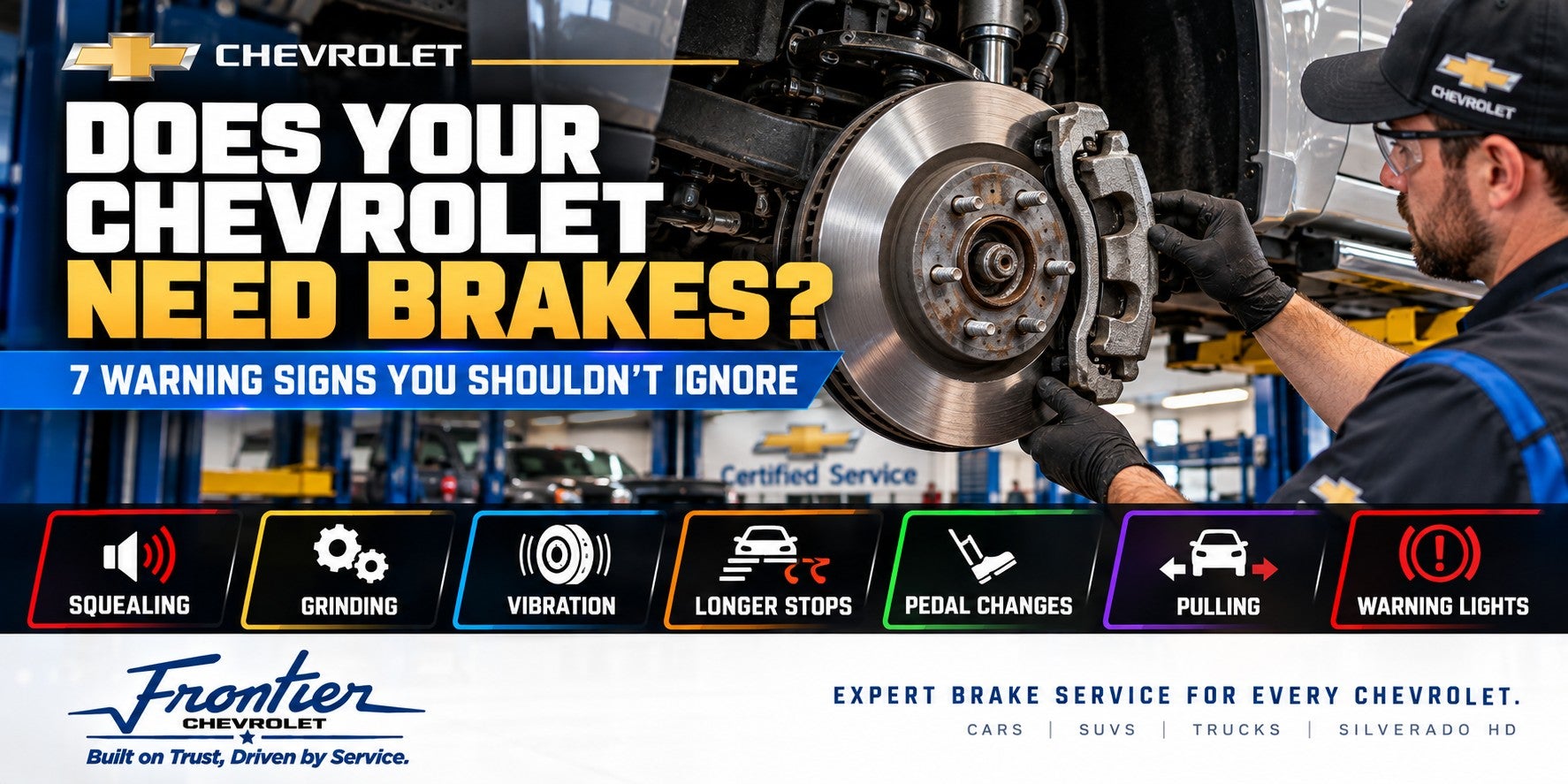
Chevrolet brake inspection showing a technician checking brake rotors and calipers with seven common brake warning signs at Frontier Chevrolet in El Reno, Oklahoma

Does My Chevrolet Need New Brakes? 7 Warning Signs Oklahoma Drivers Should Know

Does My Chevrolet Need New Brakes? 7 Warning Signs Oklahoma Drivers Should Know Your brakes usually don't go from working perfectly to needing immediate replacement overnight. More often, they give you warning signs. A new squeak. A vibration in the steering wheel. A brake pedal that feels different. A Silverado that doesn't seem to stop quite like it used to. Those changes are worth paying attention to. For Oklahoma drivers, brake wear can also be influenced by how a vehicle is used. A Silverado regularly pulling a trailer may place different demands on its braking system than an Equinox commuting between El Reno and Oklahoma City. At Frontier Chevrolet in El Reno, Oklahoma, we believe one of the most important things a vehicle owner can do is recognize when something has changed. When it comes to your brakes, don't ignore what your Chevrolet is telling you. Quick Answer: What Are the Signs My Chevrolet May Need Brake Service? Your Chevrolet may need a brake inspection if you notice squealing, grinding, vibration while braking, longer stopping distances, changes in brake-pedal feel, pulling to one side or a brake-related warning light. These symptoms don't automatically mean your Chevrolet needs new brake pads. Several braking, suspension, tire or electronic systems can produce similar symptoms. The important thing is having the cause properly diagnosed. Here are seven warning signs Chevrolet owners should know. 1. Why Are My Chevrolet Brakes Squeaking? Squeaking or squealing is one of the most common reasons drivers begin thinking about their brakes. But brake noise doesn't automatically mean your brake pads need immediate replacement. Brake noise can potentially be related to: Brake pad wear Brake pad material Moisture Surface rust Dust or debris Rotor condition Other brake-system conditions Occasional noise after your Chevrolet has been parked—particularly after rain or high humidity—may disappear after driving. Persistent or worsening brake noise deserves more attention. If your Chevrolet has developed a braking noise that wasn't there before, an inspection can help determine what's causing it. 2. What Does Grinding When Braking Mean? Grinding is different from an occasional squeak. A grinding noise while braking can indicate that components within the braking system require attention. Continuing to drive with a significant grinding condition can potentially cause additional damage and affect braking performance. Don't simply turn up the radio and hope it goes away. If your Chevrolet begins making a persistent grinding sound when you apply the brakes, have the braking system inspected promptly. 3. Why Does My Chevrolet Vibrate When I Brake? A vibration or pulsation during braking is another symptom that deserves attention. You might feel it through the: Steering wheel Brake pedal Seat Vehicle itself Brake-system components can contribute to vibration, but brakes aren't the only possible cause. Tires, wheels, suspension components and other vehicle systems can also create vibration. That's why diagnosis matters. A vibration doesn't automatically mean your Chevrolet needs new rotors. The vehicle should be inspected to determine what's actually causing the symptom before parts are replaced. 4. Why Is My Chevrolet Taking Longer to Stop? Changes in stopping performance should always be taken seriously. If your Chevrolet seems to require more distance to stop than it previously did, several factors could potentially be involved. These may include: Brake wear Tire condition Road conditions Vehicle load Brake-system problems Other mechanical conditions If your vehicle's braking performance has noticeably changed, don't wait for the condition to become more severe before having it inspected. You know how your vehicle normally feels. A meaningful change is worth investigating. 5. Why Does My Brake Pedal Feel Different? Drivers become accustomed to how their vehicle's brake pedal normally feels. That makes a sudden change particularly noticeable. You may experience a pedal that feels: Softer than normal Firmer than normal Lower than normal Spongy Inconsistent Different from one stop to another A change in brake-pedal feel doesn't tell you exactly what's wrong. But it does tell you that something has changed. Because the braking system is safety-critical, unusual brake-pedal behavior should be evaluated rather than ignored. 6. Why Does My Chevrolet Pull to One Side When Braking? If your Chevrolet consistently pulls left or right while braking, several possible causes may need to be considered. The condition could potentially involve: Brake components Tires Alignment Suspension Steering Road conditions Other mechanical issues Don't assume that pulling automatically means you need brake pads or an alignment. A proper inspection helps identify the actual cause. If the pulling is significant or has suddenly appeared, have the vehicle checked. 7. What Does a Brake or ABS Warning Light Mean? Modern Chevrolet vehicles use several electronic systems to monitor vehicle operation. Depending on the vehicle, a brake-related warning may involve the conventional braking system, Anti-lock Braking System (ABS), electronic controls or another related condition. A warning light shouldn't automatically be interpreted as meaning: "I need new brake pads." The warning indicates that the applicable system requires attention. If a brake warning appears, consult the information for your specific Chevrolet and have the vehicle inspected when appropriate. If the warning is accompanied by noticeably reduced braking performance or other serious symptoms, treat the situation with greater urgency. How Long Do Chevrolet Brakes Last? There isn't one mileage interval that tells every Chevrolet owner when brake pads need replacement. Brake life varies considerably. Factors that can affect brake wear include: Vehicle weight Driving style Highway versus city driving Stop-and-go traffic Towing Trailer weight Terrain Vehicle load Brake component design Environmental conditions A driver who spends most of the time traveling open Oklahoma highways may experience different brake wear than someone driving primarily in stop-and-go Oklahoma City traffic. A Silverado towing a camper may experience different brake loads than an unloaded Silverado used primarily for commuting. That's why actual brake condition matters more than a generic mileage number. What's the Difference Between Brake Pads and Brake Rotors? Brake pads and rotors work together to slow your Chevrolet. When you apply the brakes, the brake system uses the pads and rotors to create the friction necessary to slow the vehicle. Both components can wear over time. Brake Pads Brake pads contain friction material designed to wear as part of normal braking operation. As that material wears, the pads eventually require replacement. Brake Rotors Brake rotors are the metal discs that the brake pads contact during braking. Rotor condition can be affected by wear, heat and other operating conditions. A brake inspection can help determine the condition of both components. Do I Need New Rotors Every Time I Replace Brake Pads? Not necessarily. Whether brake rotors need replacement depends on their actual condition and whether they remain within applicable service specifications. Automatically assuming every brake-pad replacement requires new rotors isn't the right approach. Likewise, automatically assuming the existing rotors can always be reused isn't appropriate either. The braking system should be inspected and measured as necessary to determine what the vehicle actually needs. Does Towing Wear Silverado Brakes Faster? Towing can increase the demands placed on your Silverado's braking system. But there isn't a universal formula that says towing a trailer will reduce brake life by a specific number of miles. Several factors influence braking workload, including: Trailer weight Frequency of towing Terrain Traffic Driving habits Truck configuration Trailer braking equipment Vehicle load A properly functioning trailer-brake system can also play an important role when towing trailers equipped with brakes. For Silverado owners who tow regularly, brake inspections should be considered an important part of the truck's overall maintenance strategy. What Should Silverado Owners Check Before Towing? Before pulling a trailer, don't focus only on the engine and towing capacity. Your truck also needs to stop the load. Before a towing trip, consider checking: Truck brakes Trailer brakes when equipped Brake-controller operation when applicable Tires and tire pressure Trailer tires Trailer connections Brake lights Turn signals Hitch and safety chains Applicable fluid levels Knowing that your Silverado can pull the trailer is only half of the towing equation. You also need to be confident in the systems responsible for controlling and stopping it. Do Silverado 2500 HD and 3500 HD Brakes Need More Attention? Silverado HD trucks are designed for heavier-duty applications than light-duty pickups. Many 2500 HD and 3500 HD owners use their trucks for: Fifth-wheel campers Gooseneck trailers Equipment trailers Livestock trailers Commercial work Farm and ranch use That doesn't mean every Silverado HD will wear through brakes quickly. It means the truck's actual workload should be considered when developing a maintenance strategy. An HD truck regularly operating under load may deserve different inspection considerations than one driven primarily unloaded. Can Tires Affect How My Chevrolet Brakes? Absolutely. Your braking system can only do so much if the tires can't maintain proper contact with the road. Tire condition can affect: Traction Stopping performance Wet-weather grip Vehicle stability Steering response Worn, damaged or improperly inflated tires can influence how your Chevrolet behaves during braking. This is why diagnosing a stopping or pulling complaint shouldn't always begin and end with brake pads. Brakes and tires work together to stop the vehicle. Can Oklahoma Weather Affect Braking? Oklahoma drivers encounter a wide variety of road and weather conditions. Heavy rain can reduce available traction. Winter weather can create slick roads. Dust, gravel and rural-road conditions can affect vehicle operation. And changing temperatures can expose other maintenance concerns. Your brakes don't operate independently from the road beneath the tires. Adjusting speed and following distance for conditions remains important even when the vehicle's braking system is operating properly. Why Do My Brakes Squeak in the Morning? Moisture can sometimes create temporary surface rust on brake rotors while a vehicle is parked. This can be particularly noticeable after rain, overnight humidity or washing the vehicle. A brief noise during the first few stops that quickly disappears may not indicate the same condition as persistent squealing throughout the day. If the noise continues, becomes louder or is accompanied by other symptoms, have the brakes inspected. Why Does My Steering Wheel Shake When I Brake? A steering-wheel vibration that appears primarily during braking can indicate that something deserves inspection. Brake components are one possible source, but they aren't the only possibility. Tire, wheel, steering and suspension conditions can also contribute to vibration. Instead of replacing parts based solely on the symptom, proper diagnosis helps identify what's actually causing the shake. What Should I Do if My Brakes Suddenly Feel Unsafe? If your Chevrolet suddenly experiences significantly reduced braking ability, a brake pedal that behaves abnormally or another condition that makes you question whether the vehicle can be safely stopped, don't continue driving simply to see whether the problem improves. Move the vehicle to a safe location when possible and seek appropriate assistance. A serious change in braking performance deserves immediate attention. Should My Brakes Be Inspected During Routine Maintenance? Routine maintenance visits can be a good opportunity to monitor brake condition. For example, tire rotations provide access that can make it easier to observe certain brake components. The goal isn't to replace brakes unnecessarily. It's to monitor wear so you're less likely to discover a problem only after it becomes severe. That's especially useful for drivers who: Tow regularly Drive significant mileage Spend time in stop-and-go traffic Operate heavier vehicles Use their trucks commercially Chevrolet Brake Service Near El Reno and Oklahoma City Frontier Chevrolet is located in El Reno, Oklahoma, west of the Oklahoma City metro. Our service department works with Chevrolet owners from El Reno and surrounding communities, including Yukon, Mustang, Piedmont, Kingfisher, Weatherford and western Oklahoma City. Whether you drive a Silverado, Tahoe, Suburban, Traverse, Equinox, Trax, Colorado or another Chevrolet, don't ignore a meaningful change in braking performance. Brakes are one area where waiting for the symptom to become worse isn't a good maintenance strategy. Chevrolet Brake FAQs How do I know if my Chevrolet needs brakes? Common warning signs include persistent squealing, grinding, vibration, longer stopping distances, changes in brake-pedal feel, pulling while braking or brake-related warning lights. How many miles do Chevrolet brake pads last? There isn't one mileage interval that applies to every Chevrolet. Brake life depends on the vehicle, driving conditions, towing, traffic, driving habits and other factors. Does squeaking mean I need new brake pads? Not necessarily. Brake noise can have several causes. Persistent or worsening noise should be inspected to determine what's causing it. What does grinding while braking mean? Grinding can indicate that brake-system components require attention. Persistent grinding should be inspected promptly. Why does my Silverado shake when I brake? Brake components can contribute to vibration, but tires, wheels, steering and suspension components can also be involved. Inspection is needed to determine the actual cause. Do I need rotors every time I replace brake pads? Not automatically. Rotor replacement depends on the condition and specifications of the existing rotors. Does towing wear out Silverado brakes faster? Towing can increase braking workload. Actual brake wear depends on trailer weight, frequency of towing, terrain, driving style, trailer braking equipment and other factors. Can Frontier Chevrolet inspect my brakes if I didn't buy my vehicle there? Yes. You don't have to have purchased your Chevrolet from Frontier Chevrolet to request service or a brake inspection. Schedule Chevrolet Brake Service in El Reno, Oklahoma You know how your Chevrolet normally sounds, feels and stops. Pay attention when that changes. A new squeak doesn't automatically mean you need brakes. A vibration doesn't automatically mean you need rotors. And a warning light doesn't automatically identify which part needs replacement. The first step is determining what's actually causing the symptom. If your Chevrolet is squealing, grinding, vibrating, pulling, displaying a brake warning or simply doesn't stop the way it used to, schedule an inspection with Frontier Chevrolet in El Reno. Our goal is to identify what your vehicle needs—not replace parts based on assumptions. Frontier Chevrolet 1640 E. Highway 66 El Reno, Oklahoma 73036 Built on Trust, Driven by Service. Schedule your Chevrolet brake inspection today.

Chevrolet Silverado receiving an oil change at Frontier Chevrolet in El Reno, Oklahoma, with Chevrolet Oil Life Monitor service recommendations

When Does My Chevrolet Need an Oil Change? A Guide for Oklahoma Drivers

When Does My Chevrolet Need an Oil Change? A Guide for Oklahoma Drivers Your Chevrolet doesn't necessarily need an oil change simply because you've reached an old-fashioned mileage interval. Modern Chevrolet vehicles use technology to help determine when engine oil service is actually needed based on how the vehicle is being operated. That's important for Oklahoma drivers because two vehicles traveling the same number of miles may experience very different conditions. A Silverado towing a travel trailer across Oklahoma isn't doing the same work as an Equinox commuting between El Reno and Oklahoma City. A truck spending hours idling on a job site isn't experiencing the same conditions as a Tahoe traveling primarily on the highway. At Frontier Chevrolet in El Reno, Oklahoma, one of the most useful tools for understanding when your Chevrolet needs an oil change may already be built into your vehicle: The Chevrolet Engine Oil Life System. Understanding what that percentage means—and what it doesn't mean—can help you make better maintenance decisions. Quick Answer: When Does My Chevrolet Need an Oil Change? Many modern Chevrolet vehicles use an Engine Oil Life System to calculate when an oil change is needed based on vehicle operation. Rather than relying only on a fixed mileage interval, Chevrolet owners should monitor the remaining oil-life percentage and follow the maintenance recommendations for their specific vehicle. When the system indicates that an oil change is required, the engine oil and filter should be serviced according to the specifications for your Chevrolet. What Does the Chevrolet Oil Life Percentage Mean? Your Chevrolet's oil-life percentage is an estimate of the engine oil's remaining useful life. It is not a measurement of how much oil is physically inside the engine. That's an important distinction. For example: 50% oil life does not mean your engine is half full of oil. Your engine could display significant remaining oil life and still potentially have an oil-level concern that needs attention. Think of the Oil Life Monitor as an estimate of when the oil needs to be changed, not a replacement for checking the actual oil level when appropriate. What Does 20%, 10%, 5% or 0% Oil Life Mean? As the oil-life percentage decreases, your Chevrolet is getting closer to the point at which oil service is required. A practical way to think about it is: Oil Life What You Should Do 100% Oil-life system has typically been reset following an oil change 20% Start planning your next oil change 10% Service is approaching; schedule your oil change soon 5% Oil service should be addressed promptly 0% The system indicates the oil has reached the end of its calculated service life These percentages shouldn't replace the maintenance information for your particular Chevrolet. They are simply a useful way to plan ahead rather than waiting until the last minute to schedule service. Should I Change My Chevrolet's Oil Based on Mileage or Oil Life? For Chevrolet vehicles equipped with an Engine Oil Life System, owners should pay attention to the system and follow the maintenance recommendations for their particular vehicle. The old habit of automatically changing oil at one fixed mileage interval doesn't account for how differently vehicles can be operated. Engine oil life can be affected by operating conditions. For example, a vehicle may experience: Frequent short trips Stop-and-go traffic Extended idling Towing Heavy loads Highway driving Extreme temperatures Other demanding operating conditions Modern oil-life monitoring technology is designed to account for vehicle operation rather than simply functioning as a mileage countdown. Does the Chevrolet Oil Life Monitor Actually Test the Oil? The Oil Life System should not be thought of as a laboratory test of the oil inside your engine. Instead, the system uses information about vehicle operation to calculate remaining oil life. That's why your oil-life percentage may decrease differently depending on how the vehicle is driven. It also explains why two Chevrolet vehicles with similar mileage may display different remaining oil-life percentages. Can I Drive My Chevrolet With 0% Oil Life? A 0% oil-life reading should not be treated as permission to continue delaying service. It indicates that the Oil Life System has calculated that the engine oil has reached the end of its service life. If your Chevrolet reaches 0%, arrange for the oil and filter to be serviced as soon as practical according to the requirements for your vehicle. Planning your appointment before reaching 0% is the better approach. That's why seeing your oil life reach 20%, 10% or 5% can be useful—it gives you time to schedule service before the system reaches the end of its calculated interval. Is Oil Life the Same as Oil Level? No. Oil life and oil level are two different things. Oil life estimates when the oil needs to be replaced. Oil level refers to the amount of oil physically present in the engine. A vehicle can potentially have remaining oil life while still experiencing a low oil level. If your Chevrolet displays an oil-pressure warning, low-oil warning or another engine-related warning, don't assume the oil-life percentage explains the problem. Follow the instructions provided for your vehicle and have the condition inspected when necessary. Does Towing Affect Silverado Oil Life? Towing increases the workload placed on your truck. Depending on trailer weight, terrain, weather and other operating conditions, towing can increase demands on the engine, transmission and cooling system. That's one reason a Silverado owner who regularly tows shouldn't think about maintenance based solely on odometer mileage. Consider two Silverado trucks with 50,000 miles. One has spent most of its life commuting unloaded on the highway. The other regularly pulls a camper, boat or equipment trailer. The odometers may show the same mileage, but the trucks haven't necessarily experienced the same operating conditions. How you use your Silverado matters. Should I Check My Silverado Before a Towing Trip? Yes. An upcoming towing trip is a good reason to check your truck before leaving. Depending on the vehicle and trip, that can include checking: Oil life Engine oil level Tire pressure Tire condition Coolant Brakes Battery Exterior lights Trailer connections Applicable fluids DEF level on a Duramax diesel If your oil life is already low and you're preparing for a long towing trip, taking care of the service before leaving may make more sense than trying to schedule an oil change while traveling. What Oil Does My Chevrolet Need? The correct engine oil depends on the specific Chevrolet, model year and engine. Don't assume every Silverado—or even every Silverado 1500—uses exactly the same oil specification. Chevrolet vehicles can use different engines with different requirements. The correct oil specification for your vehicle should be determined using the information provided for your particular model and engine. This is especially important when comparing gasoline and diesel engines. Using the correct oil specification matters just as much as changing the oil at the appropriate time. Does My 3.0L Duramax Need Different Oil Than a Gas Silverado? The 3.0L Duramax Turbo-Diesel is a diesel engine and has maintenance requirements that differ from Chevrolet's gasoline engines. Owners should follow the oil specification and maintenance information for their particular Duramax-equipped Silverado. Diesel maintenance can also involve other items that gasoline owners don't normally encounter, including: Diesel Exhaust Fluid Diesel fuel filtration Diesel emissions systems Diesel-specific maintenance requirements Don't automatically apply a maintenance routine from a 5.3L or 6.2L gasoline Silverado to a 3.0L Duramax. What About Oil Changes for a 6.6L Duramax Silverado HD? The 6.6L Duramax Turbo-Diesel found in Silverado HD trucks is different from the 3.0L Duramax available in the Silverado 1500. Silverado 2500 HD and 3500 HD trucks may also experience very different workloads. Many HD trucks regularly tow: Fifth-wheel campers Gooseneck trailers Equipment trailers Livestock trailers Commercial trailers Others spend considerable time idling or working under load. Owners should follow the maintenance requirements for their specific HD truck rather than assuming every Duramax uses the same maintenance strategy. Does Oklahoma Heat Affect My Chevrolet's Engine Oil? Operating conditions matter when maintaining any vehicle. Oklahoma drivers can experience summer temperatures well into the 90s and above, extended highway driving, stop-and-go traffic, towing and periods of prolonged idling. Rather than trying to create a separate generic oil-change interval for Oklahoma weather, the better approach is to monitor your Chevrolet's Oil Life System and follow the maintenance requirements for your specific vehicle and operating conditions. Your vehicle knows more about how it has actually been driven than a generic mileage sticker does. Why Did My Chevrolet Oil Life Drop Faster Than Expected? Your oil-life percentage isn't necessarily going to decrease at exactly the same rate every time. Because the system considers vehicle operation, changes in how you use your Chevrolet can affect the calculated remaining oil life. For example, your driving may have recently included more: Towing Stop-and-go driving Short trips Idling Demanding operating conditions That doesn't automatically mean something is wrong with the vehicle. If you're concerned about an unusual change or you're also seeing warning messages, however, it's reasonable to have the vehicle inspected. Should I Rotate My Tires During an Oil Change? An oil-change visit can be a convenient opportunity to evaluate whether your tires are also due for rotation. Regular tire rotation can help promote more even tread wear. It also creates an opportunity to inspect the tires for: Uneven wear Low tread depth Damage Improper inflation Other potential concerns The appropriate rotation schedule depends on your vehicle and tires, so follow the recommendations applicable to your Chevrolet. For Silverado owners who tow or carry heavier loads, tire condition deserves particular attention. What Else Should Be Checked During an Oil Change? An oil change is an opportunity to look beyond the oil itself. Depending on your Chevrolet and the service being performed, it can also be a good time to consider the condition of: Tires Brakes Battery Wiper blades Air filter Fluid levels Exterior lights Visible leaks Other maintenance items That doesn't mean every item needs to be replaced every time the oil is changed. The purpose of an inspection is to understand the condition of the vehicle and identify items that may deserve attention. Should I Reset My Chevrolet Oil Life Monitor After an Oil Change? Yes. After the engine oil and filter have been properly serviced, the Oil Life System should be reset so it can begin calculating the next service interval. If the oil is changed but the system isn't reset, the displayed percentage won't accurately represent the new oil's calculated service life. Likewise, don't reset the Oil Life Monitor simply to make a service reminder disappear if the oil hasn't actually been changed. The reset should correspond with the completed oil service. Why Does My Chevrolet Still Say Change Engine Oil After an Oil Change? If the oil was recently changed but the vehicle continues displaying an oil-change message, the Oil Life System may not have been properly reset. The reset procedure can vary by vehicle and model year. If you're unsure whether the service was completed or whether the monitor was reset correctly, have the vehicle checked rather than simply assuming the warning can be ignored. Do I Need an Oil Change Before a Long Road Trip? That depends on your current oil life and the distance you plan to travel. If your Chevrolet has plenty of remaining calculated oil life, an early oil change may not necessarily be required simply because you're taking a trip. But if your oil life is already approaching the end of its calculated interval, servicing the vehicle before leaving may be the more convenient choice. Before a long trip, it's also worth checking: Tires Battery Brakes Coolant Wipers Exterior lights Applicable fluids For diesel owners, check the DEF level as well. Chevrolet Oil Changes Near El Reno and Oklahoma City Frontier Chevrolet is located in El Reno, Oklahoma, west of the Oklahoma City metro. Our service department works with Chevrolet owners from El Reno and surrounding communities, including Yukon, Mustang, Piedmont, Kingfisher, Weatherford and western Oklahoma City. Whether you drive a Silverado, Tahoe, Suburban, Traverse, Equinox, Trax, Colorado or another Chevrolet, routine oil service is one of the fundamental parts of taking care of your vehicle. And if you're unsure whether your Chevrolet is due for service, start by checking your oil-life percentage. Chevrolet Oil Change FAQs How often should I change the oil in my Chevrolet? Follow the Engine Oil Life System and maintenance information for your specific Chevrolet. Oil-change needs can vary based on vehicle, engine and operating conditions. What does 20% oil life mean on a Chevrolet? It means the system estimates approximately 20% of the engine oil's calculated useful life remains. It's a good time to begin planning your next oil change. What does 5% oil life mean? Your vehicle is approaching the end of its calculated oil-service interval. Schedule your oil change promptly rather than waiting until well after the system reaches 0%. Does 50% oil life mean my engine is half full of oil? No. Oil-life percentage estimates the remaining useful life of the engine oil. It does not measure the amount of oil physically in the engine. Should I change my oil before it reaches 0%? You can schedule service before reaching 0%, particularly when the percentage is low or you're preparing for a long trip. Follow the maintenance recommendations for your particular Chevrolet. Does towing affect Silverado oil changes? Towing increases engine workload and can affect vehicle operating conditions. Silverado owners who tow regularly should pay attention to the Oil Life System and the maintenance recommendations for their truck. Does a Duramax need different oil than a gasoline Silverado? Diesel and gasoline engines can have different oil specifications and maintenance requirements. Follow the specifications for your particular engine. Should I rotate my tires when I get an oil change? An oil-change appointment can be a convenient time to rotate and inspect the tires when rotation is due. Schedule a Chevrolet Oil Change in El Reno, Oklahoma You don't have to guess when your Chevrolet needs an oil change. Start with your vehicle. Check the Oil Life Monitor, pay attention to maintenance messages and consider how the vehicle is actually being used. If your oil life is getting low, you're preparing for a long trip, or you're simply unsure whether your Chevrolet is due for service, the team at Frontier Chevrolet in El Reno can help. Whether you drive a Silverado that works every day, a Tahoe carrying the family, an Equinox commuting to Oklahoma City or a Duramax pulling a trailer across Oklahoma, proper oil service remains one of the foundations of vehicle maintenance. Frontier Chevrolet 1640 E. Highway 66 El Reno, Oklahoma 73036 Built on Trust, Driven by Service. Schedule your Chevrolet oil change today.