


Blog

All Chevrolet Service in El Reno Oklahoma Chevrolet SUVs Silverado 1500 Trucks 2027 Chevrolet HD's at Frontier in El Reno OK Silverado 1500 vs Silverado 2500
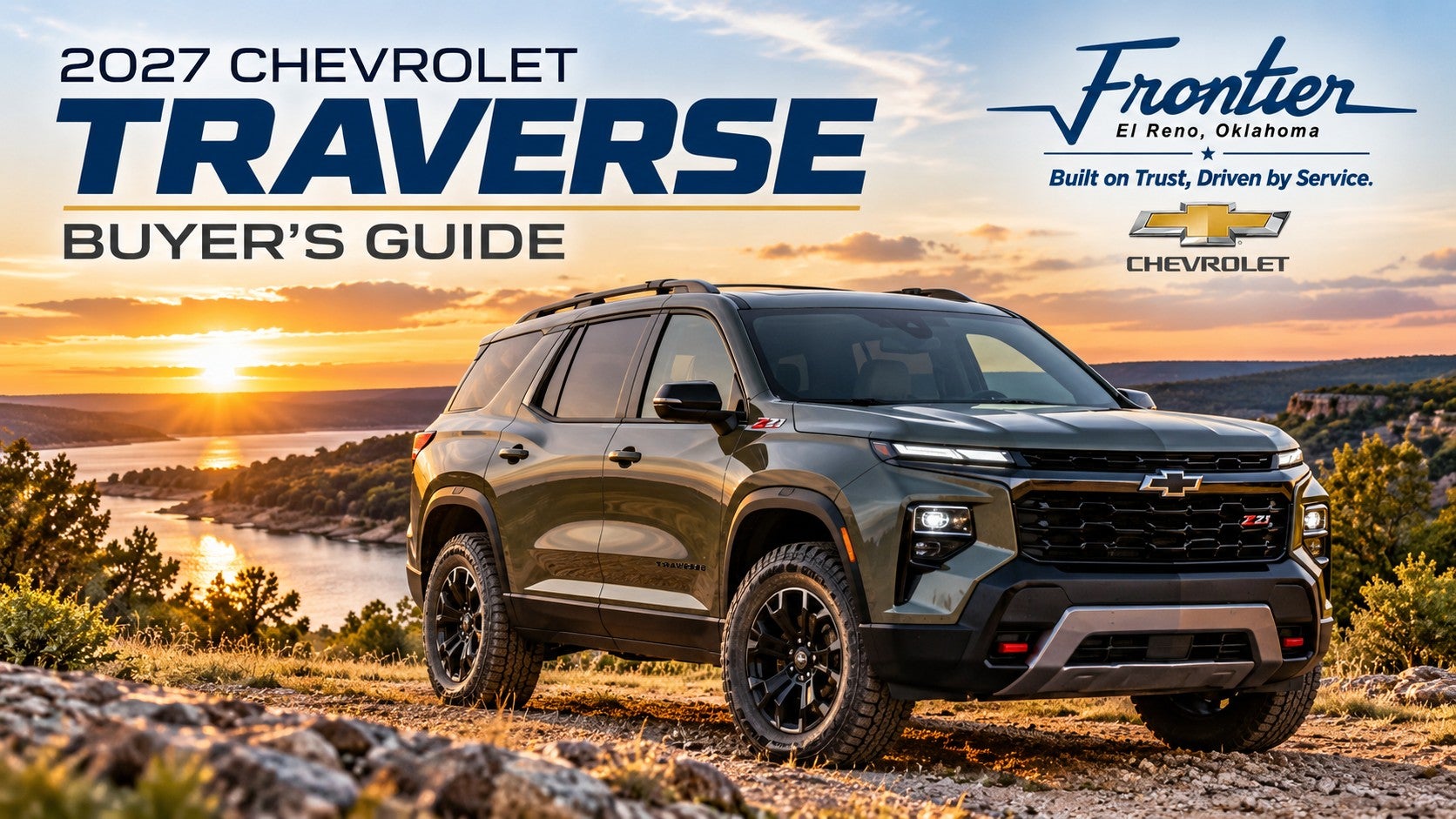
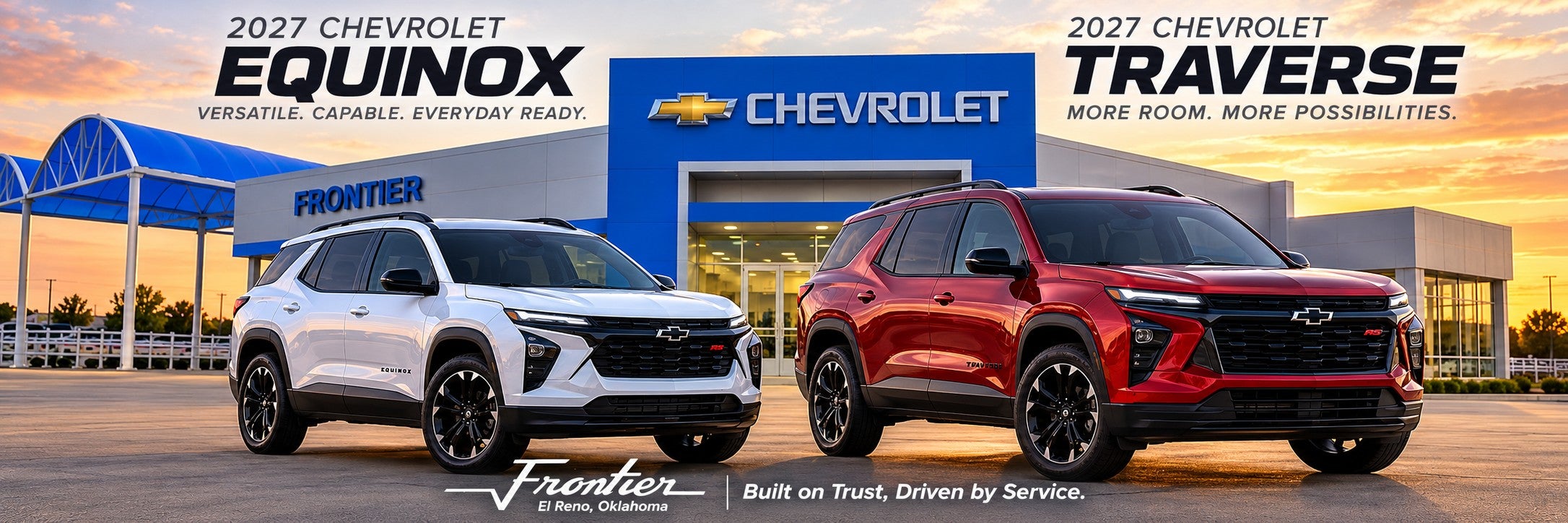
2027 Chevrolet Equinox and Traverse SUV comparison at Frontier Chevrolet in El Reno, Oklahoma, highlighting two-row versus three-row family SUV options
in Chevrolet SUVs

2027 Chevrolet Traverse vs. Equinox: Which Chevy SUV Is Right for Your Family?

2027 Chevrolet Traverse vs. Equinox: Which Chevy SUV Is Right for Your Family? If you're shopping for a new Chevrolet SUV, the decision between the 2027 Chevrolet Equinox and 2027 Chevrolet Traverse may come down to one simple question: How much SUV does your family actually need? The Equinox is a two-row SUV with seating for five, available all-wheel drive and a size that works well for commuting and everyday family use. The Traverse moves into three-row territory, offering seating for seven or up to eight depending on configuration, significantly more cargo space, more power and greater towing capability. The Traverse is bigger. But bigger doesn't automatically mean better. If five seats comfortably handle your family, buying a larger three-row SUV may mean paying for space and capability you rarely use. On the other hand, if your family is already pushing the limits of a two-row SUV, moving into the Traverse now may make more sense than outgrowing an Equinox shortly after buying it. Let's compare them. Quick Answer: Should You Buy a 2027 Equinox or Traverse? Choose the 2027 Chevrolet Equinox if you want a smaller two-row SUV, normally carry five or fewer people, value easier maneuverability and don't need substantial towing capability. Choose the 2027 Chevrolet Traverse if you need three-row seating, regularly carry more passengers, want significantly more cargo capacity or need greater towing capability. For many couples and smaller families, Equinox is enough SUV. For growing families, frequent road trips and households regularly carrying six or more people, Traverse is usually the better fit. The goal isn't to buy the biggest SUV you can afford. It's to buy the SUV that fits your life. 2027 Chevrolet Equinox vs. Traverse at a Glance Feature 2027 Chevrolet Equinox 2027 Chevrolet Traverse Seating 5 7 or up to 8 Rows 2 3 Engine 1.5L Turbo 2.5L Turbo Horsepower 175 hp 328 hp Torque Up to 203 lb.-ft. 326 lb.-ft. Maximum Cargo Space About 63.5 cu. ft. Up to 98 cu. ft. AWD Available Available Maximum Available Towing Up to 1,500 lbs. properly equipped Up to 5,000 lbs. properly equipped Infotainment Screen 11.3-inch diagonal 17.7-inch diagonal Best Fit Commuters, couples, smaller families Growing families, three-row buyers, road trips and towing The numbers make the differences clear. But specifications alone don't tell you which one belongs in your driveway. What's the Biggest Difference Between the Equinox and Traverse? Size and seating. The Equinox is a two-row, five-passenger SUV. The Traverse is a three-row SUV with seating for seven or up to eight passengers depending on configuration. That changes almost everything about how the two vehicles are used. If your typical trip includes two adults and one or two children, an Equinox may provide everything you need. If you're regularly transporting three children, friends, grandparents or teammates, the Traverse's third row becomes much more valuable. And even if you don't fill every seat, the larger vehicle provides substantially more cargo flexibility. Don't Buy a Traverse Just Because It's Bigger This is worth saying directly. Not everyone needs a three-row SUV. Suppose most of your driving looks like this: Two adults. One or two kids. Work. School. Grocery store. Dinner. Weekend activities. Occasional trips to Oklahoma City. In that situation, an Equinox may make considerably more sense. It's smaller, easier to maneuver and still provides useful passenger and cargo room. Buying a Traverse because you might need eight seats twice a year isn't automatically a good financial decision. But there's another side to that. If you're already wondering whether an Equinox will be big enough for your family, pay attention to that concern. Buying too little vehicle and trading again sooner than expected can become expensive too. How Many People Do the Equinox and Traverse Seat? 2027 Equinox The Equinox provides: Two rows Five-passenger seating That's a good configuration for couples, smaller families and drivers who primarily use the rear seat for occasional passengers. 2027 Traverse The Traverse provides: Three rows and seating for: Seven or up to eight passengers depending on configuration. The LT can offer an available second-row bench configuration that increases capacity to eight. Z71, RS and High Country configurations are oriented around seven-passenger seating. If you regularly need more than five seats, this comparison gets easy quickly. Traverse. Which Has More Cargo Space: Equinox or Traverse? The Traverse has substantially more maximum cargo capacity. The 2027 Equinox provides approximately 63.5 cubic feet of maximum cargo space with the rear seat folded. The 2027 Traverse provides up to approximately 98 cubic feet of maximum cargo space. Traverse also provides approximately: 56.6 cubic feet behind the second row and 22.9 cubic feet behind the third row. That's a major difference. But don't automatically assume you need 98 cubic feet. Ask what you actually carry. Equinox may be enough for: Groceries Strollers Sports equipment Luggage Pet supplies Everyday family cargo Weekend trips Traverse becomes more attractive for: Larger families Multiple children and car seats Large strollers Sports equipment for several kids Family vacations Camping gear Frequent airport trips Carrying passengers and luggage simultaneously That's the key distinction. Many SUVs provide plenty of cargo space with the seats folded. Families often need cargo space while the seats are occupied. That's where the larger Traverse starts earning its footprint. Which Has More Power: Traverse or Equinox? The Traverse. And it isn't particularly close. 2027 Chevrolet Equinox The Equinox uses a 1.5L turbocharged engine producing: 175 horsepower and up to 203 lb.-ft. of torque. 2027 Chevrolet Traverse The Traverse uses a 2.5L turbocharged engine producing: 328 horsepower and 326 lb.-ft. of torque. The additional output makes sense because Traverse is a larger vehicle designed to carry more passengers, more cargo and heavier trailers. That doesn't mean the Equinox is underpowered for its purpose. It means the two vehicles were designed for different jobs. If you're primarily commuting and transporting a smaller household, horsepower alone isn't a reason to move into the larger SUV. Equinox vs. Traverse: Which Is Better for Towing? If towing matters, Traverse has the clear advantage. The 2027 Equinox offers up to 1,500 pounds of available towing capacity when properly equipped. The 2027 Traverse can tow up to 5,000 pounds when properly equipped. That's a substantial difference. Equinox towing may work for: Certain small trailers or lightweight recreational equipment within the vehicle's properly equipped ratings. Traverse towing opens the door to: Larger recreational trailers and other loads that exceed Equinox capability, assuming the specific Traverse and trailer are properly configured. Never select a tow vehicle from the headline maximum alone. Trailer weight, passengers, cargo, hitch equipment and vehicle configuration all matter. If you're buying an SUV specifically because you intend to tow, tell us what you're actually towing. That's a much better place to start. Does the Equinox or Traverse Have AWD? Both offer all-wheel drive. That can make either vehicle attractive for Oklahoma drivers dealing with: Heavy rain Winter weather Gravel roads Rural properties Unpaved parking areas Outdoor recreation But the Traverse lineup also offers something particularly interesting for buyers whose driving extends beyond pavement. Traverse Z71 The 2027 Traverse Z71 adds meaningful capability-oriented hardware including: Advanced Twin-Clutch AWD Terrain Mode Hill Descent Control Off-road suspension Skid plate 18-inch wheels All-terrain tires That's more than a cosmetic package. For someone living on acreage, frequently traveling rural roads or regularly heading outdoors, Traverse Z71 deserves consideration. Interestingly, Equinox also offers an ACTIV model with all-terrain tires and uniquely tuned suspension. So Chevrolet provides buyers with more rugged versions of both SUVs—but the larger Traverse Z71 offers considerably more overall capability. Which Is Easier to Drive Around Oklahoma City? For most drivers, Equinox. The smaller dimensions make it easier to: Navigate parking lots Fit into parking spaces Maneuver through traffic Use in tighter urban environments Park in a garage That's worth considering if most of your driving involves commuting between El Reno, Yukon and Oklahoma City. A larger SUV can provide valuable space. But you carry that extra size with you every day—even on the days when nobody is sitting in the third row. If you don't need that space regularly, the smaller Equinox can be the more sensible daily driver. Which Is Better for I-40 Commuting? Either can work well, but we'd lean Equinox for a smaller household and Traverse for a larger family. If you're commuting from El Reno toward Yukon or Oklahoma City primarily by yourself or with one passenger, the Traverse's third row isn't doing much for you. Equinox provides the SUV seating position and available AWD many buyers want without requiring a three-row footprint. However, if that same vehicle handles school transportation, family activities and road trips after the workday ends, Traverse may justify the additional size. Your commute is only one part of the ownership decision. Which Is Better for Families With Car Seats? This depends heavily on how many children you're transporting. One or two car seats? Start with the Equinox. Bring the actual seats and test the fit. Three children or multiple car seats? We'd look seriously at Traverse. Regularly transporting grandparents, friends or additional children? Traverse becomes even more compelling. This is one area where we strongly recommend an in-person test. Bring the car seats. Install them. Move the front seats where you normally sit. Put the kids in their normal positions. Then check the cargo area. A specification sheet can't tell you whether your family's everyday routine fits comfortably. Which Is Better for Road Trips? For two to four people, Equinox may be all you need. For a larger family, Traverse has the advantage. The reason isn't simply seating capacity. It's the combination of: Passenger room Third-row availability Cargo capacity More power Greater towing capability Larger infotainment display Available driver-assistance technology The 2027 Traverse features a 17.7-inch diagonal infotainment display and 11-inch Driver Information Center. Available Super Cruise also adds another technology consideration for buyers who spend substantial time traveling compatible highways. If your family regularly heads across Oklahoma, drives to Texas, takes vacations or spends weekends traveling for youth sports, the extra space can become much more valuable than it appears during a short dealership test drive. Equinox vs. Traverse Technology Both vehicles offer modern Chevrolet infotainment and driver-assistance technology. Equinox The 2027 Equinox includes an 11.3-inch diagonal infotainment touchscreen and offers features such as: Apple CarPlay and Android Auto compatibility Available wireless phone charging Available HD Surround Vision Available Rear Camera Mirror Available Interior Camera Traverse The 2027 Traverse steps up to a 17.7-inch diagonal infotainment display and 11-inch Driver Information Center. It also offers available Super Cruise, with availability varying by trim and applicable service plan. If technology is important to you, don't just compare screen measurements online. Sit in both vehicles. Connect your phone. Navigate the menus. Try the cameras. Technology that looks impressive on a specification sheet should also be easy for you to use every day. Which SUV Is Better for Rural Oklahoma? This one depends on what "rural" means for you. If you're talking about maintained highways and occasional gravel roads, an AWD Equinox may be completely adequate. If your routine includes: Long gravel roads Acreage Hunting or fishing access Rougher rural roads More cargo More passengers Heavier towing then Traverse—particularly Traverse Z71 —starts making a stronger argument. Again, don't buy the badge. Buy the capability you actually need. Equinox vs. Traverse for a Growing Family This may be the hardest decision. Imagine you currently have one child. An Equinox provides plenty of room. But you're planning another child and regularly travel with grandparents. Should you buy the smaller vehicle now or move into Traverse? There's no universal answer. But we'd ask you to think about how long you plan to keep the vehicle. If you're buying for three years and your current needs clearly fit Equinox, that may be the sensible choice. If you're planning to keep the vehicle for eight or ten years and expect your family to grow significantly, Traverse may save you from outgrowing the vehicle. Think beyond today's driveway. But don't buy for an imaginary future either. There's a balance. When Is the Traverse Worth the Move Up? We'd seriously consider Traverse when at least a few of these are true: You need more than five seats You regularly use a third row You have three or more children You frequently carry additional passengers You need substantially more cargo room You take frequent family road trips You tow more than Equinox is designed to handle You want Traverse Z71 capability You expect your family to grow You've already outgrown your current two-row SUV If none of those describe you, don't assume Traverse is automatically the right answer. When Does the Equinox Make More Sense? Equinox deserves serious consideration if: Five seats are enough You have one or two children You don't need a third row You primarily commute Easier parking matters You want available AWD Your towing needs are modest You don't routinely carry large amounts of cargo You want SUV versatility without a three-row footprint There's nothing "lesser" about choosing the smaller SUV when it's the right tool for the job. Which 2027 Chevrolet SUV Would We Recommend? Here's where we'd start. Couple or Single Commuter Equinox Unless you regularly need substantial cargo room or additional passenger capacity, Traverse is probably more vehicle than necessary. Couple With One or Two Children Start with Equinox. Bring the car seats and normal family gear and see whether everything fits comfortably. Family With Three Children Compare both, but we'd look closely at Traverse. The third row and additional cargo flexibility may become valuable quickly. Family of Six or More Traverse. This decision is straightforward. Rural Driver Who Wants AWD Compare Equinox ACTIV and Traverse Z71. Your passenger, cargo and towing requirements should determine which size makes sense. Frequent Road-Trip Family Traverse gets the advantage, particularly when more than four people regularly travel together. Driver Who Occasionally Needs Extra Space Don't automatically buy Traverse. Determine whether occasional cargo needs can be handled by folding the Equinox rear seat rather than carrying a larger SUV every day. 2027 Chevrolet Equinox vs. Traverse FAQ Is the Traverse bigger than the Equinox? Yes. The Traverse is a larger three-row SUV, while the Equinox is a smaller two-row SUV. How many people does the 2027 Equinox seat? The 2027 Equinox seats five passengers in two rows. How many people does the 2027 Traverse seat? The Traverse seats seven or up to eight passengers depending on configuration. Which has more cargo space? The Traverse. It provides up to approximately 98 cubic feet of maximum cargo space compared with approximately 63.5 cubic feet in the Equinox. Which has more horsepower? The Traverse. Its 2.5L turbocharged engine produces 328 horsepower, compared with 175 horsepower from the Equinox's 1.5L turbocharged engine. Can the Equinox tow? Yes. The 2027 Equinox offers up to 1,500 pounds of available towing capacity when properly equipped. How much can the Traverse tow? The 2027 Traverse can tow up to 5,000 pounds when properly equipped. Does the Equinox have AWD? Yes. All-wheel drive is available on the 2027 Equinox. Does the Traverse have AWD? Yes. All-wheel drive is available, and the Traverse Z71 includes an Advanced Twin-Clutch AWD system as part of its capability-focused equipment. Is the Equinox big enough for two kids? For many families, yes. We recommend bringing your actual car seats and normal cargo to a test drive to confirm the fit. Should I buy an Equinox or Traverse for three kids? We'd compare both, but the Traverse deserves serious consideration because of its third row and additional cargo flexibility. Is the Traverse worth the extra size? It can be if you regularly use the third row, need more cargo capacity or require greater towing capability. If five seats meet your needs, the smaller Equinox may be the more practical choice. Compare the 2027 Equinox and Traverse at Frontier Chevrolet in El Reno You can compare specifications online all day. Eventually, the best way to answer Equinox or Traverse? is to put your family in both. Bring the kids. Bring the car seats. Bring the stroller if that's part of your everyday routine. Sit in every row. Open the cargo area. Connect your phone. And drive both SUVs. If the Equinox handles everything you need, we'll tell you. If your family clearly needs the extra space and capability of Traverse, we'll tell you that too. The goal isn't to sell you more SUV. It's to help you find the right SUV. Frontier Chevrolet 1640 E. Highway 66 El Reno, Oklahoma 73036 Serving Chevrolet shoppers from El Reno, Yukon, Mustang, Oklahoma City and communities across central and western Oklahoma. Built on Trust, Driven by Service.
Read More
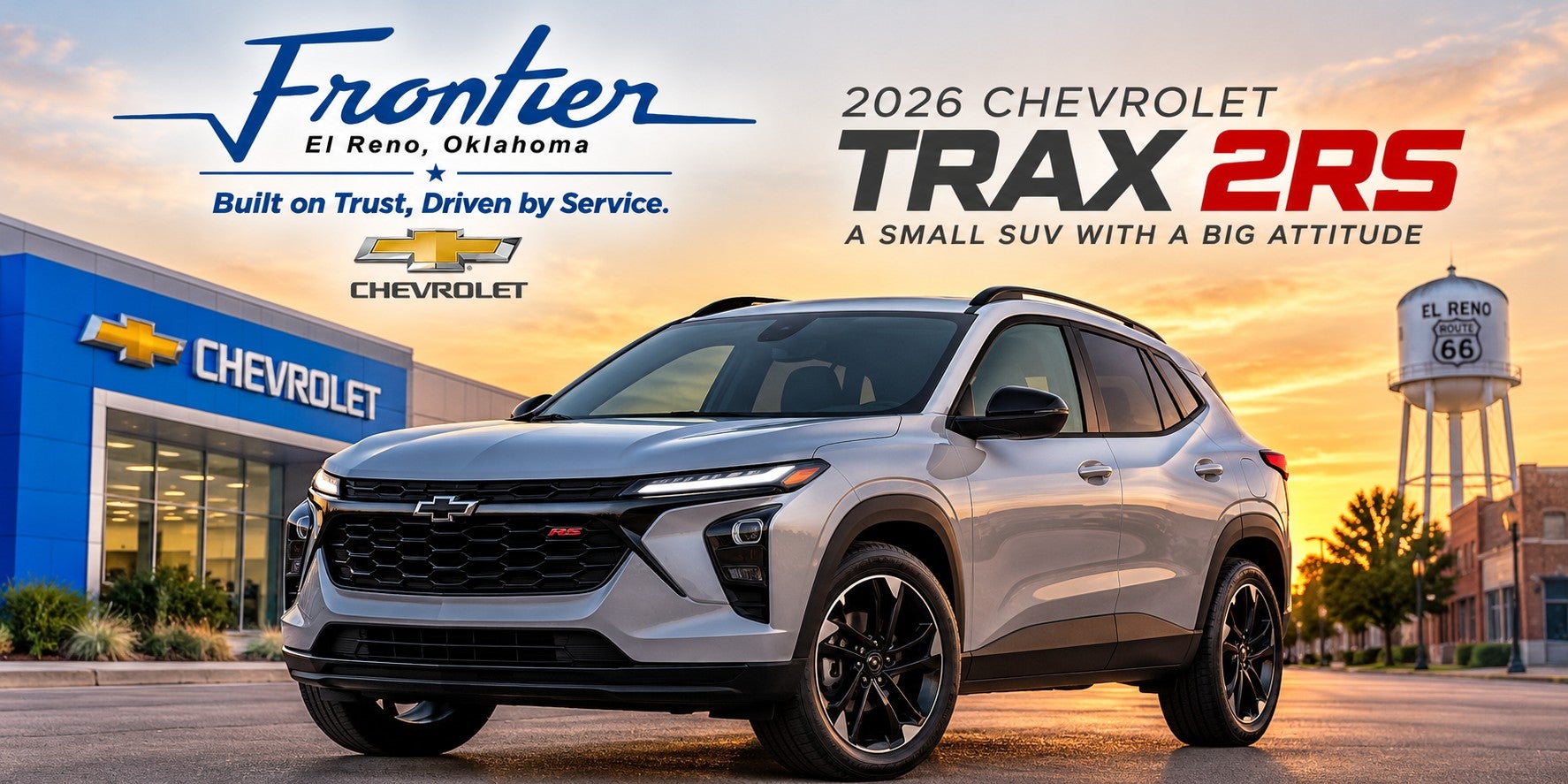
2026 Chevrolet Trax 2RS at Frontier Chevrolet in El Reno, Oklahoma, featuring sporty RS styling, 19-inch wheels and a compact SUV design

2026 Chevrolet Trax 2RS: Is It the Right Small SUV for Oklahoma Drivers?

2026 Chevrolet Trax 2RS: Is It the Right Small SUV for Oklahoma Drivers? If you're shopping for a small SUV around Oklahoma City, it's easy to assume you need to move into a larger—and more expensive—vehicle to get useful passenger space, cargo room and modern technology. The 2026 Chevrolet Trax 2RS makes a strong argument that you may not need to. The 2RS combines the practical size and efficiency of the Trax with the sportier appearance and upgraded features of one of the most distinctive trims in the lineup. But the Trax isn't designed to do everything. It doesn't offer all-wheel drive. It isn't rated to tow. And buyers who regularly travel rough rural roads or need significantly more capability may be better served by an Equinox. So who should buy the Trax 2RS? That's the question that matters. Quick Answer: Is the 2026 Chevrolet Trax 2RS Worth It? Yes—for the right buyer. The 2026 Chevrolet Trax 2RS is a strong choice for someone who wants an affordable, well-equipped small SUV for commuting, family transportation, highway driving and everyday use without moving into a larger SUV. The 2RS adds distinctive RS styling, 19-inch machined two-tone wheels, black exterior details and red interior accents while retaining the Trax's practical five-passenger cabin and up to 54 cubic feet of maximum cargo space. If you need AWD or meaningful towing capability, we'd recommend looking at another Chevrolet SUV. If you don't need those things, the Trax 2RS deserves a serious look. What Is the 2026 Chevrolet Trax 2RS? The Trax is Chevrolet's small SUV designed around affordability, efficiency and everyday versatility. The 2026 Trax lineup includes five trims: LS 1RS LT 2RS ACTIV The 2RS takes the Trax in a sportier direction. Rather than making the vehicle larger or dramatically changing its powertrain, Chevrolet gives the 2RS a more aggressive appearance and additional features. That makes it particularly appealing to someone who likes the affordability and maneuverability of the Trax but doesn't necessarily want the look or equipment of an entry-level small SUV. What Engine Is in the 2026 Trax 2RS? Every 2026 Chevrolet Trax uses a 1.2L ECOTEC turbocharged three-cylinder engine. It produces: 137 horsepower and 162 lb.-ft. of torque. The Trax is front-wheel drive. This isn't a performance SUV despite the RS badge. Instead, the powertrain is designed around the kind of driving most Trax owners actually do: Daily commuting City driving School and work transportation Interstate travel Shopping and errands Weekend trips If horsepower is one of your primary buying criteria, there are more powerful Chevrolet SUVs. That's not really the Trax's mission. Its appeal is getting useful SUV versatility without paying for size, power or capability you may never use. What Kind of Fuel Economy Does the 2026 Trax Get? Chevrolet lists the 2026 Trax at an EPA-estimated 30 MPG combined. For drivers commuting between El Reno, Yukon and Oklahoma City, fuel economy can be an important part of the ownership equation. That is particularly true for someone moving out of an older SUV or truck who doesn't actually need that vehicle's size or capability anymore. The Trax gives buyers an SUV-style seating position and cargo flexibility while remaining relatively efficient for everyday transportation. What Makes the 2026 Trax 2RS Different? The 2RS is one of the sportiest-looking versions of the Trax. Key 2RS design features include: 19-inch machined two-tone wheels RS badging Unique RS grille Black Chevrolet bowtie emblems Red interior accents These features don't turn the Trax into a sports car. What they do is give the 2RS a much more distinctive appearance than buyers may expect from an affordable small SUV. For many shoppers, that's exactly the appeal. You get the practical side of the Trax without choosing the most basic-looking version of it. Is the Trax 2RS Big Enough for a Family? The 2026 Trax seats five passengers. Chevrolet also provides a 60/40 split-folding rear seat, which allows you to trade rear passenger space for additional cargo capacity when necessary. For a single driver, couple or smaller family, that can provide plenty of flexibility. But we'd recommend evaluating the Trax based on your actual family rather than a specification sheet. If you use child seats, bring them. If you regularly carry a stroller, bring it. If your kids haul sports equipment several nights a week, see how it fits. The right question isn't: "Is the Trax big?" The right question is: "Is the Trax big enough for how we actually live?" For many households, the answer will be yes. For others, moving up to an Equinox or Traverse will make more sense. How Much Cargo Space Does the 2026 Trax Have? The 2026 Chevrolet Trax provides up to approximately 54 cubic feet of maximum cargo space with the rear seats folded. That's one of the reasons the Trax can make sense for someone who doesn't need a larger SUV. The 60/40 split-folding rear seat also means you don't necessarily have to choose between carrying passengers and carrying longer cargo. Potential everyday uses include: Groceries Luggage Strollers Sports equipment Shopping trips Pet supplies Small home-improvement purchases Weekend travel gear If you routinely need significantly more room than that, however, we'd rather move you into the right-sized SUV than pretend the Trax is something it isn't. Does the 2026 Chevrolet Trax 2RS Have AWD? No. The 2026 Chevrolet Trax is front-wheel drive only. There is no AWD Trax configuration. That's one of the most important things to understand before buying one. Does That Mean You Need a Different SUV? Not necessarily. If the majority of your driving consists of: El Reno streets I-40 Oklahoma City commuting Maintained highways Suburban roads Normal everyday pavement front-wheel drive may be completely appropriate for your needs. But if you specifically want AWD because you regularly travel gravel roads, live on rural property or want additional capability for poor road conditions, we'd recommend comparing the Trax with an AWD-equipped Chevrolet SUV. Don't pay for capability you don't need—but don't buy less capability than you actually require. Can the 2026 Chevrolet Trax Tow? No. Chevrolet does not rate the 2026 Trax for towing. This is an area where we'd rather be completely clear. If towing is part of your lifestyle, the Trax isn't the Chevrolet we'd recommend. Even if you're only thinking about occasionally pulling a small trailer, tell us what you intend to tow before choosing your vehicle. There are other Chevrolet SUVs and trucks designed for that job. The Trax is designed primarily around passenger transportation, cargo flexibility, efficiency and everyday driving—not trailering. Is the 2026 Trax 2RS Good for Highway Driving? For many Oklahoma drivers, highway use will be a major part of Trax ownership. El Reno's location along I-40 means a vehicle may spend just as much time at highway speeds as it does around town. The Trax's combination of compact exterior dimensions, turbocharged engine and approximately 30 MPG combined fuel-economy rating makes it well suited to the type of mixed city/highway driving common around the Oklahoma City metro. The 2RS also gives drivers a more upscale-looking version of the Trax without requiring them to move into a substantially larger vehicle. As with any vehicle, the best way to decide whether you like its acceleration, seating position, visibility and highway behavior is to drive it on the roads you actually use. A short drive around a dealership parking lot doesn't tell you much. What Technology Does the 2026 Trax Offer? The Trax offers technology that would have been unusual in an affordable small SUV not that many years ago. Available technology includes an 11-inch diagonal center HD touchscreen, along with wireless Apple CarPlay and wireless Android Auto compatibility. Available equipment also includes: Wireless phone charging Built-in Wi-Fi hotspot capability Adaptive Cruise Control Rear Park Assist Rear Cross Traffic Alert Lane Change Alert with Side Blind Zone Alert Exact equipment can vary by vehicle, so we'd recommend checking the window sticker on the specific Trax 2RS you're considering rather than assuming every vehicle is equipped identically. What Safety Features Does the 2026 Trax Have? The 2026 Trax includes Chevy Safety Assist. That package includes driver-assistance technologies such as: Automatic Emergency Braking Forward Collision Alert Front Pedestrian Braking Lane Keep Assist with Lane Departure Warning Following Distance Indicator IntelliBeam automatic high beams The Trax also includes features such as a Rear Vision Camera and Teen Driver technology. Additional driver-assistance features may be available depending on equipment. These systems are designed to assist the driver and do not replace attentive driving. 2026 Trax 2RS vs. ACTIV: What's the Difference? These two versions of the Trax are likely to appeal to buyers for different reasons. Choose Trax 2RS if you prefer: Sportier styling 19-inch machined two-tone wheels RS-specific appearance Black bowtie emblems Red interior accents Consider Trax ACTIV if you prefer: A more rugged visual theme 18-inch black-painted aluminum wheels Black grille with Titanium chrome accents ACTIV-specific badging Unique interior accents It's important not to overstate the difference. Unlike the Equinox ACTIV—which has functional equipment such as all-terrain tires and unique suspension tuning—the Trax ACTIV is still a front-wheel-drive Trax. So with the Trax, 2RS versus ACTIV is largely a styling and equipment decision rather than choosing between a street SUV and a true off-road configuration. For shoppers who prefer a sporty appearance, we'd lean toward the 2RS. Trax 1RS vs. 2RS: Why Move Up to the 2RS? Both carry RS styling, but the 2RS takes that appearance further. The question shouldn't simply be: "Is 2RS better?" Instead ask: "Do I value the additional equipment and appearance enough to choose it over another Trax?" For someone specifically attracted to the RS look, the 2RS is where we'd start. And because Frontier Chevrolet currently has multiple 2026 Trax 2RS models available, shoppers have an opportunity to compare actual vehicles rather than deciding entirely from photographs. 2026 Trax 2RS vs. Equinox: Should You Move Up? This may be the most important comparison for a Trax shopper. The Trax and Equinox can both serve as everyday Chevrolet SUVs, but they're aimed at different buyers. Choose the Trax 2RS if: You want a smaller SUV Purchase price matters Fuel economy matters Five seats are enough You don't need AWD You don't tow Most driving is on maintained pavement Sporty styling matters Consider the Equinox if: You specifically want available AWD You want a larger SUV You need more capability You want additional power You may need light towing capability Your driving regularly includes rural or less-maintained roads This is exactly where we don't believe in automatically moving someone into the more expensive vehicle. If the Trax does everything you need, why pay for SUV capability you're not going to use? But the opposite is also true. If you know you need AWD or towing capability, buying a Trax because it's less expensive doesn't make it the right vehicle. Is the Trax 2RS Good for Oklahoma Drivers? For the right Oklahoma driver, absolutely. We particularly like the Trax 2RS for someone whose routine looks something like: El Reno → Yukon → Oklahoma City → home It's compact enough for parking and urban driving, provides useful cargo flexibility, seats five and offers strong fuel economy for a small SUV. It can also work well for: First-time new-vehicle buyers College students Young professionals Couples Small families Commuters Empty nesters downsizing from a larger SUV Drivers replacing an older sedan who want more cargo flexibility Where we'd be more cautious is with someone who regularly travels rough rural roads, needs AWD, tows trailers or routinely carries a large family. That's where another Chevrolet may be the better choice. Who Should Buy a 2026 Chevrolet Trax 2RS? We'd put the Trax 2RS near the top of the list for someone who says: "I want a small SUV that's affordable to own, looks good, has modern technology and gives me enough room for everyday life." That's exactly where the 2RS fits. It isn't trying to be a Traverse. It isn't trying to be a Tahoe. And it certainly isn't trying to replace a Silverado. That's part of what makes it appealing. You're not buying capability for a hypothetical situation that may never happen. You're buying a vehicle designed around everyday transportation. Who Should NOT Buy a Trax 2RS? This is just as important. We'd recommend looking at another Chevrolet if: You need AWD You intend to tow You need three-row seating You regularly carry more than five people You routinely travel rough roads You need substantially more cargo room You want considerably more engine performance If any of those describe your situation, tell us. The answer isn't to convince you the Trax can do something it wasn't designed to do. The answer is to help you find the Chevrolet that fits the job. Why We're Talking About the 2026 Trax 2RS There's another practical reason we're highlighting this particular model. Frontier Chevrolet currently has multiple 2026 Chevrolet Trax 2RS models available in El Reno. That gives shoppers an opportunity to compare available colors and equipment rather than simply choosing whichever Trax happens to be available. Inventory changes, so current availability should always be confirmed before making the drive. But if the 2RS sounds like the right fit, it's worth comparing the available vehicles. 2026 Chevrolet Trax 2RS FAQ What engine does the 2026 Trax 2RS have? The 2026 Trax 2RS uses a 1.2L ECOTEC turbocharged three-cylinder engine producing 137 horsepower and 162 lb.-ft. of torque. Is the 2026 Trax 2RS AWD? No. The 2026 Chevrolet Trax is front-wheel drive only. AWD is not available. How many people does the Trax seat? The 2026 Chevrolet Trax seats five passengers. How much cargo space does the Trax have? The 2026 Trax provides up to approximately 54 cubic feet of maximum cargo space with the rear seating folded. What fuel economy does the 2026 Trax get? Chevrolet lists the 2026 Trax at an EPA-estimated 30 MPG combined. Can a Chevrolet Trax tow a trailer? No. Chevrolet does not rate the 2026 Trax for towing. If you need to tow, we'd recommend choosing another Chevrolet designed for that purpose. What's different about the Trax 2RS? The 2RS emphasizes sporty styling with 19-inch machined two-tone wheels, RS badging, a unique grille, black bowtie emblems and red interior accents. Is the Trax 2RS good for a family? It can be a good choice for a smaller family that needs five seats and flexible cargo space. Families needing a third row or significantly more room should consider a larger Chevrolet SUV. Should I buy a Trax or Equinox? Choose Trax if you want a smaller, efficient front-wheel-drive SUV and don't need towing capability. Consider Equinox if available AWD, additional capability or a larger vehicle better fits your needs. Is the Trax 2RS good for commuting to Oklahoma City? It can be a strong fit for commuters because of its manageable size, five-passenger seating, cargo flexibility and EPA-estimated 30 MPG combined fuel economy. Shop 2026 Chevrolet Trax 2RS Models at Frontier Chevrolet in El Reno If you're shopping for a 2026 Chevrolet Trax 2RS near Oklahoma City, we'd encourage you to do more than compare pictures and payments online. Come drive one. See whether the seating position works for you. Put your normal cargo in the back. Connect your phone. Drive it at highway speed. And decide whether the Trax gives you everything you actually need. If it does, there's no reason to buy a larger SUV just because one exists. If it doesn't, we'll tell you that too and help you compare the next step up. The goal isn't to sell you more SUV. It's to help you find the right SUV. Frontier Chevrolet 1640 E. Highway 66 El Reno, Oklahoma 73036 Serving Chevrolet shoppers from El Reno, Yukon, Mustang, Oklahoma City and communities across central and western Oklahoma. Built on Trust, Driven by Service.
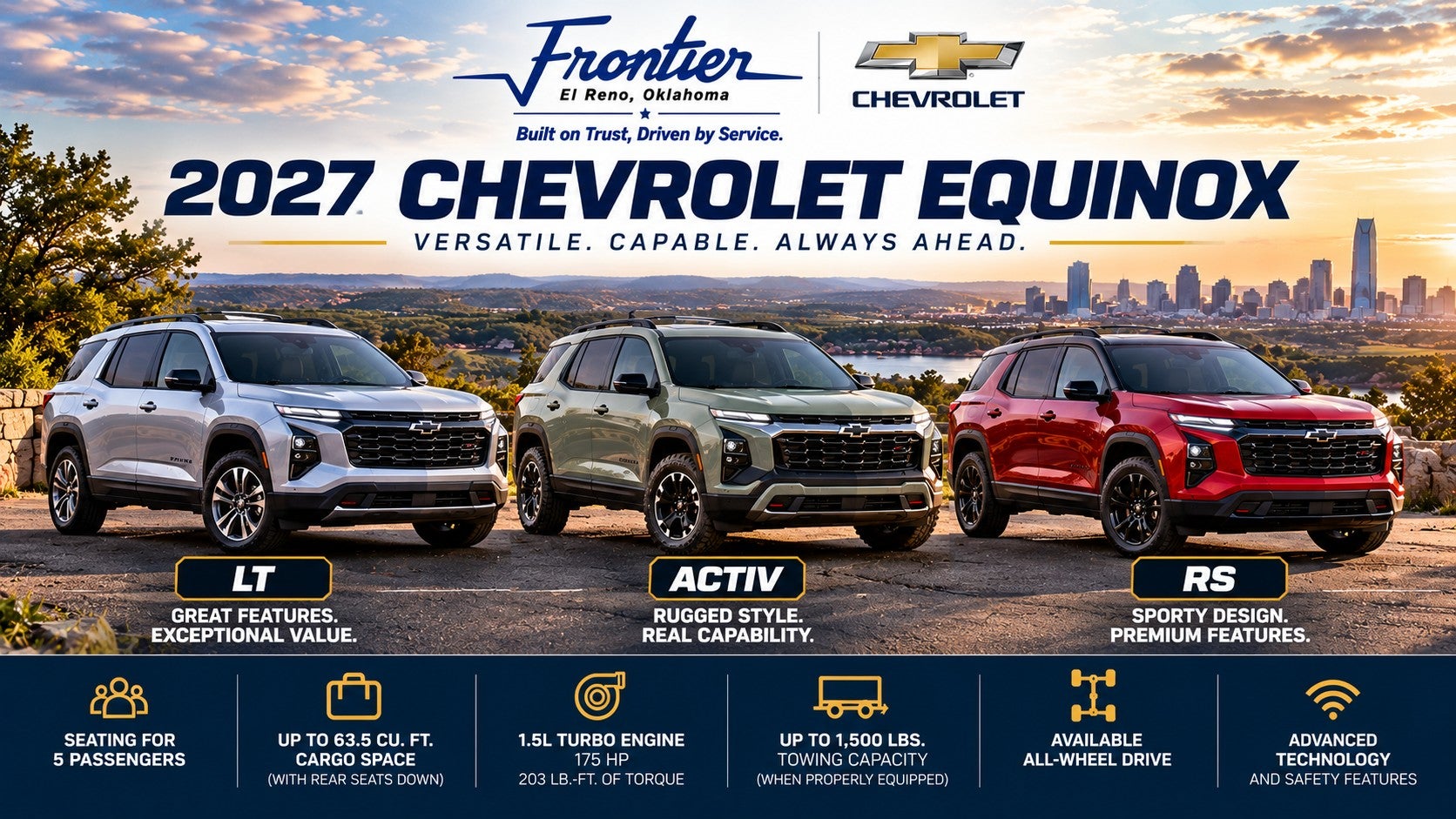
2027 Chevrolet Equinox LT, ACTIV and RS trim comparison featuring seating, cargo space, available AWD and technology from Frontier Chevrolet in El Reno, Oklahoma

2027 Chevrolet Equinox Buyer’s Guide: LT vs. ACTIV vs. RS — Which One Is Right for You?

2027 Chevrolet Equinox Buyer’s Guide: LT vs. ACTIV vs. RS — Which One Is Right for You? The Chevrolet Equinox sits in one of the most competitive parts of the SUV market. That's good for shoppers because there are plenty of choices. It also means choosing the right SUV can get complicated quickly. For 2027, the Chevrolet Equinox keeps the lineup relatively straightforward with three main gasoline-powered models: LT, ACTIV and RS. All three share the same basic Equinox formula: seating for five, a turbocharged engine, useful cargo space, modern technology and available all-wheel drive. The differences come down to how you want your Equinox equipped—and how you actually plan to use it. Quick Answer: Which 2027 Chevrolet Equinox Should You Buy? For most buyers, we'd start with the 2027 Equinox LT. It delivers the core technology, comfort and versatility that make the Equinox appealing without requiring you to move into a higher trim. Choose the Equinox ACTIV if you regularly travel gravel roads, live on acreage, spend time outdoors or simply want all-terrain tires and a suspension tuned for a more adventurous use case. Choose the Equinox RS if sporty styling, larger wheels and blacked-out exterior details matter more than the ACTIV's rugged equipment. LT = Value and versatility ACTIV = Rugged capability RS = Sporty style The best Equinox isn't automatically the most expensive one. It's the one that fits how you actually drive. What's New and Important About the 2027 Chevrolet Equinox? The current-generation Equinox combines a more truck-inspired exterior design with the size and maneuverability expected from a compact SUV. For 2027, Chevrolet continues to offer the Equinox in LT, ACTIV and RS configurations. Important features include: 1.5L turbocharged engine 175 horsepower Up to 203 lb.-ft. of torque Available all-wheel drive Drive Mode Selector Up to 1,500 pounds of available towing capacity when properly equipped Seating for five 11.3-inch diagonal infotainment touchscreen Apple CarPlay and Android Auto compatibility More than 15 standard safety and driver-assistance features Available HD Surround Vision Available wireless phone charging For 2027, Chevrolet also adds an available Interior Camera designed to provide a cabin view and security recording capability. Another small but interesting change is Autumn Harvest Metallic, a new exterior color available exclusively on LT and ACTIV. What Engine Is in the 2027 Chevrolet Equinox? Every gasoline-powered 2027 Equinox uses a 1.5L turbocharged engine. It produces: 175 horsepower and up to 203 lb.-ft. of torque. The Equinox isn't intended to be a performance SUV. The powertrain is designed around everyday driving: commuting, errands, family transportation, highway trips and the kind of mixed driving most compact-SUV owners actually do. That's an important distinction. If your priorities involve substantially more towing, three-row seating or significantly greater power, another Chevrolet may make more sense. But if you're looking for an everyday SUV that's easier to maneuver and park than a Traverse or Tahoe, the Equinox fits an important middle ground. Does the 2027 Chevrolet Equinox Have AWD? Yes. All-wheel drive is available on the 2027 Equinox. For Oklahoma drivers, that can be useful if your driving regularly includes: Gravel roads Rural roads Rain and severe weather Snow and ice Acreage or country property Outdoor recreation But we wouldn't automatically recommend AWD to everyone. If nearly all your driving is around El Reno, Yukon or Oklahoma City on maintained pavement, you may decide you don't need it. That's exactly the kind of decision that should be based on how you drive, rather than simply buying every available feature. 2027 Chevrolet Equinox Trim Levels The gasoline-powered 2027 Equinox lineup gives shoppers three primary choices: LT ACTIV RS Instead of treating those as simply good, better and best, it's more useful to think about the type of buyer each one fits. 2027 Equinox LT: Best Overall Value The Equinox LT is where we'd recommend most shoppers begin. Standard and available features include: 1.5L turbo engine Heated front seats Heated steering wheel 11.3-inch diagonal infotainment touchscreen Available HD Surround Vision Available all-wheel drive That's a substantial amount of everyday equipment without automatically paying for the appearance and specialty equipment included on ACTIV or RS. Who Should Buy the Equinox LT? The LT makes sense if you want: An everyday commuter A family SUV for five Modern technology Heated comfort features Useful cargo space Available AWD Strong overall value For someone commuting from El Reno or Yukon into Oklahoma City, running kids to school and activities, or simply wanting a practical SUV without unnecessary extras, LT may be all the Equinox you need. 2027 Equinox ACTIV: Is It More Than an Appearance Package? Yes. This is an important distinction. Some "off-road" or "adventure" trims in the SUV market amount mostly to different wheels, colors and badges. The Equinox ACTIV receives actual functional changes. Chevrolet equips the ACTIV with: All-terrain tires Uniquely tuned suspension EvoTex and sueded microfiber seating surfaces ACTIV-specific styling Available two-tone white roof Those first two features matter. All-terrain tires and different suspension tuning give ACTIV a legitimate reason to exist beyond appearance. Is the Equinox ACTIV an Off-Road SUV? We wouldn't describe it as a hardcore off-road vehicle. That's not what the Equinox is designed to be. Instead, think of ACTIV as the Equinox for someone whose daily life occasionally extends beyond perfect pavement. That could include: Gravel county roads Ranch or acreage access Campsites Fishing areas Rural properties Outdoor activities Poorly maintained roads For many Oklahoma buyers, that's a more realistic use case than extreme off-roading anyway. Who Should Buy the Equinox ACTIV? We'd look closely at ACTIV if you want the everyday size and efficiency of an Equinox but regularly encounter less-than-perfect roads. It also makes sense if you simply prefer its more rugged appearance and interior treatment. 2027 Equinox RS: The Sporty Choice The Equinox RS takes almost the opposite approach from ACTIV. Instead of rugged styling and all-terrain equipment, RS gives the Equinox a more aggressive street-oriented personality. Features include: Black mirrors Black exterior moldings Black emblems and badging 19-inch wheels Available 20-inch machined wheels Flat-bottom steering wheel Available two-tone black roof Who Should Buy the Equinox RS? RS is the obvious choice if appearance is a major part of your buying decision. It's designed for someone who likes the practicality and size of the Equinox but wants something more visually aggressive than the LT. For drivers spending most of their time on pavement, the RS approach may make more sense than ACTIV. Equinox ACTIV vs. RS: What's the Difference? This is probably one of the most useful comparisons in the entire lineup. Both sit above LT, but they approach the Equinox very differently. Choose ACTIV if you want: All-terrain tires Unique suspension tuning Rugged styling Outdoor versatility A more adventure-oriented interior and exterior Choose RS if you want: Sportier styling Blacked-out exterior details Larger wheels Flat-bottom steering wheel A more street-oriented appearance Neither is automatically better. ACTIV is the rugged Equinox. RS is the sporty Equinox. If you drive gravel roads every week, we'd lean ACTIV. If your Equinox spends almost all its time commuting around Oklahoma City and you prefer the RS appearance, we'd lean RS. 2027 Equinox Trim Comparison Trim Best For Character Key Difference LT Everyday value Practical Core Equinox features ACTIV Rural roads/outdoor use Rugged All-terrain tires and unique suspension tuning RS Street driving/style Sporty Blacked-out styling and larger wheels Our advice is simple: Choose based on use first. Choose based on appearance second. How Many People Does the 2027 Equinox Seat? The 2027 Chevrolet Equinox seats five passengers in two rows. There is no third row. That's important when deciding between an Equinox and Traverse. If five seats are enough, Equinox gives you a smaller vehicle that's easier to maneuver and park. If you're regularly carrying six, seven or eight people, you're shopping in the wrong part of the Chevrolet lineup. That's when we'd point you toward the Traverse. Is the 2027 Equinox Big Enough for a Family? For many families, yes. But this is one question where we wouldn't rely entirely on dimensions. If you have one or two children, the Equinox can make a lot of sense. If you regularly carry three children, multiple car seats, strollers, sports equipment and luggage, we'd recommend physically testing your normal setup before making the decision. Bring the car seats. Bring the stroller. Have the kids sit where they'll actually sit. Open the rear cargo area. A vehicle doesn't need to be the biggest SUV available. It needs to be big enough for your family. How Much Can the 2027 Equinox Tow? The 2027 Chevrolet Equinox can tow up to 1,500 pounds when properly equipped. That can be useful for certain small trailers and recreational equipment. However, this is another area where shoppers need to be realistic about their needs. If you're planning to tow a substantial boat, camper or larger utility trailer, the Equinox probably isn't the Chevrolet we'd recommend. The Traverse offers considerably more available towing capability, while Tahoe, Suburban and Silverado move into entirely different capability levels. Tell us what you plan to tow before choosing the vehicle. That's much easier than trying to make the wrong SUV fit the job later. What Technology Comes in the 2027 Equinox? Technology is one of the Equinox's stronger areas. At the center of the cabin is an 11.3-inch diagonal infotainment touchscreen. The system offers smartphone integration including Apple CarPlay and Android Auto compatibility. Other available technology includes: Wireless phone charging HD Surround Vision Rear Camera Mirror Interior Camera Additional camera and driver-assistance technologies For 2027, the new available Interior Camera adds the ability to view the cabin and provide security recording functionality. For shoppers coming out of an older vehicle, we'd recommend spending time with the touchscreen and driver displays during the test drive. Modern vehicle technology can be difficult to judge from a feature list alone. What Safety Features Does the 2027 Equinox Have? Chevrolet lists more than 15 standard safety and driver-assistance features on the 2027 Equinox. Chevy Safety Assist includes six core technologies: Automatic Emergency Braking Front Pedestrian Braking Lane Keep Assist with Lane Departure Warning Forward Collision Alert Following Distance Indicator IntelliBeam Additional available systems can provide even more driver assistance and visibility. As always, these technologies are designed to assist the driver—not replace attentive driving. Is the 2027 Equinox Good for Oklahoma Driving? We think the Equinox fits Oklahoma particularly well because it covers a wide range of everyday driving without requiring a large SUV. Consider how many different environments an Oklahoma driver may encounter: El Reno streets I-40 commuting Oklahoma City traffic Gravel county roads Severe thunderstorms Winter weather Rural properties Weekend trips The Equinox is small enough to remain manageable in traffic and parking lots while available AWD and the ACTIV configuration give buyers options for less-than-perfect conditions. That versatility is really the point of the vehicle. 2027 Equinox vs. Trax: Which One Should You Buy? This is a comparison we'll explore in greater detail separately, but the basic decision is straightforward. The Trax sits below Equinox in Chevrolet's SUV lineup. The Equinox gives buyers a larger step up in capability and offers available AWD. Consider Trax if: Lower purchase price is a priority You primarily drive pavement You don't need AWD You want a smaller SUV Your passenger and cargo needs are modest Consider Equinox if: You want more SUV capability Available AWD matters You need additional flexibility You want up to 1,500 pounds of available towing capability ACTIV's all-terrain equipment appeals to you For some buyers, Trax is all the SUV they need. There's nothing wrong with that. The goal should be buying the vehicle that fits your needs rather than automatically moving up the lineup. 2027 Equinox vs. Traverse: Do You Need Three Rows? This is where the decision gets particularly important for families. The Equinox seats five in two rows. The Traverse provides three rows and can seat up to eight depending on configuration. If five seats comfortably handle your family, the Equinox may make more sense. If you're already thinking: "We might need a third row in a year or two…" then we'd recommend comparing both before buying. Choose Equinox if: Five seats are enough You want a smaller SUV Easier parking and maneuverability matter Your towing requirements are modest You don't need three rows Choose Traverse if: You need three rows You regularly carry more passengers You need significantly more cargo flexibility You need greater towing capability Your family is outgrowing a two-row SUV Buying slightly more vehicle than you need can be expensive. Buying too little vehicle and trading again in two years can be expensive too. That's why this comparison matters. Which 2027 Chevrolet Equinox Would We Recommend? There isn't one answer for everyone. Best for Most Buyers: Equinox LT This is where we'd start. The LT provides the core features that make the Equinox attractive without requiring you to pay for specialty styling or equipment you may not need. Best for Rural Oklahoma: Equinox ACTIV If you live on acreage, regularly travel gravel roads or spend weekends outdoors, ACTIV's all-terrain tires and uniquely tuned suspension give it a legitimate advantage. Best for Sporty Styling: Equinox RS If your driving is primarily pavement and you want the most aggressive-looking Equinox, RS is the natural choice. Don't Start With the Trim — Start With How You Drive Before deciding between LT, ACTIV and RS, answer a few questions. Do you need AWD? Do you regularly drive gravel or rural roads? How many passengers do you normally carry? Do you plan to tow anything? Is rugged capability or sporty appearance more important? Once we know those answers, choosing the trim becomes much easier. At Frontier Chevrolet, the goal isn't to sell you the most expensive Equinox. It's to help you find the Equinox that fits how you actually drive. 2027 Chevrolet Equinox FAQ What engine is in the 2027 Chevrolet Equinox? The 2027 Equinox uses a 1.5L turbocharged engine producing 175 horsepower and up to 203 lb.-ft. of torque. Does the 2027 Equinox have AWD? Yes. All-wheel drive is available on the 2027 Chevrolet Equinox. How many people does the 2027 Equinox seat? The Equinox seats five passengers in two rows. It does not offer a third row. How much can the 2027 Equinox tow? When properly equipped, the 2027 Chevrolet Equinox can tow up to 1,500 pounds. What is the difference between Equinox LT and ACTIV? The LT emphasizes everyday value and comfort. ACTIV adds a more rugged approach that includes all-terrain tires, uniquely tuned suspension and distinctive interior and exterior treatments. What is the difference between Equinox ACTIV and RS? ACTIV is geared toward a more rugged use case with all-terrain tires and unique suspension tuning. RS focuses on sporty styling with black exterior details, larger wheels and a flat-bottom steering wheel. Is the Equinox ACTIV actually different or mostly an appearance package? It has functional differences. Chevrolet equips ACTIV with all-terrain tires and uniquely tuned suspension in addition to its unique styling. Does the Equinox have a third row? No. The 2027 Equinox is a two-row SUV seating five passengers. Buyers who need three rows should consider the Chevrolet Traverse. Is the Equinox bigger than the Trax? The Equinox sits above Trax in Chevrolet's SUV lineup and offers features the Trax does not, including available all-wheel drive. Should I buy an Equinox or Traverse? Choose Equinox if five seats are enough and you prefer a smaller two-row SUV. Consider Traverse if you need three-row seating, more passenger and cargo flexibility or substantially greater towing capability. Shop the 2027 Chevrolet Equinox at Frontier Chevrolet in El Reno If you're shopping for a 2027 Chevrolet Equinox near Oklahoma City, don't choose between LT, ACTIV and RS based solely on pictures or trim names. Tell us how you drive. Tell us whether you need AWD. Tell us how many people you normally carry. And tell us whether your driving includes rural roads, towing or outdoor activities. We'll help narrow the choices from there. Frontier Chevrolet 1640 E. Highway 66 El Reno, Oklahoma 73036 Serving Chevrolet shoppers from El Reno, Yukon, Mustang, Oklahoma City and communities across central and western Oklahoma. Built on Trust, Driven by Service.
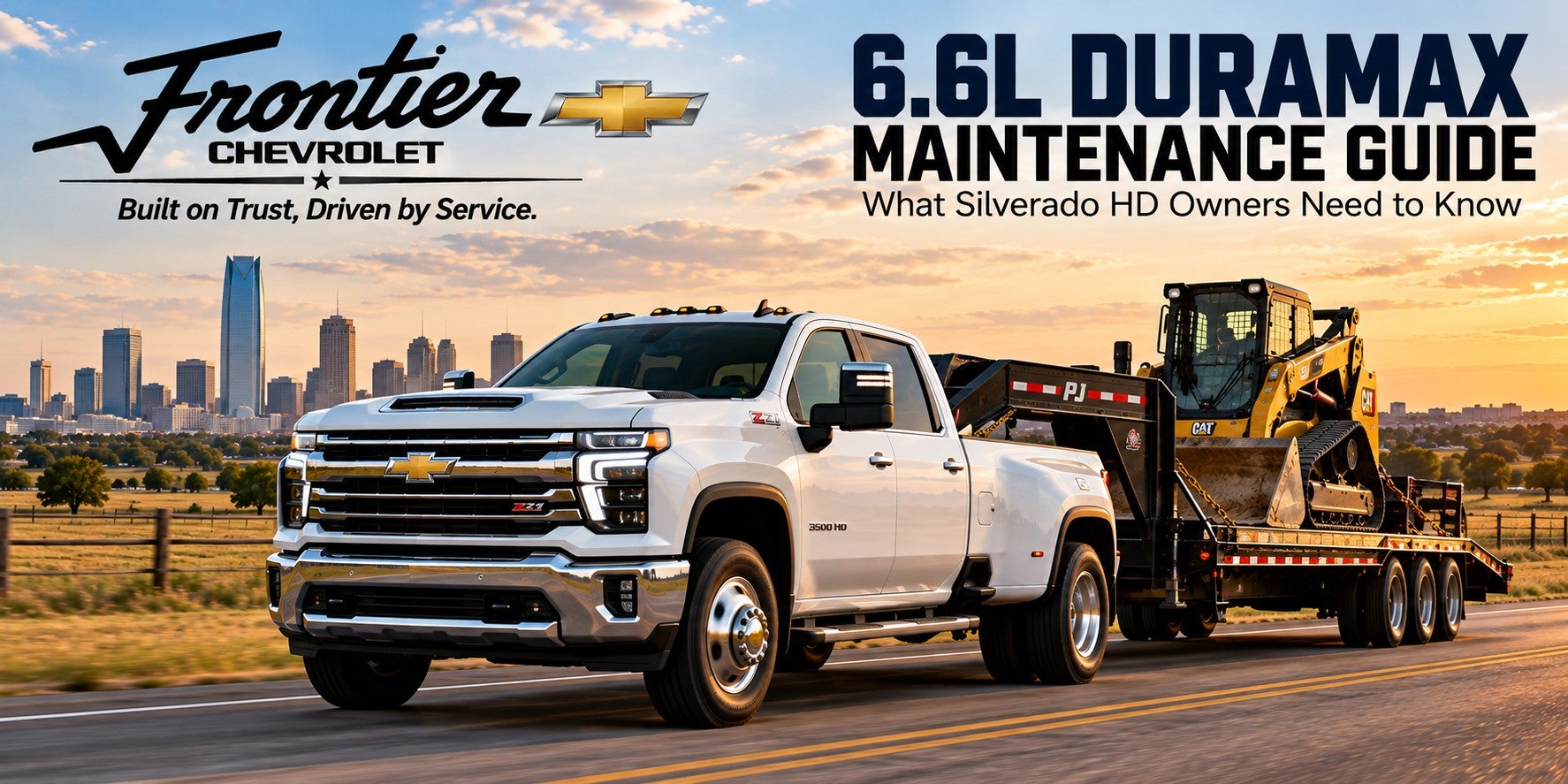
Chevrolet Silverado HD 6.6L Duramax towing heavy equipment with the Oklahoma City skyline in the background for Frontier Chevrolet in El Reno, Oklahoma

6.6L Duramax Maintenance Guide: What Silverado HD Owners Need to Know

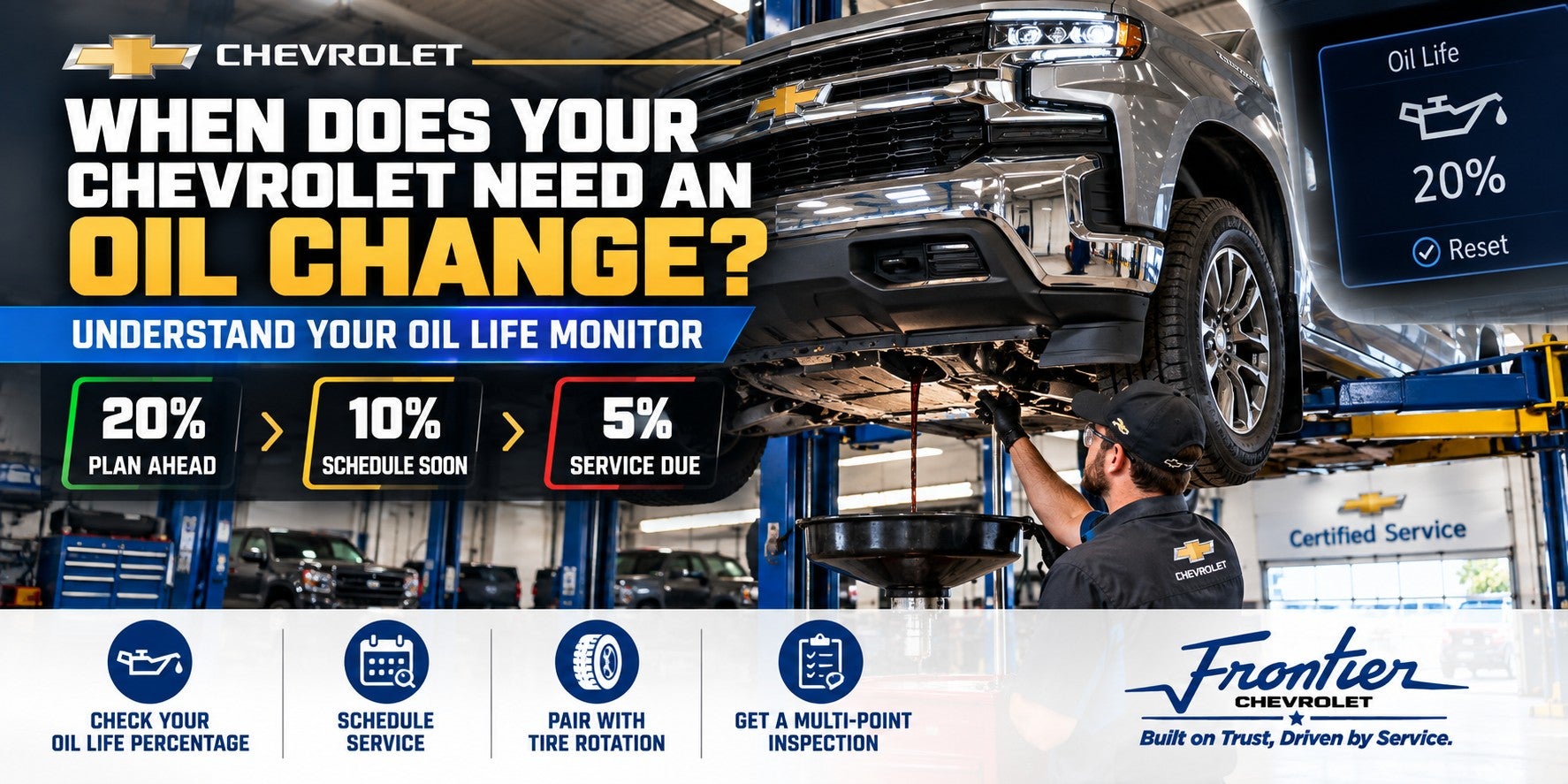
6.6L Duramax Maintenance Guide: What Silverado HD Owners Need to Know The Chevrolet Silverado 2500 HD and 3500 HD with the 6.6L Duramax are built to work. These trucks tow campers, equipment trailers, livestock trailers, construction equipment and other heavy loads across Oklahoma every day. But a truck designed for heavy-duty use also deserves maintenance that reflects how it is actually being used. Modern Duramax maintenance goes beyond simply changing the engine oil. Owners should understand fuel-filter maintenance, Diesel Exhaust Fluid (DEF), the diesel particulate filter, regeneration, cooling-system condition and how towing, heavy loads, extended idling and demanding operating conditions can affect the truck. At Frontier Chevrolet in El Reno, our approach is straightforward: Maintain your Duramax based on the truck you actually own and the work it actually does—not diesel advice written 20 years ago. Quick Answer: What Maintenance Does a 6.6L Duramax Need? A Chevrolet Silverado HD with the 6.6L Duramax requires regular engine oil and filter service, fuel-filter maintenance, DEF monitoring and attention to its diesel exhaust aftertreatment system, along with normal Silverado HD maintenance such as tires, brakes, cooling-system, transmission and driveline inspections. Exact requirements depend on model year, mileage and how the truck is used. Heavy towing, commercial use, extended idling and other demanding operation make regular inspections particularly important. What Is the 6.6L Duramax? The 6.6L Duramax is Chevrolet's heavy-duty turbo-diesel V8 available in Silverado HD trucks. For the 2026 Chevrolet Silverado HD, the current 6.6L Duramax produces: 470 horsepower 975 lb.-ft. of torque 10-speed Allison automatic transmission Up to 36,000 pounds of maximum available towing capacity in a qualifying Silverado 3500 HD configuration Silverado 2500 HD models can also provide substantial towing capability, but the maximum rating varies by cab, bed, drivetrain, hitch, equipment and configuration. Don't assume every Duramax Silverado HD can tow the maximum advertised number. Always use the trailering information for the specific truck. Are All 6.6L Duramax Engines the Same? No. The Duramax name has been around for decades, and Chevrolet has used multiple generations of the 6.6L diesel. That matters when researching maintenance online. Older Duramax generations include engines commonly identified by codes such as: LB7 LLY LBZ LMM LML Newer Silverado HD trucks use the L5P generation of the 6.6L Duramax. A maintenance recommendation, fluid specification or repair discussion written for an older Duramax should not automatically be applied to a current L5P truck. Before following technical information, verify: Model year + engine + application. “6.6L Duramax” alone isn't specific enough. How Often Should I Change the Oil in a 6.6L Duramax? Your Silverado HD's Engine Oil Life System should be a primary guide for oil-change timing. Rather than simply counting miles, the system evaluates vehicle operating conditions to estimate remaining engine-oil life. When your Driver Information Center displays " Change Engine Oil Soon," have the engine oil and filter serviced promptly. Chevrolet also directs owners to change the engine oil and filter at least annually even if the Oil Life System has not requested service earlier. For a heavy-duty diesel, this approach makes sense. Two trucks with 10,000 miles may have lived completely different lives. One may have accumulated those miles cruising unloaded on the highway. Another may have spent those same miles: Pulling a heavy trailer Idling on a jobsite Operating in Oklahoma summer heat Driving dusty roads Carrying substantial payload Making repeated short trips Mileage alone doesn't tell the whole story. Does Towing Affect Duramax Oil Life? It can. Heavy towing increases engine load and heat compared with unloaded driving. That doesn't mean every Duramax owner should invent a fixed shortened oil-change interval. Instead, regularly monitor the Oil Life System and consider how the truck is being operated. Chevrolet specifically identifies frequent trailering, heavy loads, mountainous driving, extended idling and dusty conditions as examples of demanding operation that can require additional maintenance attention. A work truck should be maintained like a work truck. What Oil Does a 6.6L Duramax Use? The correct engine-oil viscosity and specification depend on the model year and engine application. This is an area where internet advice can create problems because older 6.6L Duramax engines may have different requirements than current L5P engines. Before servicing your truck, verify the oil requirements listed for your specific Silverado HD. Don't choose engine oil simply because the container says: Diesel or Heavy Duty The oil needs to meet Chevrolet's requirements for your particular engine. When Should I Change the Fuel Filter on a 6.6L Duramax? Fuel filtration is particularly important on a modern diesel. Your Silverado HD can monitor remaining fuel-filter life and provide a message when service is required. If your Driver Information Center indicates: Change Fuel Filter don't simply clear the message and continue driving. Replace the filter according to Chevrolet's maintenance requirements and reset the Fuel Filter Life System after the service has actually been completed. Exact maximum time or mileage requirements should be verified for your truck's model year. Why Is Fuel Quality Important on a Duramax? Modern diesel fuel systems operate at extremely demanding pressures and tolerances. The fuel filter is part of the protection system. Contaminated fuel or neglected filtration can create problems that are significantly more expensive than routine filter maintenance. Chevrolet specifically emphasizes fuel quality and proper filtration when discussing maintenance of the 6.6L Duramax. That's why fuel-filter maintenance shouldn't be treated as an optional service just because the engine currently runs normally. What Does the Fuel Filter Life Percentage Mean? If your Silverado HD displays remaining Fuel Filter Life, that percentage is estimating remaining useful filter life. It is not: Fuel level Fuel quality DEF level Engine oil life As the percentage decreases, fuel-filter service is approaching. After the filter is replaced, the system should be properly reset. Resetting the monitor without replacing the filter doesn't perform maintenance—it only removes the reminder. What Is DEF on a 6.6L Duramax? DEF stands for Diesel Exhaust Fluid. Modern 6.6L Duramax trucks use DEF as part of the emissions-control system. DEF is stored in its own tank. It is not diesel fuel. It is not a fuel additive. And it should never intentionally be added to the diesel fuel tank. Your Silverado monitors DEF and provides warnings when attention is needed. How Often Does a 6.6L Duramax Need DEF? There isn't one useful refill mileage that applies to every Duramax owner. DEF consumption can vary depending on: Engine workload Towing Payload Driving conditions Mileage Operating environment A truck regularly pulling a heavy fifth-wheel camper or equipment trailer may use DEF differently from one that spends most of its time unloaded. Monitor the truck rather than relying on somebody else's refill schedule. What Happens if My Duramax Runs Low on DEF? Your Silverado HD will provide warnings as DEF becomes low. Don't ignore them. If the required condition isn't corrected, additional warnings and operating restrictions can eventually occur. It's much easier to address DEF when the truck first warns you than to wait until the situation becomes urgent. For trucks used commercially or for long-distance towing, checking DEF before departure is a good habit. What Is the DPF on a 6.6L Duramax? DPF stands for Diesel Particulate Filter. It is part of the diesel exhaust aftertreatment system. The DPF captures particulate matter from the exhaust. As soot accumulates, the vehicle manages it through a process called regeneration. This is normal modern diesel operation. What Is DPF Regeneration? Regeneration allows the diesel aftertreatment system to reduce soot accumulated in the Diesel Particulate Filter. During regeneration, exhaust temperatures can become significantly higher. Depending on operating conditions, you may occasionally notice differences in: Exhaust smell Engine sound Fan operation Instant fuel-economy readings Idle characteristics But don't diagnose regeneration based on one symptom alone. Several vehicle conditions can produce similar symptoms. A regeneration event is not automatically evidence that something is wrong with your Duramax. Should I Let a Duramax Finish Regeneration? If your truck provides a specific message or instruction related to the diesel exhaust system, follow the instructions provided by Chevrolet for your vehicle. Avoid relying on generic internet procedures that prescribe a particular speed, RPM or number of highway miles for every Duramax. Modern Silverado HD trucks monitor their own systems. The information coming from your truck is more relevant than a procedure written for a different Duramax generation. Is Excessive Idling Bad for a Modern Duramax? Extended idling creates different operating conditions than driving the truck under normal load. For work trucks, some idling may be unavoidable. But don't assume a diesel needs to idle excessively simply because older diesel engines were commonly operated that way. Modern Duramax engines and emissions systems are significantly different. Follow Chevrolet's operating guidance for your model year and pay attention to vehicle messages. Should I Warm Up My Duramax Before Towing? A modern diesel doesn't need to sit idling for an excessive amount of time every morning. However, Chevrolet specifically recommends allowing a 6.6L Duramax to fully warm up before trailering large loads. That's different from saying the truck should idle in the driveway for an arbitrary amount of time. Normal operation allows the engine and related systems to reach proper operating temperature. When you're preparing to pull a significant load, temperature and vehicle condition matter. What Should I Check Before Heavy Towing? Before connecting a large trailer, inspect more than the engine. Consider checking: Engine oil level and Oil Life Fuel Filter Life DEF level Coolant Transmission condition Tires and tire pressure Truck brakes Trailer brakes Trailer tires Hitch or gooseneck/fifth-wheel equipment Safety chains Breakaway system Trailer wiring Lights Mirrors Dashboard warning messages Also verify that the truck, hitch and trailer combination are within their applicable ratings. Engine power does not override weight ratings. How Much Can a 6.6L Duramax Tow? The 2026 Silverado HD with the 6.6L Duramax offers up to 36,000 pounds of maximum available towing capacity in the qualifying Silverado 3500 HD configuration. Silverado 2500 HD towing ratings are lower and vary by configuration. Actual towing capability depends on factors including: 2500 HD vs. 3500 HD Single rear wheel vs. dual rear wheel Cab configuration Bed length 2WD vs. 4WD Conventional vs. gooseneck/fifth-wheel towing Equipment packages Passengers Cargo Hitch ratings Always use the ratings for the specific truck. What Is the Duramax Exhaust Brake? Silverado HD Duramax models offer a diesel exhaust brake designed to assist with vehicle control while towing. The system works with the transmission, Tow/Haul mode and grade-braking functions to help slow the truck and trailer. This can be particularly valuable when descending grades with a heavy load. An exhaust brake doesn't eliminate the need for properly maintained truck and trailer brakes. It complements them. Does Heavy Towing Change Maintenance Needs? Heavy towing affects far more than the engine. Regularly towing substantial loads can increase demands on: Engine Cooling system Transmission Driveline Tires Brakes Suspension Fuel system Diesel emissions system If your Silverado HD earns its living pulling equipment every day, tell your service advisor. That usage information matters when inspecting the truck. What About Farm, Ranch and Oilfield Use? Oklahoma work trucks don't always spend their lives on pavement. Dust, dirt, gravel roads, mud, heavy loads and extended operation can change maintenance considerations. Trucks used in these environments deserve additional attention to items such as: Air filtration Tires Steering and suspension Brakes Driveline Cooling system Fluid leaks Underbody components Mileage alone may underestimate how hard the truck has worked. What Maintenance Does a Commercial Duramax Need? Commercial use varies dramatically. A Silverado HD used by a contractor pulling equipment every day has a different operating profile from a privately owned truck pulling a camper several weekends each year. Commercial owners should pay particular attention to: Maintenance monitors Daily or regular vehicle inspections Fluid levels Tires Brakes Fuel filtration Cooling-system condition Trailer equipment Warning messages Downtime costs money. Preventive maintenance can often be less disruptive than waiting for a warning sign to become a breakdown. My Duramax Has 100,000 Miles. What Should I Service? Don't replace everything simply because the odometer reached a round number. Start by reviewing the truck's: Model year Maintenance history Current mileage Engine hours when relevant Previous repairs Fluid-service history Fuel-filter history Towing history Current maintenance monitors Chevrolet maintenance schedule At higher mileage, inspections become increasingly valuable because not every component ages according to the odometer alone. A 100,000-mile highway truck may have experienced very different wear from a 100,000-mile commercial towing truck. Mileage tells you how far the truck traveled. It doesn't tell you everything the truck has done. My Duramax Doesn't Get Driven Much. Does It Still Need Maintenance? Yes. Low mileage doesn't eliminate time-based maintenance. Engine oil, filters, fluids, batteries, tires and other components can still age. A truck that sits for extended periods may also develop different concerns than one driven regularly. This is particularly relevant to Silverado HD trucks used primarily for: RV towing Seasonal work Farm use Trailer hauling Recreational towing Don't judge maintenance needs exclusively by annual mileage. Why Is My Duramax Fuel Economy Dropping? A change in fuel economy doesn't automatically mean something is broken. Fuel economy can be affected by: Trailer weight Payload Highway speed Headwinds Temperature Tire pressure Idling Regeneration Driving conditions Fuel quality Mechanical condition A Silverado HD pulling a large fifth wheel into an Oklahoma headwind is going to consume fuel differently than the same truck cruising unloaded. Look for meaningful changes from the truck's normal pattern. What Duramax Warning Messages Should I Not Ignore? Pay attention to messages involving: Engine oil Fuel filter DEF Diesel exhaust system Engine temperature Charging system Engine operation Transmission Other monitored systems Some messages indicate upcoming maintenance. Others may indicate a condition requiring more immediate attention. Don't assume what a message means. Read it and respond accordingly. Does a Check Engine Light Mean My Duramax Needs an Emissions Part? No. A Check Engine Light can be triggered by many different monitored conditions. A diagnostic trouble code provides a starting point for diagnosis. It does not necessarily mean: “Replace the part named in the code.” Testing matters. This is especially important on modern diesel trucks with interconnected engine, fuel, electrical and aftertreatment systems. A code is information. Diagnosis determines the cause. Buying a Used 6.6L Duramax? Check the Maintenance History A used Silverado HD Duramax can represent significant value, but the truck's previous use matters. Before buying one, review available information about: Oil-change history Fuel-filter maintenance DEF and emissions-system repairs Cooling-system maintenance Transmission and driveline service Warning-light history Previous repairs Towing use Commercial use Modifications Be especially cautious about assuming aftermarket modifications automatically improve the truck. Modifications can affect reliability, drivability, emissions compliance and future serviceability. A clean truck with documented maintenance is usually more reassuring than one with a long list of unexplained modifications. Can Frontier Chevrolet Service My Duramax if I Didn't Buy It There? Yes. You do not need to have purchased your Silverado HD from Frontier Chevrolet to request service. Whether you bought the truck new, used or somewhere else entirely, we can discuss its maintenance needs and current concerns. 6.6L Duramax Service Near Oklahoma City Frontier Chevrolet is located in El Reno, west of the Oklahoma City metro. That puts us in an area where Silverado HD trucks are frequently used for exactly what Chevrolet built them to do: Construction Agriculture Ranching Equipment hauling Commercial work RV towing Horse and livestock trailers Heavy recreational towing That also means we understand that an HD truck isn't necessarily just transportation. For many owners, it's a tool that needs to be available when the work starts. 6.6L Duramax Maintenance FAQs What maintenance does a 6.6L Duramax need? Regular maintenance includes engine oil and filter service, fuel-filter maintenance, DEF monitoring and diesel aftertreatment-system awareness in addition to normal Silverado HD maintenance such as tires, brakes, fluids and inspections. How often should I change the oil in a 6.6L Duramax? Use the Silverado HD Engine Oil Life System and Chevrolet's maintenance requirements for your model year. When the truck displays Change Engine Oil Soon, have the oil and filter serviced promptly. Oil and filter service should also occur at least annually. When should I change the Duramax fuel filter? Monitor Fuel Filter Life and follow the maintenance requirements for your particular model year. Address a Change Fuel Filter message rather than simply resetting it. Does the 6.6L Duramax use DEF? Yes. Modern 6.6L Duramax engines use Diesel Exhaust Fluid as part of their emissions-control system. What is regeneration? Regeneration is the process used by the diesel aftertreatment system to help manage soot accumulated in the Diesel Particulate Filter. Should I idle my Duramax before towing? Avoid applying outdated diesel habits automatically. Chevrolet recommends allowing the 6.6L Duramax to fully warm up before trailering large loads, but that doesn't mean every truck requires excessive stationary idling. How much can a 6.6L Duramax tow? A properly configured 2026 Silverado 3500 HD with the 6.6L Duramax can provide up to 36,000 pounds of maximum available towing capacity. Your truck's actual rating depends on its specific configuration. Is the L5P the same as older Duramax engines? No. The L5P is a newer generation of the 6.6L Duramax. Specifications and service information for older LB7, LLY, LBZ, LMM or LML engines should not automatically be applied to an L5P. Can Frontier Chevrolet service a high-mileage Duramax? Yes. Maintenance recommendations should consider the truck's model year, mileage, maintenance history, operating conditions and current condition rather than mileage alone. Schedule 6.6L Duramax Service in El Reno, Oklahoma A Silverado HD Duramax may spend its life towing equipment, pulling an RV, working on a ranch or simply providing an owner with the capability to handle a heavy load whenever necessary. Whatever the job, maintenance should reflect how the truck is actually being used. Monitor your Oil Life. Monitor Fuel Filter Life. Keep DEF at the appropriate level. Pay attention to warning messages. Inspect the truck and trailer before heavy towing. And don't rely on maintenance advice written for a completely different generation of Duramax. If your Silverado 2500 HD or 3500 HD needs maintenance, displays a warning message or isn't operating the way it normally does, schedule service with Frontier Chevrolet in El Reno. The goal isn't to service your Duramax more than necessary. It's to service the right systems at the right time. Frontier Chevrolet 1640 E. Highway 66 El Reno, Oklahoma 73036 Built on Trust, Driven by Service. Schedule your Duramax service today.

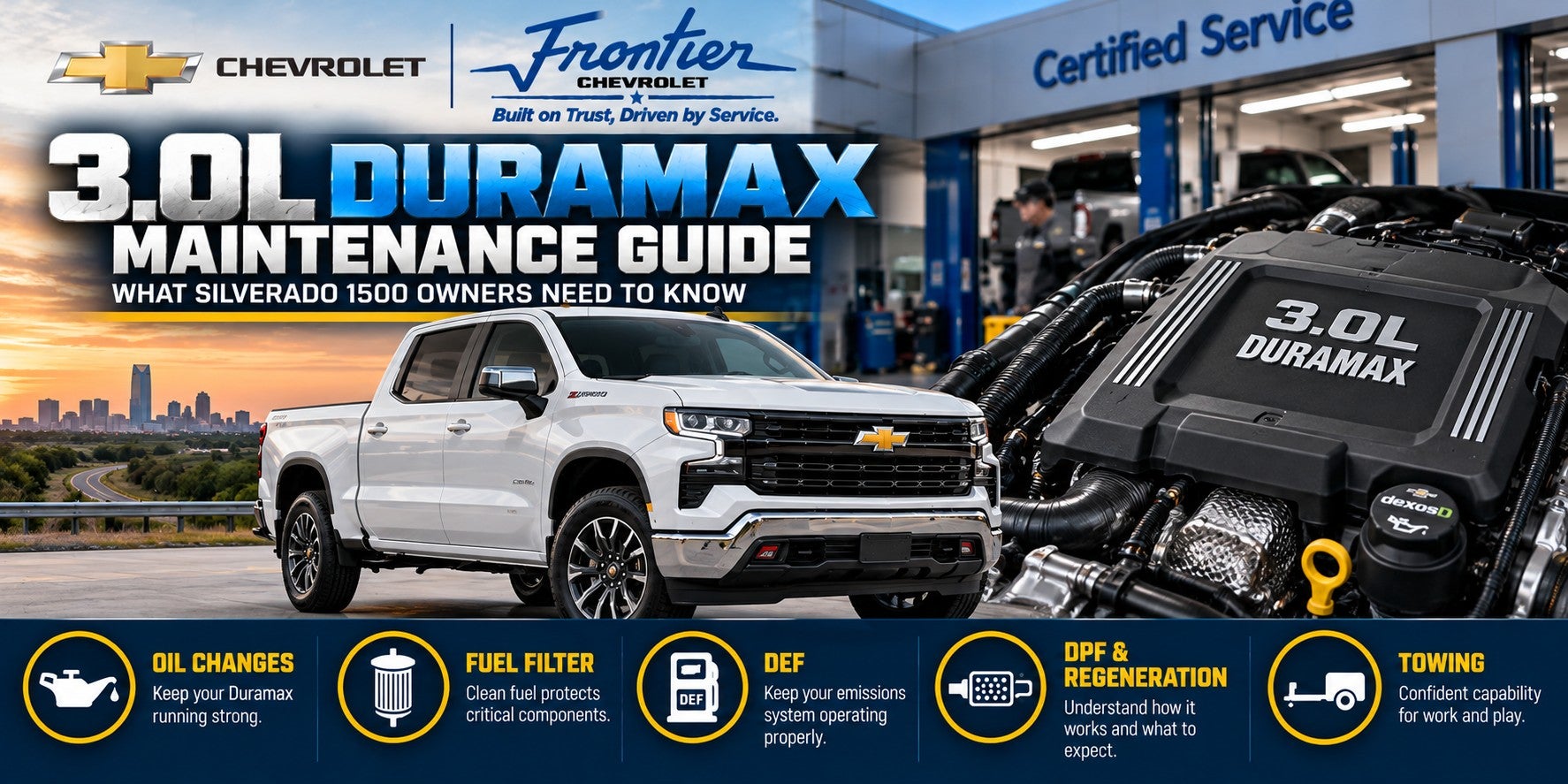
2026 Chevrolet Silverado 1500 with 3.0L Duramax diesel highlighting oil changes, fuel filter, DEF, DPF regeneration and towing maintenance at Frontier Chevrolet in El Reno, Oklahoma

3.0L Duramax Maintenance Guide: What Silverado 1500 Owners Need to Know

3.0L Duramax Maintenance Guide: What Silverado 1500 Owners Need to Know The 3.0L Duramax gives Chevrolet Silverado 1500 owners something unusual in today's light-duty truck market: diesel torque, strong towing capability and impressive highway efficiency in a half-ton pickup. But maintaining a 3.0L Duramax isn't exactly the same as maintaining a gasoline Silverado. In addition to normal truck maintenance, owners need to understand diesel engine oil, fuel-filter maintenance, Diesel Exhaust Fluid (DEF), the diesel particulate filter, regeneration and how towing or short-trip driving can affect the way the truck operates. At Frontier Chevrolet in El Reno, Oklahoma, our recommendation is simple: Don't maintain your 3.0L Duramax based on diesel advice written for a completely different engine. Maintain the truck you actually own. Quick Answer: What Maintenance Does a 3.0L Duramax Need? A Chevrolet Silverado 1500 with the 3.0L Duramax requires diesel-specific maintenance in addition to normal truck maintenance. Owners should monitor engine oil life, fuel-filter life, Diesel Exhaust Fluid (DEF), air filtration and diesel aftertreatment systems while also maintaining tires, brakes and other vehicle fluids and components. Exact requirements should be verified for your Silverado's model year and configuration. The truck's own maintenance monitors are valuable tools. Use them. What Is the 3.0L Duramax? The 3.0L Duramax is an inline-six turbo-diesel available in Chevrolet Silverado 1500 trucks. For the 2026 Silverado 1500, Chevrolet rates the 3.0L Duramax at: 305 horsepower 495 lb.-ft. of torque 10-speed automatic transmission Up to 13,300 pounds of available towing capacity when properly equipped Actual towing capacity depends on the truck's specific configuration, equipment, passengers and cargo. The combination makes the 3.0L Duramax attractive to Silverado owners who want diesel torque without moving into a Silverado 2500 HD or 3500 HD. But don't confuse it with the 6.6L Duramax used in Chevrolet's heavy-duty trucks. They are very different engines. LM2 vs. LZ0: Are All 3.0L Duramax Engines the Same? No. This is important when researching maintenance information online. Earlier Silverado 1500 3.0L Duramax trucks used the LM2 version of the engine. Newer Silverado 1500 diesels use the LZ0 version. Both belong to Chevrolet's 3.0L Duramax family, but that doesn't mean every component, specification or service procedure should automatically be treated as interchangeable. If you're researching: Oil specifications Parts Filters Service procedures Maintenance requirements Technical information verify the model year and engine application first. A forum post about somebody else's 3.0L Duramax isn't necessarily maintenance guidance for yours. How Often Should I Change the Oil in a 3.0L Duramax? Your Silverado's Engine Oil Life System should be one of your primary guides for oil-change timing. The system estimates remaining oil life based on vehicle operation rather than simply counting miles. When the truck displays a Change Engine Oil Soon message, the oil and filter should be serviced promptly. Chevrolet also advises changing engine oil and the filter at least annually even if the Oil Life System has not requested an earlier change. That means we don't recommend blindly applying an arbitrary oil-change mileage to every 3.0L Duramax. A truck that spends significant time towing, idling or operating under demanding conditions may accumulate its miles very differently from one primarily driven unloaded on the highway. How the truck accumulated the miles matters. What Oil Does the 3.0L Duramax Use? Using the correct oil specification is important in a modern diesel engine. For current Chevrolet 3.0L Duramax applications, Chevrolet lists 0W-20 dexosD diesel engine oil for applicable Silverado 1500 models. However, specifications should always be verified for your exact model year before service. Don't assume: “Diesel oil is diesel oil.” The correct viscosity and specification matter. This is another reason we don't recommend choosing engine oil solely from the label on the front of a bottle. Use oil that meets Chevrolet's requirements for your specific 3.0L Duramax. Should I Change My 3.0L Duramax Oil Early Because I Tow? Towing increases engine workload, but that doesn't mean every owner should automatically ignore the Oil Life System and substitute the same shortened interval. Instead, consider the complete operating environment. Factors can include: Trailer weight Frequency of towing Oklahoma summer temperatures Terrain Extended idling Stop-and-go operation Highway mileage Dusty operating conditions The Oil Life System is designed to account for operating conditions when estimating remaining oil life. Check it regularly and respond when the truck tells you service is approaching. When Should I Change the Fuel Filter on a 3.0L Duramax? The 3.0L Duramax uses a fuel filter to help protect the diesel fuel system from contaminants. Silverado diesel models can provide a Fuel Filter Life indication through the vehicle's information system. When fuel-filter life becomes low or the vehicle displays a Change Fuel Filter message, don't ignore it. Maintenance guidance for the 3.0L Duramax has generally called for replacement by the applicable mileage/time limit or sooner when the Fuel Filter Life System indicates service is required. Because requirements can vary by model year, verify the schedule for your particular Silverado. What Does Fuel Filter Life Percentage Mean? Think of the Fuel Filter Life display similarly to the Oil Life display. If the truck shows remaining fuel-filter life, it's estimating how much useful service life remains. It isn't telling you how full the fuel tank is. And it isn't a fuel-quality gauge. As the percentage decreases, you're approaching fuel-filter service. After the filter is actually replaced, the Fuel Filter Life System should be properly reset. Don't reset the monitor without changing the filter simply to make the warning disappear. That removes useful maintenance information without correcting anything. Why Is the Fuel Filter So Important on a 3.0L Duramax? Modern diesel fuel systems operate under demanding conditions. The fuel filter helps prevent unwanted contaminants from reaching critical fuel-system components. That's why fuel-filter maintenance isn't something we'd recommend postponing indefinitely because the truck still seems to run normally. Preventive maintenance is about addressing wear and contamination before they become drivability problems. What Is DEF on a 3.0L Duramax? DEF stands for Diesel Exhaust Fluid. The 3.0L Duramax uses DEF as part of its emissions-control system. DEF is stored separately from diesel fuel. It is not a fuel additive and should never intentionally be poured into the diesel fuel tank. Your Silverado monitors DEF level and can provide warnings as the level becomes low. Rather than trying to memorize one universal DEF refill mileage, monitor the truck. DEF consumption varies with operating conditions. Does Towing Use More DEF? DEF consumption can vary with vehicle workload and operating conditions. A Silverado frequently towing a substantial trailer may use DEF differently than a truck driven primarily unloaded. Other factors can influence consumption as well. That's why the truck's DEF-level information is more useful than assuming every 3.0L Duramax should consume the same amount every certain number of miles. Before a long towing trip, check your DEF level along with the other important truck and trailer systems. What Happens if My 3.0L Duramax Runs Low on DEF? Your Silverado can provide warnings as DEF becomes low. Don't ignore them. The emissions system is designed around having the required fluid available. Continued operation without addressing applicable DEF warnings can eventually lead to additional messages or operating restrictions. The easy solution is to address the warning before it becomes urgent. What Is the DPF on a 3.0L Duramax? DPF stands for Diesel Particulate Filter. It is part of the diesel exhaust aftertreatment system. The DPF captures particulate matter from the exhaust. As material accumulates, the vehicle uses a process called regeneration to help manage soot within the filter. For a modern diesel owner, understanding regeneration is useful because it explains some operating characteristics that may seem unusual if you've never owned a diesel before. What Is Regeneration on a 3.0L Duramax? During regeneration, the diesel aftertreatment system creates the conditions needed to help reduce soot accumulated in the DPF. This can occur as part of normal vehicle operation. A regeneration event does not automatically mean something is wrong with your Silverado. Depending on conditions, drivers may occasionally notice changes in: Engine operation Exhaust temperature Fuel-economy readings Fan operation Odor However, those symptoms alone should never be used to diagnose regeneration. If the truck displays a warning or service message, follow the information provided for the vehicle. Are Short Trips Bad for the 3.0L Duramax? Short trips aren't automatically harmful to a 3.0L Duramax. But a diesel used almost exclusively for very short trips operates differently from one regularly driven long enough to reach full operating temperature. Modern diesel engines also have emissions systems that must manage exhaust temperatures and particulate matter. That's why driving pattern matters. If your Silverado primarily makes: Short commutes Repeated brief trips Low-speed trips Extended periods of idling pay particular attention to vehicle messages and maintenance indicators. Don't assume that low annual mileage automatically means the truck has experienced easy operating conditions. Should I Take My Duramax on the Highway to “Clean It Out”? We wouldn't recommend inventing your own maintenance procedure based on something you read online. Normal longer-distance driving can provide different operating conditions than repeated short trips, but there isn't a universal rule that every 3.0L Duramax owner should drive a specific speed for a specific number of minutes to “clean out” the engine. If the truck displays a message related to the diesel exhaust system, follow the instructions provided for your vehicle. The Driver Information Center is more relevant to your truck than somebody else's diesel ritual. Is the 3.0L Duramax Good for Towing? Towing is one of the major reasons buyers choose the 3.0L Duramax. For the 2026 Silverado 1500, Chevrolet lists up to 13,300 pounds of available towing capability with the 3.0L Duramax in the qualifying configuration. That does not mean every 3.0L Duramax Silverado can tow 13,300 pounds. Actual trailering capacity depends on: Cab and bed configuration Drivetrain Equipment Trailering package Vehicle options Passengers Cargo Trailer setup Always use the ratings for the specific truck. Does Towing Change 3.0L Duramax Maintenance? Regular towing increases the workload placed on more than the engine. It can affect maintenance considerations involving: Engine oil Cooling system Transmission Brakes Tires Driveline Fuel system Diesel aftertreatment system This doesn't mean parts automatically need replacement simply because you tow. It means the way you use your Silverado should be part of the maintenance conversation. What Should I Check Before Towing With a 3.0L Duramax? Before a longer towing trip, consider checking: Engine oil level and oil life Fuel-filter life DEF level Coolant Tires and tire pressure Truck brakes Trailer brakes Trailer tires Hitch equipment Safety chains Trailer wiring and lights Applicable vehicle fluids Dashboard warning messages Don't forget the trailer. A well-maintained Silverado cannot compensate for neglected trailer tires, brakes or connections. What Should I Check Before a Long Road Trip? Even if you're not towing, a pre-trip inspection can help catch problems before you're several hundred miles from home. Consider checking: Oil life Fuel-filter life DEF Tires Spare tire Brakes Battery Coolant Exterior lights Wiper blades Warning messages If your Silverado has recently developed a new noise, vibration, leak or warning light, addressing it before the trip is usually better than hoping it disappears somewhere down the highway. How Does Oklahoma Heat Affect a 3.0L Duramax? Oklahoma summer temperatures can increase the thermal demands placed on any vehicle. Add a trailer, highway speed and a heavy load, and the truck may be working considerably harder. That's why cooling-system condition, tire pressure and other maintenance items deserve attention before summer towing. Don't wait until you're hooked to a trailer on a 100-degree day to discover that something needed service. What About Cold-Weather Starting? Diesel starting characteristics can change as temperatures drop. Modern 3.0L Duramax trucks are significantly different from older diesels, so don't automatically apply habits developed around diesel engines from decades ago. Pay attention to: Battery condition Starting performance Vehicle messages Appropriate fuel Chevrolet's cold-weather operating guidance If the truck begins cranking differently or becomes difficult to start, diagnose the condition rather than assuming “that's just what diesels do.” Why Is My 3.0L Duramax Fuel Economy Dropping? A temporary change in fuel economy doesn't automatically indicate a mechanical problem. Fuel economy can change because of: Towing Payload Driving speed Wind Temperature Tire pressure Stop-and-go traffic Idling Regeneration activity Driving habits Mechanical condition Look at the pattern rather than one trip. If fuel economy changes significantly and remains lower without an obvious explanation, inspection may be worthwhile. What 3.0L Duramax Warning Messages Should I Pay Attention To? Don't ignore messages simply because the truck still drives normally. Depending on the model year and condition, messages can relate to systems such as: Engine oil Fuel filter DEF Diesel exhaust system Engine operation Charging system Cooling system Other monitored systems Some messages indicate upcoming maintenance. Others can indicate a condition requiring more immediate attention. Read the message rather than assuming what it means. Does a Check Engine Light Mean My Duramax Has an Emissions Problem? Not necessarily. A Check Engine Light can appear for many reasons. Modern diesel trucks monitor numerous engine, fuel, electrical and emissions-related systems. A diagnostic trouble code can provide valuable information, but a code alone doesn't always identify the part that should be replaced. A trouble code is information—not automatically a diagnosis. Proper testing still matters. Buying a Used 3.0L Duramax? Check the Maintenance History A used Silverado 1500 Duramax can be an appealing truck, but maintenance history matters. Before buying, consider reviewing available records for: Oil and filter changes Fuel-filter service Warning-light history Diesel emissions-system repairs Cooling-system maintenance Other scheduled maintenance Previous repairs Towing or commercial use when known Also pay attention during the test drive. Does the truck start normally? Are warning lights present? Does it accelerate smoothly? Are there unusual noises, vibrations or odors? Does the maintenance information show upcoming service? A clean-looking truck is great. A clean maintenance history is even better. Is the 3.0L Duramax Expensive to Maintain? Compared with a gasoline Silverado, a diesel introduces additional maintenance considerations such as the fuel filter and DEF. Actual ownership cost depends heavily on: Mileage Usage Towing Service requirements Fuel prices Repair history How long you own the truck Don't evaluate the engine based solely on the price of one oil change. Consider the complete ownership picture and whether the diesel's efficiency, torque and towing characteristics fit how you'll actually use the Silverado. 3.0L Duramax Service Near El Reno and Oklahoma City Frontier Chevrolet is located in El Reno, Oklahoma, west of the Oklahoma City metro. The 3.0L Duramax is a particularly good fit for many Oklahoma truck owners because one Silverado may need to handle several different jobs: Daily commuting Highway travel Camper towing Boat towing Farm and ranch use Work Family transportation That versatility is one of the engine's strengths. It also means two 3.0L Duramax trucks with the same mileage may have experienced very different operating conditions. Maintenance should consider the truck's mileage, model year, maintenance monitors and how it is actually used. 3.0L Duramax Maintenance FAQs What maintenance does a 3.0L Duramax need? In addition to normal Silverado maintenance, owners should monitor engine oil and filter service, fuel-filter life, DEF, air filtration and applicable diesel aftertreatment systems. How often should I change the oil in my 3.0L Duramax? Use the Silverado's Engine Oil Life System and applicable Chevrolet maintenance guidance. When the vehicle indicates that an oil change is due, service it promptly. Oil and filter service should also occur at least annually. What oil does the 3.0L Duramax use? Current Chevrolet parts information lists 0W-20 dexosD diesel engine oil for applicable 3.0L Duramax Silverado 1500 models. Always verify the specification for your exact model year. When should I replace the 3.0L Duramax fuel filter? Monitor the Fuel Filter Life System and follow the maintenance schedule for your particular model year. Don't ignore a Change Fuel Filter message. Does the 3.0L Duramax use DEF? Yes. DEF is part of the diesel emissions-control system and is stored separately from diesel fuel. What is regeneration on a 3.0L Duramax? Regeneration is a normal process used by the diesel aftertreatment system to help manage soot accumulated in the Diesel Particulate Filter. Are short trips bad for a 3.0L Duramax? Short trips aren't automatically harmful, but repeated short-trip operation creates different engine and aftertreatment operating conditions than longer drives. Pay attention to vehicle messages and maintenance requirements. How much can a 3.0L Duramax tow? The 2026 Silverado 1500 offers up to 13,300 pounds of available towing capability with the 3.0L Duramax when properly equipped in the qualifying configuration. Your specific truck's rating may be lower. Is the LM2 the same as the LZ0? No. They're different versions of Chevrolet's 3.0L Duramax. Verify specifications, parts and service information for your particular model year and engine. Can Frontier Chevrolet service my 3.0L Duramax if I bought it somewhere else? Yes. You don't have to have purchased your Silverado from Frontier Chevrolet to request maintenance or service. Schedule 3.0L Duramax Service in El Reno, Oklahoma The 3.0L Duramax doesn't need to be complicated to own. Know which engine and model year you have. Watch your Oil Life and Fuel Filter Life systems. Keep DEF at the appropriate level. Pay attention to diesel exhaust-system messages. And maintain the truck based on how you actually use it. If your Silverado 1500 3.0L Duramax needs maintenance, displays a warning message or simply isn't operating the way it normally does, schedule service with Frontier Chevrolet in El Reno. Our goal is to determine what your truck actually needs rather than replacing parts based on assumptions. Frontier Chevrolet 1640 E. Highway 66 El Reno, Oklahoma 73036 Built on Trust, Driven by Service. Schedule your 3.0L Duramax service today.

Chevrolet Duramax diesel maintenance guide featuring 3.0L Duramax Silverado 1500 and 6.6L Duramax Silverado HD trucks with oil change, fuel filter, DEF, DPF regeneration and towing maintenance at Frontier Chevrolet in El Reno, Oklahoma

Chevrolet Duramax Diesel Maintenance Guide: What Oklahoma Truck Owners Should Know

Chevrolet Duramax Diesel Maintenance Guide: What Oklahoma Truck Owners Should Know Duramax diesel engines are built for drivers who expect more from their trucks. For some Oklahoma owners, that means towing a camper across the state. For others, it's pulling equipment, hauling livestock, working on a farm or ranch, traveling long highway miles or simply enjoying the torque and efficiency available from a diesel-powered Silverado. But owning a diesel also means understanding that maintenance is different from a gasoline-powered truck. Oil changes are only part of the picture. Fuel filters, Diesel Exhaust Fluid (DEF), the diesel particulate filter, emissions-system operation and how the truck is actually driven can all become part of Duramax ownership. At Frontier Chevrolet in El Reno, we believe understanding those systems makes it easier to properly maintain your truck. Quick Answer: What Maintenance Does a Duramax Diesel Need? Chevrolet Duramax maintenance can include engine oil and filter changes, fuel-filter service, Diesel Exhaust Fluid (DEF), tire and brake inspections, fluid checks and maintenance of diesel emissions and aftertreatment systems. Exact requirements vary between the 3.0L Duramax and 6.6L Duramax and by model year, vehicle configuration and use. Follow the maintenance information for your specific Chevrolet rather than assuming every Duramax uses the same schedule. How you use your diesel matters too. A Silverado 1500 Duramax used primarily for highway commuting has a very different workload from a Silverado 3500 HD pulling a gooseneck trailer. 3.0L Duramax vs. 6.6L Duramax: They're Not the Same Engine One of the biggest mistakes in generic diesel-maintenance advice is treating every Duramax as though it's the same engine. 3.0L Duramax The 3.0L Duramax turbo-diesel has been available in light-duty Chevrolet applications such as the Silverado 1500. It's designed to combine diesel torque and capability with the everyday usability expected from a light-duty truck. 6.6L Duramax The 6.6L Duramax turbo-diesel is associated with Chevrolet's heavy-duty Silverado 2500 HD and 3500 HD trucks. These trucks may be used for significantly heavier towing, hauling and commercial applications. The engines differ in design, application, capacities, components and maintenance requirements. Don't use a maintenance specification for a 6.6L Duramax simply because you own a Duramax—or vice versa. Always identify the engine, model year and vehicle before determining the appropriate maintenance procedure or specification. What Maintenance Does a 3.0L Duramax Need? A 3.0L Duramax maintenance strategy can include attention to: Engine oil and filter Fuel filter Diesel Exhaust Fluid Cooling system Air filtration Tires Brakes Other applicable fluids Diesel emissions and aftertreatment systems Vehicle-specific scheduled maintenance The vehicle's monitoring systems can also provide information about maintenance needs. For example, don't assume that every oil change should happen at an arbitrary mileage simply because that's what you've always done with previous vehicles. Use the information Chevrolet provides for your particular truck. What Maintenance Does a 6.6L Duramax Need? The basic categories may sound similar, but the operating environment can be dramatically different. Silverado HD Duramax trucks are often used for: Fifth-wheel towing Gooseneck trailers Equipment hauling Livestock trailers Commercial work Farm and ranch use Long-distance towing Heavy payloads That workload matters. A 6.6L Duramax regularly operating under significant load should be maintained with its actual usage in mind. Owners should follow the maintenance schedule and specifications applicable to their exact model year and truck configuration. How Often Does a Duramax Need an Oil Change? There isn't one universal mileage interval that should be applied to every Duramax. Modern Chevrolet vehicles may use an engine-oil-life monitoring system that considers vehicle operating conditions when estimating remaining oil life. Rather than relying exclusively on a generic mileage sticker, pay attention to: Oil-life percentage Vehicle messages Owner's manual information Actual operating conditions Towing and heavy use Time and mileage When the system indicates that oil service is due, don't continue delaying the service simply because the truck hasn't reached an arbitrary mileage number. The way the truck accumulated its miles matters. Does Towing Affect Duramax Oil Life? Towing can increase the workload placed on the engine and other vehicle systems. How much that affects maintenance depends on factors such as: Trailer weight Frequency of towing Terrain Ambient temperature Driving conditions Truck configuration Operating time This is another reason the Oil Life System and Chevrolet's maintenance recommendations are more useful than assuming every diesel should follow the same oil-change interval. A Duramax that regularly works under load isn't being used the same way as one driven unloaded on the highway. What Oil Does My Duramax Use? The correct oil depends on the specific engine, model year and Chevrolet requirements. Don't assume that because an oil is labeled for diesel engines, it's automatically correct for your Duramax. The oil must meet the applicable viscosity and performance specifications for that engine. This is especially important because the 3.0L and 6.6L Duramax are different engines. Before adding or changing oil, verify the specification for your exact truck. When Should I Change My Duramax Fuel Filter? Clean fuel is particularly important in modern diesel fuel systems. Your Duramax may provide fuel-filter-life information that helps indicate when service is approaching. The correct service interval or replacement point depends on the specific vehicle and Chevrolet's maintenance recommendations. Don't ignore a fuel-filter service message. The fuel filter's job is to help prevent contaminants from reaching sensitive fuel-system components. Replacing it according to the appropriate maintenance schedule is preventive maintenance—not something you want to think about only after a fuel-system problem develops. Why Is the Duramax Fuel Filter Important? Modern diesel fuel systems operate differently from older diesel systems many truck owners may remember. Fuel-system components can operate under very demanding conditions. Contamination or improper fuel can create expensive problems. The fuel filter provides an important layer of protection by helping remove contaminants before fuel reaches critical components. That's why fuel-filter maintenance deserves its own place in a Duramax maintenance strategy. What Is DEF on a Duramax Diesel? DEF stands for Diesel Exhaust Fluid. It is used as part of the emissions-control system on applicable modern diesel vehicles. DEF is not diesel fuel. It belongs in its dedicated DEF system and should never be intentionally added to the diesel fuel tank. The vehicle monitors DEF level and system operation and can provide messages when attention is required. If your Duramax displays a DEF-related message, read the message carefully and address it appropriately. How Often Does My Duramax Need DEF? DEF consumption isn't identical for every driver. Usage can vary based on operating conditions and how the truck is being used. Factors can include: Mileage Engine workload Towing Driving conditions Vehicle configuration A truck frequently towing heavy loads may use DEF differently than one operating primarily unloaded. The vehicle provides information about DEF level, so don't rely solely on a fixed mileage estimate. What Happens if My Duramax Runs Low on DEF? Modern diesel vehicles monitor DEF level and system performance. As DEF becomes low, the vehicle can provide warnings or messages to the driver. Those messages shouldn't be ignored. Depending on the vehicle and condition, continued operation without addressing a DEF-related warning can eventually result in additional vehicle warnings or operating restrictions. The best strategy is simple: When your Duramax tells you DEF requires attention, address it before it becomes urgent. What Is a Diesel Particulate Filter? Modern Duramax diesels use emissions-control equipment designed to reduce exhaust emissions. One component is the Diesel Particulate Filter, commonly called the DPF. The DPF helps capture particulate matter from the exhaust. Over time, the system must manage material collected within the filter. That's where regeneration comes into the conversation. What Is Duramax DPF Regeneration? Regeneration is a process used by the diesel aftertreatment system to help manage soot accumulated in the Diesel Particulate Filter. Depending on operating conditions and the vehicle, this process can occur as part of normal diesel operation. Many drivers may never pay much attention to it. Others may occasionally notice changes in vehicle behavior while the emissions system is operating. The important point is that regeneration is part of modern diesel ownership. It doesn't automatically mean something is wrong with the truck. How Do I Know if My Duramax Is Regenerating? Depending on the vehicle and operating conditions, a driver may notice changes while the diesel aftertreatment system is operating. However, symptoms such as unusual odor, changes in idle, increased fan activity or different fuel-economy readings shouldn't automatically be diagnosed as regeneration. Several vehicle conditions can produce similar observations. If the truck displays a message, warning light or behavior you're unsure about, refer to the information for your specific Chevrolet or have the vehicle inspected. Don't diagnose a diesel problem from one symptom alone. Why Does My Duramax Smell Hot After Driving? Diesel exhaust and aftertreatment systems can operate at elevated temperatures. Under certain conditions, a driver may notice a hot smell after operating the truck. That observation alone doesn't prove there is a problem—or that regeneration is occurring. Pay attention to the complete situation. If you notice: Warning messages Smoke that appears abnormal Fluid leaks Unusual noises Loss of power Persistent odors Other changes in operation have the truck inspected. Why Does My Duramax Fan Keep Running? Cooling-system operation can vary based on engine temperature, workload, ambient temperature and other vehicle conditions. A Duramax that's been towing on a hot Oklahoma day may experience very different thermal conditions than a truck making a short unloaded trip. Don't assume increased fan operation automatically indicates a failure. But if fan behavior has changed significantly or is accompanied by warning messages, overheating indications or other symptoms, further inspection may be appropriate. Are Short Trips Bad for a Duramax Diesel? This question deserves more than a simple yes or no. Modern diesel engines and their emissions systems benefit from operating conditions that allow the engine and exhaust system to reach appropriate temperatures. A truck used almost exclusively for very short trips may experience different operating conditions than one regularly driven longer highway distances. That doesn't mean a Duramax cannot make short trips. It means how the truck is used matters. If your Duramax is primarily used for short-distance driving, pay close attention to vehicle messages and maintenance requirements. Is Highway Driving Good for a Duramax? Diesel trucks are often well suited for longer-distance operation. Highway driving can allow the engine and related systems to operate at stable temperatures for longer periods. However, don't turn this into a rule that says every Duramax must regularly be driven a specific highway distance. Follow the vehicle's messages and maintenance information. If the truck requests a particular action related to the diesel exhaust system, follow the instructions provided for that vehicle. Does Towing Change Duramax Maintenance? It can affect how quickly certain maintenance needs arise because towing increases vehicle workload. Regular towing can place additional demands on: Engine Transmission Cooling system Brakes Tires Driveline Fuel system Exhaust and emissions systems This doesn't mean every Duramax used for towing needs parts replaced early. It means maintenance decisions should consider how the truck actually works. What Should I Check Before Towing With a Duramax? Before a major towing trip, consider checking more than fuel level. Depending on the truck and trailer, inspection may include: Engine oil condition and life Coolant level DEF level Fuel-filter status Tires and tire pressure Brakes Trailer brakes Trailer connections Hitch equipment Lights Applicable fluids Vehicle warning messages Also inspect the trailer itself. A well-maintained truck doesn't compensate for neglected trailer tires, brakes or equipment. Does My Duramax Need Different Maintenance if I Tow Frequently? Possibly. Chevrolet maintenance recommendations may distinguish between different operating conditions or vehicle uses. A truck regularly towing heavy trailers, operating commercially or working in demanding environments may require different maintenance considerations than one used primarily for light-duty driving. Use the maintenance information for your specific model year and configuration. Don't rely on a maintenance schedule copied from another Duramax owner whose truck may be used completely differently. What Does a Check Engine Light Mean on a Duramax? A Check Engine Light doesn't tell you which part needs replacement. Modern Duramax trucks contain numerous monitored systems. A warning could potentially involve: Engine operation Fuel system Emissions system Sensors Electrical systems Other monitored components Diagnostic trouble codes provide technicians with information that helps begin the diagnostic process. But even a trouble code isn't always the same thing as a diagnosis. Read the data, test the system and determine the cause before replacing parts. Should I Ignore a Duramax Warning if the Truck Still Runs Fine? No. A truck can appear to drive normally while still storing information about a condition that requires attention. If your Duramax displays a warning or service message, understand what the message means. Some conditions may require prompt attention. Others may simply indicate upcoming maintenance. Ignoring every warning until the truck stops running is not a maintenance strategy. Why Is My Duramax Losing Fuel Economy? Fuel economy can change for many reasons. Potential factors include: Towing Payload Driving speed Weather Wind Tire pressure Driving habits Regeneration activity Fuel quality Mechanical condition Other operating factors A temporary change doesn't automatically indicate a mechanical failure. If fuel economy changes significantly and remains different without an obvious explanation, further inspection may be worthwhile. Should I Let My Duramax Idle to Warm Up? Avoid relying on outdated diesel habits simply because they were common with older trucks. Modern Duramax engines, fuel systems and emissions systems are significantly different from diesel trucks built decades ago. Follow Chevrolet's operating guidance for your specific model year rather than assuming prolonged idling is necessary. The same applies to other diesel traditions passed down from older generations of trucks. Modern diesel ownership should be based on the requirements of the truck you own today—not the diesel someone owned 30 years ago. Can I Service My Duramax at Any Chevrolet Dealer? Chevrolet dealers can provide service for Chevrolet vehicles, but diesel capability, technician training, equipment and appointment availability can vary by location and repair. For more involved Duramax concerns, it's reasonable to ask whether the service department can perform the specific diesel diagnosis or repair your truck requires. At Frontier Chevrolet in El Reno, our goal is to understand the concern before making assumptions about what your Duramax needs. What Should I Tell the Technician About My Duramax? The more accurately you describe the problem, the better starting point you give the technician. Instead of: “My truck is acting weird.” Try to describe: When the problem occurs Whether the engine is hot or cold Vehicle speed Whether you're towing Whether a warning message appears How long the symptom lasts Whether it happens every time Any recent maintenance Any recent fuel or DEF additions Details matter. Intermittent diesel problems can be much easier to diagnose when the technician understands the conditions under which they occur. Duramax Diesel Service Near El Reno and Oklahoma City Frontier Chevrolet is located in El Reno, Oklahoma, west of the Oklahoma City metro. Our location puts us in the middle of an area where diesel trucks aren't simply lifestyle vehicles. They're used for: Agriculture Ranching Construction Commercial work Equipment hauling RV towing Livestock trailers Long-distance highway travel Everyday transportation Whether you drive a Silverado 1500 with a 3.0L Duramax or a Silverado HD equipped with a 6.6L Duramax, maintenance should match the truck, engine and way you use it. The goal isn't to service your diesel more than necessary. It's to service the right systems at the right time. Chevrolet Duramax Maintenance FAQs What maintenance does a Duramax diesel need? Duramax maintenance can include engine oil and filter changes, fuel-filter service, DEF, cooling-system checks, air filtration and maintenance of applicable diesel emissions systems, along with normal truck maintenance such as tires and brakes. Is 3.0L Duramax maintenance the same as 6.6L Duramax maintenance? No. They are different engines used in different applications. Maintenance requirements, capacities and specifications should be verified for the exact engine and model year. How often should I change Duramax oil? Follow the Oil Life System and maintenance information applicable to your specific Chevrolet rather than assuming one universal mileage interval applies to every Duramax. When should I change my Duramax fuel filter? Follow the fuel-filter-life information and maintenance recommendations for your specific truck. Don't ignore a fuel-filter service message. What is DEF? Diesel Exhaust Fluid is used by applicable diesel emissions-control systems. It is stored separately from diesel fuel and should only be added to the appropriate DEF system. What is DPF regeneration? Regeneration is a process used by the diesel aftertreatment system to help manage soot accumulated in the Diesel Particulate Filter. Are short trips bad for a Duramax? Short trips create different operating conditions than longer drives. Owners whose trucks primarily make short trips should pay particular attention to vehicle messages and maintenance requirements. Does towing affect Duramax maintenance? Towing increases vehicle workload and can influence maintenance considerations for the engine, transmission, cooling system, brakes, tires and other systems. Can Frontier Chevrolet service my Duramax if I didn't buy it there? Yes. You don't have to have purchased your Silverado from Frontier Chevrolet to request Duramax maintenance or service. Schedule Duramax Diesel Service in El Reno, Oklahoma Owning a Duramax doesn't have to mean guessing about diesel maintenance. Know which Duramax you have. Pay attention to the truck's maintenance monitors and messages. Use the correct fluids and filters. Understand DEF and the diesel aftertreatment system. And maintain the truck based on how you actually use it. If your Silverado Duramax needs maintenance, displays a warning message or simply isn't operating the way it normally does, schedule service with Frontier Chevrolet in El Reno. We'll work to identify what your truck actually needs rather than treating every Duramax the same. Frontier Chevrolet 1640 E. Highway 66 El Reno, Oklahoma 73036 Built on Trust, Driven by Service. Schedule your Chevrolet Duramax service today.

Chevrolet Silverado receiving battery and starting-system testing for slow cranking, clicking, repeated jump-starts and charging problems at Frontier Chevrolet in El Reno, Oklahoma

Why Won’t My Chevrolet Start? 7 Signs Your Battery May Be Failing

Why Won’t My Chevrolet Start? 7 Signs Your Battery May Be Failing You turn the key or press the start button—and your Chevrolet doesn't start. Maybe the engine cranks slowly. Maybe you hear clicking. Maybe the lights come on but the engine doesn't. Or maybe a jump-start gets you going, only for the same problem to return a few days later. It's easy to blame the battery. But a Chevrolet that won't start doesn't automatically need a new battery. At Frontier Chevrolet in El Reno, Oklahoma, we recommend looking at the entire starting and charging system before assuming one component is responsible. Understanding the symptoms can help you know what to do next. Quick Answer: Why Won't My Chevrolet Start? A Chevrolet that won't start may have a weak or discharged battery, poor battery connections, a starter problem, a charging-system issue or another electrical or mechanical condition. Slow cranking, clicking, repeated jump-starts and unusual electrical behavior can point toward a battery-related problem, but proper testing is the best way to determine the actual cause. Don't replace a battery simply because the vehicle didn't start once. Find out why it didn't start. 1. Why Is My Chevrolet Cranking Slowly? A healthy starting system should normally turn the engine over with enough speed to start it. If your Chevrolet suddenly sounds slower or weaker while cranking, pay attention. A slow crank can potentially involve: A weak battery Low battery charge Battery connections Starting-system components Cold temperatures Other electrical or mechanical conditions A battery that still starts the vehicle today may be showing early signs that its performance is declining. If cranking speed has noticeably changed, testing the battery and starting system can provide more useful information than waiting until the vehicle won't start at all. 2. Why Does My Chevrolet Click but Not Start? Clicking when you attempt to start your Chevrolet can have several possible causes. The battery may not have enough available power to operate the starting system properly. But clicking can also be associated with: Battery connections Cables Starter components Electrical-system conditions Other starting-system problems Clicking doesn't automatically mean the starter is bad, and it doesn't automatically mean the battery needs replacement. Testing helps separate the symptom from the actual cause. 3. Why Does My Chevrolet Keep Needing a Jump-Start? If your Chevrolet needs one jump-start after something obvious happened—such as lights being left on—the cause may be relatively straightforward. Repeated jump-starts are different. If the battery keeps losing enough charge that the vehicle won't start, possible areas to investigate include: Battery condition Charging system Battery connections Electrical draw while parked Driving patterns Other electrical conditions A jump-start gets the vehicle running. It doesn't explain why the battery lost its charge. If the problem keeps returning, diagnose the reason instead of making jump-starting part of your routine. 4. Can a Weak Battery Cause Electrical Problems? A vehicle's electrical systems depend on stable electrical power. When battery voltage or system voltage isn't where it should be, you may notice unusual behavior. Depending on the vehicle and condition, symptoms could include: Dim lighting Slow power accessories Starting problems Warning messages Electronic systems behaving differently than normal Modern Chevrolet vehicles contain numerous electronic modules and systems, so electrical symptoms shouldn't automatically be traced to one component without testing. A weak battery is one possibility. It isn't the only possibility. 5. What Does the Battery Warning Light Mean? This is an important distinction: A battery-shaped warning light does not necessarily mean you need a new battery. Depending on the Chevrolet and condition, a battery or charging-system warning can indicate that the vehicle's electrical system isn't operating as expected. The battery is only one part of that system. Other components and connections are involved in maintaining electrical power while the vehicle operates. If a battery or charging warning appears while you're driving, don't simply purchase a battery based on the symbol. Have the charging and electrical system evaluated. 6. Why Won't My Chevrolet Start After Sitting? Vehicles that sit for extended periods can sometimes develop battery-related problems. Even when a vehicle is turned off, certain systems may continue to use small amounts of electrical power. How quickly a battery loses charge can depend on factors such as: Battery condition Length of time parked Temperature Electrical accessories Vehicle systems Previous state of charge Possible abnormal electrical draw Short, infrequent trips may also make it more difficult for the charging system to replenish energy used during starting. If your Chevrolet regularly sits for extended periods and repeatedly has a discharged battery afterward, it's worth determining why. 7. What Should I Look for Around My Chevrolet Battery? You don't need to disassemble anything to notice that something around the battery doesn't look normal. Visible conditions worth having inspected may include: Corrosion around battery connections Loose or damaged-looking connections Damaged cables An unusual-looking battery case Other visible deterioration Avoid attempting repairs you're not comfortable performing, particularly around electrical systems. A visual inspection can identify obvious concerns, but battery and charging-system testing provides more useful information about what's happening electrically. Is It My Battery, Alternator or Starter? Several starting-system problems can produce similar symptoms. Here's a simplified starting point: Symptom Possible Area to Check Slow or weak cranking Battery, connections or starting system Clicking but engine won't crank Battery, connections or starter system Battery repeatedly loses charge Battery, charging system or electrical draw Battery/charging warning while driving Charging or electrical system Vehicle starts after a jump but problem returns Battery and charging system should be tested Lights work but engine won't crank Starting/electrical system requires diagnosis This table is not a diagnosis. Symptoms overlap. Testing the battery, charging system and starting system can help identify which component or condition is actually responsible. Can a Battery Test Good and Still Cause Problems? Battery testing needs to be interpreted in the context of the symptoms and the entire electrical system. A starting problem may involve the battery, but it can also involve: Connections Cables Charging system Starter Electrical draw Other vehicle systems This is why replacing parts based on a single symptom isn't always the best approach. If the problem is intermittent, tell the technician exactly what happens and under what conditions. For example: “It only struggles to start first thing in the morning.” is more useful than: “Sometimes it doesn't start.” Details help diagnosis. How Long Does a Chevrolet Battery Last? There isn't one exact lifespan that applies to every Chevrolet battery. Battery life can be influenced by: Climate Under-hood temperatures Driving habits Vehicle usage Battery type Electrical demands Time spent parked Charging-system performance Battery condition Rather than replacing a battery based only on age, consider its age together with testing results and vehicle symptoms. An older battery showing declining performance deserves more attention than one operating normally. Does Oklahoma Heat Damage Car Batteries? Oklahoma summer heat can be hard on automotive batteries. High temperatures can contribute to the chemical processes and deterioration that occur inside a battery over time. The frustrating part is that the driver may not notice the effect immediately. A battery can lose capacity during hot weather and continue starting the vehicle until another condition exposes the weakness. That's one reason battery health matters before extreme weather arrives. Why Do Battery Problems Show Up When It Gets Cold? Cold weather can expose a battery that was already losing performance. Starting an engine requires significant electrical power, and colder conditions can increase starting demands while battery performance may also be reduced. That means the first cold morning of the season may appear to have "killed" the battery. In reality, the battery may already have been weakened. Cold weather often reveals battery problems rather than creating them overnight. Why Won't My Silverado Start? A Silverado that won't start can experience many of the same battery, charging and starting-system conditions as other vehicles. But how the truck is used can also matter. Consider whether your Silverado: Sits for extended periods Makes mostly short trips Operates additional electrical accessories Is used commercially Tows regularly Experiences extreme temperatures Has recently shown slower cranking Don't automatically assume a Silverado no-start condition means the battery needs replacement. Start with testing. Why Does My Silverado Click but Not Start? If your Silverado clicks when you attempt to start it but the engine doesn't crank normally, the battery and battery connections are reasonable areas to investigate. However, the starter and other starting-system components can produce similar symptoms. Repeatedly attempting to start the truck usually doesn't provide much additional information. Testing does. What About Silverado 2500 HD and 3500 HD Trucks? Heavy-duty Silverado trucks may be used differently than typical passenger vehicles. Many operate as: Work trucks Tow vehicles Farm and ranch trucks Commercial vehicles Equipment haulers Fifth-wheel tow vehicles Some may also sit between periods of heavy use. For these trucks, reliable starting isn't just a convenience—it can affect work schedules and towing plans. Periodic battery and charging-system checks can be particularly valuable before long trips, towing season or extreme weather. Are Duramax Diesel Starting Problems Different? Diesel engines have operating and starting characteristics that differ from gasoline engines. If a Duramax-powered Silverado develops a starting problem, don't automatically assume the issue is identical to a gasoline truck. Depending on the truck and symptoms, diagnosis may involve evaluating the applicable battery, starting, charging, fuel, engine-management or other systems. The important point is the same: Diagnose the actual condition before replacing parts. This is especially important with diesel trucks where several systems may contribute to a hard-start or no-start complaint. Can Short Trips Affect My Chevrolet Battery? They can. Starting the engine requires energy from the battery. Once the engine is running, the charging system helps replenish that energy while also supporting the vehicle's electrical needs. If a Chevrolet is repeatedly driven only very short distances, operating conditions may not always allow the battery to recover in the same way it would during longer drives. That doesn't mean every short-trip driver will have battery problems. It means driving patterns are worth considering when diagnosing repeated low-charge conditions. Can Accessories Drain My Silverado Battery? Additional electrical equipment can increase electrical demands. Depending on the truck, aftermarket or added equipment might include: Work lights Auxiliary lighting Audio equipment Trailer equipment Cameras Communication equipment Inverters Other work accessories Proper installation matters. If a Silverado begins experiencing battery problems after electrical equipment is added, that information should be included when the vehicle is diagnosed. Why Is My Newer Chevrolet Battery Dead? Vehicle age alone doesn't determine why a battery becomes discharged. A newer Chevrolet can still experience a discharged battery because of: Something being left on Extended parking Battery condition Electrical-system issues Charging-system issues Electrical draw Other operating conditions A dead battery and a failed battery aren't necessarily the same thing. The question isn't only whether the battery is discharged. It's why it became discharged. Should I Replace My Battery Before a Long Trip? If your battery is showing warning signs, has questionable test results or you've experienced recent starting problems, having it checked before a long trip makes sense. The same applies before: A long towing trip Vacation travel Extreme summer heat Cold-weather travel Remote driving A few minutes spent checking the vehicle before leaving can be much easier than dealing with a no-start condition far from home. What Should I Do if My Chevrolet Won't Start? If the vehicle won't start, first consider the circumstances. Did you leave lights or accessories on? Does the engine crank? Does it crank slowly? Do you hear clicking? Are the dashboard lights operating? Is there a warning message? Did the vehicle have starting problems recently? If you aren't comfortable diagnosing or jump-starting the vehicle safely, seek assistance. If a jump-start gets the vehicle running but the problem returns, have the battery and electrical system checked. Don't assume the problem has been solved simply because the engine is running again. Chevrolet Battery Service Near El Reno and Oklahoma City Frontier Chevrolet is located in El Reno, Oklahoma, west of the Oklahoma City metro. Our service department works with Chevrolet owners from El Reno and surrounding communities, including Yukon, Mustang, Piedmont, Kingfisher, Weatherford and western Oklahoma City. Whether you drive a Silverado, Tahoe, Suburban, Traverse, Equinox, Trax, Colorado or another Chevrolet, starting problems are easier to address when they're diagnosed before you're stranded. If your Chevrolet is cranking slowly, clicking, repeatedly needing a jump-start or displaying an electrical warning, consider having the system tested. Chevrolet Battery & Starting FAQs Why won't my Chevrolet start? A no-start condition can potentially involve the battery, battery connections, starter, charging system, electrical system or another vehicle condition. Diagnosis depends on exactly what the vehicle does when you attempt to start it. Does clicking mean my Chevrolet battery is dead? Not necessarily. A weak or discharged battery is one possibility, but connections, the starter and other electrical conditions can produce similar symptoms. Why does my Chevrolet start after a jump but die again later? The battery may not be holding sufficient charge, the charging system may not be replenishing it properly, or another electrical condition may be involved. Battery and charging-system testing can help determine the cause. Does the battery warning light mean I need a battery? Not automatically. A battery-shaped warning can relate to the charging or electrical system rather than simply indicating that the battery itself needs replacement. How long should a Chevrolet battery last? There isn't one exact lifespan for every battery. Climate, driving patterns, electrical demands, battery type, vehicle use and other factors can affect battery life. Can Oklahoma heat shorten battery life? High temperatures can contribute to battery deterioration over time, making Oklahoma summer conditions an important consideration in battery health. Why does my Silverado crank slowly in cold weather? Cold conditions can increase starting demands while reducing available battery performance. Cold weather can expose a battery that was already losing capacity. Can Frontier Chevrolet test my battery if I didn't buy my vehicle there? Yes. You don't have to have purchased your Chevrolet from Frontier Chevrolet to request battery, starting or charging-system service. Schedule Chevrolet Battery & Starting System Service in El Reno If your Chevrolet won't start, don't automatically ask: “How much is a battery?” Start with a better question: “Why didn't my Chevrolet start?” Sometimes the answer is the battery. Sometimes it isn't. If your Chevrolet is cranking slowly, clicking, repeatedly requiring a jump-start or showing other unusual electrical behavior, schedule an inspection with Frontier Chevrolet in El Reno. Our goal is to identify the cause of the problem so you can make an informed decision about what your Chevrolet actually needs. Frontier Chevrolet 1640 E. Highway 66 El Reno, Oklahoma 73036 Built on Trust, Driven by Service. Schedule your Chevrolet battery and starting-system service today.

Chevrolet Silverado receiving a tire and alignment inspection for uneven tire wear at Frontier Chevrolet in El Reno, Oklahoma

Why Is My Chevrolet Wearing Tires Unevenly? Tire & Alignment Guide for Oklahoma Drivers

Why Is My Chevrolet Wearing Tires Unevenly? Tire & Alignment Guide for Oklahoma Drivers Your tires can tell you a lot about what's happening with your Chevrolet. Wear on one edge. A steering wheel that no longer sits straight. A vehicle that seems to pull left or right. One tire wearing noticeably faster than the others. Those aren't things you should automatically dismiss as normal tire wear. For Oklahoma drivers, tire condition can also be affected by potholes, rough pavement, gravel roads, temperature changes, towing and the way a vehicle is driven every day. At Frontier Chevrolet in El Reno, we recommend paying attention to how your tires are wearing—not just how much tread they have left. Quick Answer: Why Are My Chevrolet Tires Wearing Unevenly? Uneven tire wear can be caused by incorrect tire pressure, alignment issues, worn or damaged steering and suspension components, missed tire rotations or the way the vehicle is being used. If your Chevrolet is pulling, the steering wheel is off-center or the tires are developing unusual wear patterns, an inspection can help identify the cause before additional tire wear occurs. An alignment may be part of the solution, but it isn't the answer to every tire-wear problem. The first step is determining why the tire is wearing abnormally. What Does Uneven Tire Wear Look Like? Don't only look at the center of the tire. Look across the entire tread surface. Depending on the condition, you may notice: More wear on the inside edge More wear on the outside edge Excessive wear in the center Wear on both outer edges Irregular or patchy wear One tire wearing differently from the others Different wear between the front and rear tires Different wear patterns can have different causes. That's why simply replacing the tire without identifying the underlying issue may not solve the problem. Why Are My Tires Wearing on the Inside Edge? Excessive wear along the inside portion of a tire can be associated with alignment or steering and suspension conditions. The important point is that the tire itself may not be the only problem. If you install a new tire without addressing the condition responsible for the abnormal wear, the replacement tire could eventually develop a similar pattern. A tire and vehicle inspection can help determine what needs attention. Why Are My Tires Wearing on the Outside Edge? Outside-edge wear can also have several possible causes. Depending on the wear pattern and vehicle, factors may include: Tire pressure Alignment Driving conditions Steering or suspension components Vehicle loading Tire rotation history One unusual wear pattern doesn't automatically diagnose the problem. The entire tire and related vehicle systems should be considered. Can Incorrect Tire Pressure Cause Uneven Tire Wear? Yes. Tire pressure affects how the tire contacts the road. Operating with incorrect pressure can contribute to abnormal tire wear and may also affect: Handling Ride quality Fuel economy Traction Tire temperature Overall tire performance That's one reason tire pressure should be checked regularly rather than only when the Tire Pressure Monitoring System warns you. Should I Use the PSI Printed on the Side of the Tire? Use the vehicle manufacturer's recommended cold tire pressure for your specific Chevrolet rather than assuming the maximum pressure molded into the tire sidewall is the correct operating pressure. Recommended tire-pressure information can typically be found on the vehicle's tire information label. Requirements can vary by vehicle, tire and configuration, so use the information provided for your specific Chevrolet. Why Does Tire Pressure Change When Oklahoma Weather Changes? Tire pressure can change as outside temperatures change. That's why Oklahoma's seasonal temperature swings can sometimes trigger a low-tire-pressure warning even when there isn't an obvious tire puncture. If a warning appears, check the tire pressures rather than simply assuming weather is the only cause. A tire may also be losing air because of a puncture, wheel issue, valve-related condition or another problem. How Do I Know if My Chevrolet Needs an Alignment? Several symptoms can indicate that your vehicle deserves an alignment or steering and suspension inspection. These may include: Uneven tire wear Vehicle pulling An off-center steering wheel Changes in steering feel Abnormal tire wear after hitting a pothole Handling that feels different than normal However, these symptoms don't automatically prove that alignment is the cause. Tires, brakes, steering and suspension components can produce similar symptoms. An alignment check helps determine whether the vehicle's wheel angles are within specification. Why Is My Chevrolet Pulling to One Side? A vehicle that pulls left or right can be frustrating, but alignment isn't the only possible explanation. Pulling may potentially involve: Tire pressure Tire condition Alignment Brakes Steering components Suspension components Road crown Other vehicle conditions If your Chevrolet consistently pulls in the same direction on different roads, it's worth having the vehicle inspected. This is also why replacing parts based solely on a symptom isn't the best approach. Diagnose first. Repair what the vehicle actually needs. Why Is My Steering Wheel Off-Center? When you're traveling straight down a reasonably level road, your steering wheel should generally appear appropriately centered. If you notice that the wheel must consistently be held at an unusual angle to keep the vehicle traveling straight, alignment may be one of the conditions worth checking. An off-center steering wheel can sometimes appear after: Hitting a pothole Striking a curb Suspension or steering repairs Tire or wheel damage Changes in alignment If the condition suddenly appears after a significant impact, have the vehicle inspected. Can Oklahoma Potholes Knock My Chevrolet Out of Alignment? A hard impact with a pothole can potentially affect tires, wheels, steering, suspension or alignment. Not every pothole automatically creates an alignment problem. But after a significant impact, pay attention to changes such as: New vibration Vehicle pulling Off-center steering wheel Tire-pressure loss New tire or wheel damage Changes in handling If the vehicle feels different afterward, an inspection is a better strategy than waiting to see whether the problem becomes worse. Do Gravel Roads Affect Tires and Alignment? Driving on gravel doesn't automatically mean your Chevrolet needs frequent alignments. However, vehicles regularly driven on rough rural roads can experience operating conditions that are very different from vehicles spending most of their lives on smooth highways. Rough surfaces can increase exposure to: Potholes Washboarding Loose rocks Road debris Uneven surfaces For Oklahoma truck owners who regularly travel ranch, farm or rural roads, periodic tire and suspension inspections can be especially useful. How Often Should I Rotate My Chevrolet Tires? The correct tire-rotation schedule depends on the vehicle, tires and manufacturer's maintenance recommendations. Rather than assuming every Chevrolet should follow one universal mileage interval, consult the maintenance information for your specific vehicle. Regular tire rotations can help distribute wear more evenly among the tires. They also create a useful opportunity to inspect: Tread depth Wear patterns Tire pressure Visible tire damage Wheels Brakes The goal isn't simply moving tires from one position to another. It's monitoring how the tires are performing over time. Will Tire Rotation Fix Uneven Tire Wear? Rotation can help manage normal tire wear, but it doesn't correct the mechanical cause of abnormal wear. For example, if an alignment, tire-pressure or suspension condition is causing a tire to wear abnormally, rotating that tire doesn't eliminate the underlying problem. It simply moves the tire to another position. If abnormal wear is already present, identify the cause before assuming rotation alone will fix it. Will an Alignment Fix Uneven Tire Wear? An alignment can correct certain wheel-angle conditions that contribute to abnormal tire wear, but it cannot restore tread that has already worn away. This distinction matters. Correcting the alignment can help prevent the same condition from continuing, but an already damaged or severely worn tire may still require replacement. And alignment isn't responsible for every tire-wear problem. That's why the tire, alignment, steering and suspension systems should be evaluated together when necessary. Do I Need an Alignment When I Buy New Tires? Not automatically. But if the old tires show abnormal wear, the vehicle pulls, the steering wheel is off-center or there are other indications of an alignment issue, checking alignment before allowing the new tires to develop the same wear pattern makes sense. New tires don't correct an existing alignment problem. If you're investing in a new set of tires, it's worth understanding why the previous set wore the way it did. Why Is My Silverado Wearing Tires Unevenly? Silverado tire wear can be influenced by how the truck is actually used. Two identical trucks can experience very different tire life if one spends most of its time commuting while the other regularly pulls a trailer or operates on rough roads. Factors worth considering include: Tire pressure Tire rotation Alignment Towing Payload Driving conditions Steering and suspension condition Tire type Highway versus city driving For Silverado owners, usage matters. Does Towing Affect Silverado Tire Wear? Towing changes the workload placed on the truck. The amount of additional tire stress depends on factors such as: Trailer weight Tongue or pin weight Truck configuration Payload Tire condition Tire pressure Road conditions Frequency of towing That's why tire inspection should be part of preparing a Silverado for regular towing. Before a longer towing trip, inspect the truck's tires as well as the trailer's tires. What Should I Check Before Towing With My Silverado? Before leaving with a trailer, consider checking: Tire condition Tread Tire pressure Trailer tires Spare tires Wheels Trailer connections Brakes Trailer brakes when equipped Lights Hitch equipment Applicable fluid levels A truck's ability to pull the trailer is important. So is the condition of the equipment connecting that truck to the road. Do Silverado 2500 HD and 3500 HD Tires Need Different Attention? Heavy-duty trucks may operate under significantly different conditions than light-duty vehicles. Silverado HD owners may regularly use their trucks for: Fifth-wheel towing Gooseneck trailers Equipment trailers Livestock trailers Commercial work Farm and ranch use Heavy payloads That makes correct tire selection, pressure, loading and inspection particularly important. Don't assume the requirements for a Silverado HD are identical to those of a passenger car or light crossover. Use the specifications and recommendations for your particular truck and tire configuration. Why Does My Silverado Steering Wheel Shake? A steering-wheel vibration can have several possible causes. Tires and wheels are among the possibilities, but they're not the only ones. Potential areas that may need inspection include: Tires Wheel balance Wheels Steering components Suspension components Brakes Other vehicle systems Pay attention to when the vibration occurs. Does it happen at a particular speed? Only while braking? After hitting a pothole? While towing? Those details can help a technician diagnose the problem. Can Bad Alignment Cause My Steering Wheel to Shake? Alignment and steering geometry can affect how a vehicle drives, but a shaking steering wheel shouldn't automatically be diagnosed as an alignment problem. Wheel balance, tires, wheels, brakes and suspension components can also contribute to vibration. Again, diagnosis matters. A symptom tells you where to start looking. It doesn't always tell you which part to replace. Can Worn Tires Affect Braking? Yes. Your brakes create the force needed to slow the vehicle, but your tires are what connect that vehicle to the road. Tire condition can affect: Traction Wet-weather performance Stopping performance Steering Vehicle stability This is particularly important during Oklahoma thunderstorms and other conditions where the road surface may provide less traction. Good brakes and poor tires are not a good combination. Should I Replace All Four Tires at Once? The correct answer depends on the vehicle, drivetrain, existing tire condition and the replacement tire being considered. There isn't one answer that applies to every Chevrolet. If you're replacing fewer than four tires, proper tire matching and placement should be considered for the specific vehicle. This is another area where recommendations should be based on the actual Chevrolet rather than a generic rule. What Should I Do if My Tire Pressure Warning Light Comes On? A Tire Pressure Monitoring System warning means you should check the tires. Don't assume the warning automatically means you have a flat tire. And don't assume it's automatically caused by cold weather. Check the tire pressures and inspect for visible problems. If one tire repeatedly loses pressure after being properly inflated, have it inspected to determine why. Chevrolet Tire and Alignment Service Near El Reno and Oklahoma City Frontier Chevrolet is located in El Reno, Oklahoma, west of the Oklahoma City metro. Our service department works with Chevrolet owners from El Reno and surrounding communities, including Yukon, Mustang, Piedmont, Kingfisher, Weatherford and western Oklahoma City. Whether you drive a Silverado, Tahoe, Suburban, Traverse, Equinox, Trax, Colorado or another Chevrolet, unusual tire wear deserves attention. Don't just replace a worn tire without asking why it wore that way. Finding the cause can help protect the replacement tire and improve the way your Chevrolet drives. Chevrolet Tire & Alignment FAQs Why are my Chevrolet tires wearing unevenly? Possible causes include incorrect tire pressure, alignment issues, missed tire rotations, steering or suspension conditions and how the vehicle is being used. How do I know if my Chevrolet needs an alignment? Uneven tire wear, pulling, an off-center steering wheel or changes in handling can indicate that an alignment check or vehicle inspection is appropriate. Will an alignment fix tires that are already worn unevenly? No. An alignment may correct a condition contributing to future wear, but it cannot replace tread that has already worn away. Why does my Silverado pull to one side? Tire pressure, tire condition, alignment, brakes, steering, suspension and even road conditions can contribute to pulling. The vehicle should be inspected to determine the cause. Does towing affect Silverado tires? Towing can increase the load placed on the truck and its tires. Tire condition, pressure, truck configuration, payload and trailer weight should all be considered. Should I get an alignment when I buy new tires? Not automatically, but checking alignment makes sense if the previous tires had abnormal wear, the vehicle pulls or there are other signs of an alignment problem. Can a pothole affect my alignment? A significant pothole impact can potentially affect tires, wheels, steering, suspension or alignment. Pay attention to any changes in handling afterward. Can Frontier Chevrolet check my tires if I didn't buy my Chevrolet there? Yes. You don't have to have purchased your Chevrolet from Frontier Chevrolet to request tire, alignment or other service. Schedule Chevrolet Tire & Alignment Service in El Reno Your tires shouldn't just be evaluated by asking: “How much tread is left?” Also ask: “Are they wearing the way they should?” Uneven tire wear can be an early clue that something else deserves attention. If your Chevrolet is pulling, vibrating, wearing tires unevenly or has an off-center steering wheel, schedule an inspection with Frontier Chevrolet in El Reno. We'll work to identify what's causing the condition so you can make an informed decision about what your Chevrolet actually needs. Frontier Chevrolet 1640 E. Highway 66 El Reno, Oklahoma 73036 Built on Trust, Driven by Service. Schedule your Chevrolet tire and alignment service today.

2027 Chevrolet Silverado HD with the 8.3L Duramax Mongoose engine at Frontier Chevrolet in El Reno, Oklahoma, featuring 555 horsepower and 1,230 lb-ft of torque

Custom Order Your Mongoose Today: Build Your 2027 Chevrolet Silverado HD

Custom Order Your Mongoose Today: Build Your 2027 Chevrolet Silverado HD Frontier Chevrolet | El Reno, Oklahoma | Updated November 2026 The new Mongoose is coming—and if you already know you want one, there's no reason to simply hope the right truck eventually shows up on a dealer lot. The 2027 Chevrolet Silverado HD introduces an all-new available 8.3L Duramax Turbo-Diesel V8, known as the Mongoose engine, producing 555 horsepower and 1,230 lb-ft of torque. With maximum available towing reaching 38,000 pounds when properly equipped, this isn't just another Silverado HD engine update. It's one of Chevrolet's biggest heavy-duty powertrain changes in years. At Frontier Chevrolet in El Reno, Oklahoma, we're helping customers explore ordering the 2027 Silverado 2500HD and 3500HD in the configurations they actually want. If you're serious about owning a Mongoose-powered Silverado HD, now is the time to start the conversation. Quick Answer: Can I Custom Order a 2027 Silverado HD With the Mongoose Engine? Yes. Frontier Chevrolet can help customers explore ordering a 2027 Chevrolet Silverado 2500HD or 3500HD equipped with the available 8.3L Duramax Mongoose engine. Availability of specific configurations depends on Chevrolet production, allocation, ordering constraints and other factors, but starting early gives you the opportunity to identify exactly what you want rather than simply choosing from whatever eventually reaches dealer inventory. Meet the Mongoose: Chevrolet's New 8.3L Duramax The biggest news surrounding the 2027 Silverado HD is under the hood. Chevrolet's new available 8.3L Duramax Turbo-Diesel V8 delivers: 555 horsepower 1,230 lb-ft of torque Allison 10-speed automatic transmission Diesel exhaust braking Grade-braking technology Up to 38,000 pounds of maximum available towing when properly configured The previous 6.6L Duramax produced 470 horsepower and 975 lb-ft of torque. That means the Mongoose brings an additional 85 horsepower and 255 lb-ft of torque. For someone pulling a large fifth-wheel, livestock trailer, heavy equipment or a loaded gooseneck, those are meaningful numbers. Why Custom Order Your 2027 Silverado HD? Heavy-duty truck buyers don't all need the same truck. That's exactly why ordering can make sense. A Silverado HD used to pull cattle across Western Oklahoma has different requirements than one pulling a fifth-wheel RV across the country. A contractor hauling equipment may need something completely different from either one. When you're investing in a heavy-duty truck, settling for the wrong configuration because it's the truck sitting on the lot doesn't make much sense. Depending on Chevrolet availability and ordering constraints, an order can allow you to target the combination that best fits your needs, including: Silverado 2500HD or 3500HD Single rear wheel or dual rear wheel 2WD or 4WD Cab configuration Bed configuration Trim level Exterior color Interior preferences Trailering equipment Convenience and technology packages Available 8.3L Duramax Mongoose engine The goal is simple: Build the truck around the job instead of trying to make the job fit the truck. Silverado 2500HD or 3500HD: Which Mongoose Should You Order? Before worrying about color, wheels or interior options, this is the more important decision. Order a Silverado 2500HD If... A properly configured 2500HD comfortably handles your loaded trailer, tongue or pin weight, passengers and cargo. For many buyers, a 2500HD offers an excellent combination of heavy-duty capability and everyday usability. It can be a strong fit for: Ranch and farm use Livestock trailers Equipment trailers Construction Large travel trailers Recreational towing Work during the week and personal use on the weekend Order a Silverado 3500HD If... Your workload requires greater payload capacity or more demanding towing configurations. A 3500HD—particularly an available dual-rear-wheel configuration—deserves consideration for: Large fifth-wheel campers Heavy gooseneck trailers Commercial hauling Heavy equipment Agricultural operations High pin-weight trailers Demanding fleet applications Don't order a 3500HD simply because it's bigger. And don't order a 2500HD simply because it's easier to live with. Start with the weight you're actually moving. Frontier Chevrolet can help you work backward from your towing and payload requirements to identify the Silverado HD configuration that makes sense. Which 2027 Silverado HD Trim Should You Order? Chevrolet offers six Silverado HD trim levels for 2027. Work Truck The practical choice for customers who need the truck primarily as a tool. WT can make sense for farms, fleets, construction companies and commercial buyers who put capability ahead of luxury. Custom Custom adds more styling and convenience while remaining value-focused. For 2027, the Trail Boss package becomes available on Custom for the first time, creating an interesting option for buyers who need HD capability but regularly encounter dirt roads, pastures or rough jobsites. LT For many buyers, LT may be the sweet spot. It provides a strong balance of technology, comfort and heavy-duty capability without moving all the way into the premium trims. LTZ LTZ moves the Silverado HD further toward premium comfort and technology while maintaining its serious work capability. ZR2 The Silverado HD ZR2 is designed for buyers who need heavy-duty capability away from pavement. Available off-road hardware includes specialized Multimatic DSSV dampers, a factory lift, 35-inch mud-terrain tires, Terrain Mode and additional off-road equipment. High Country High Country sits at the premium end of the Silverado HD lineup. If you spend significant time in your truck and want serious diesel capability combined with a more upscale interior and advanced technology, High Country deserves consideration. What If You Need a Very Specific Silverado HD? This is where ordering becomes especially valuable. Maybe you're looking for: A 3500HD dually with the Mongoose for a large fifth-wheel. Maybe it's: A 2500HD Crew Cab 4x4 LT for cattle and equipment trailers. Or perhaps: A High Country Duramax that can work during the week without feeling like a work truck when you're traveling with the family. The more specific your requirements become, the less likely it is that the exact truck happens to be sitting in inventory at exactly the right time. That's why we'd rather start by asking: What do you need the truck to do? From there, we can help determine which configuration deserves consideration. How Does Custom Ordering a Chevrolet Silverado HD Work? The process starts with a conversation. 1. Tell Us How You'll Use the Truck Trailer type, loaded trailer weight, expected pin or tongue weight, payload requirements and how frequently you tow all matter. This should come before picking options. 2. Choose Your Silverado HD Configuration We'll help you explore the available: 2500HD and 3500HD models Cab and bed combinations 2WD and 4WD configurations Single and dual-rear-wheel configurations Trim levels Engine availability Trailering equipment Packages and options 3. Build the Truck You Want Once you've identified the correct foundation, we can work through the available colors, interior choices, technology and convenience equipment. 4. Frontier Chevrolet Reviews the Order We'll review the requested configuration and available ordering information. Some combinations may be affected by Chevrolet production constraints, allocation or option availability. If something isn't currently available, we'll explain the options rather than promise something Chevrolet can't build. 5. Submit the Order When Available Once the configuration and ordering requirements are confirmed, Frontier Chevrolet can work with you on the next steps for submitting the order. 6. Follow the Order's Progress Production and transportation timing can vary. We'll communicate available order information as the truck moves through the process. 7. Take Delivery of Your Mongoose When your Silverado HD arrives, we'll complete the delivery process and help you get familiar with the truck, its technology and its trailering features. Then it's time to put it to work. How Long Does a Custom-Ordered Silverado HD Take? There isn't one honest answer. Production schedules, allocation, option constraints, transportation and demand can all affect timing. A highly specific 3500HD configuration may have a different timeline than a more common 2500HD. That's why we're not going to advertise an arbitrary number of weeks and pretend every order follows the same schedule. If timing matters, talk to us before ordering. We can discuss the information available at that time and help you decide whether ordering or searching available/incoming inventory makes more sense. Do I Have to Pay MSRP When I Custom Order? Pricing should be discussed based on the specific order and programs available at the time. Manufacturer incentives, programs and eligibility can change between the date an order is placed and the date a vehicle arrives. Rather than make a blanket pricing promise months before delivery, Frontier Chevrolet will explain the applicable pricing and available programs associated with your specific purchase. Can I Trade My Current Truck When My Mongoose Arrives? Yes, Frontier Chevrolet can evaluate your current vehicle as part of the purchase process. Keep in mind that a vehicle's market value can change over time. If you're ordering a truck that won't arrive immediately, today's trade value shouldn't automatically be treated as the vehicle's value months from now. We'll evaluate the trade based on its condition, mileage and market when appropriate. Can I Finance a Custom-Ordered Silverado HD? Yes. Frontier Chevrolet can help customers explore available financing options when purchasing their Silverado HD. Actual rates, terms, lender approvals and manufacturer programs will depend on the customer and programs available at the appropriate time. Should You Order a 2027 Mongoose or Buy a 2026 Duramax Now? This comes down to your priorities. Wait for the 2027 Mongoose if: You specifically want the new 8.3L Duramax You want 555 horsepower and 1,230 lb-ft of torque You need additional maximum towing capability You want the new 2027 HD technology You can wait for the right truck Consider a 2026 Silverado HD if: You need a heavy-duty truck now The current 6.6L Duramax already handles your workload We have the right configuration available Current pricing or incentives make the 2026 attractive You don't need the Mongoose's additional capability Newer doesn't automatically mean better for your situation. If you need a truck today, waiting months for capability you don't actually need may not make financial sense. If you specifically want the Mongoose, however, settling for something else because it's available today probably won't make you happy either. Frequently Asked Questions About Ordering a 2027 Silverado HD Mongoose What is the Mongoose engine? The Mongoose is Chevrolet's new 8.3L Duramax Turbo-Diesel V8 available in the 2027 Silverado HD. It produces 555 horsepower and 1,230 lb-ft of torque. Can I order the Mongoose in a Silverado 2500HD? The new 8.3L Duramax is available in the 2027 Silverado HD lineup. Specific configurations and availability should be confirmed when placing an order. Can I order a 2027 Silverado 3500HD dually with the Mongoose? Chevrolet offers the Silverado 3500HD in dual-rear-wheel configurations. Frontier Chevrolet can help you explore available 3500HD Duramax configurations and current ordering availability. How much can the Mongoose Silverado HD tow? The 2027 Silverado HD offers up to 38,000 pounds of maximum available towing when properly equipped. That maximum requires a specific configuration and does not apply to every Silverado HD. Can I choose my Silverado HD color and options? Customers can select from combinations Chevrolet makes available for the applicable model and trim. Some equipment or combinations may be restricted by production constraints or ordering requirements. When will the 2027 Silverado HD arrive? Chevrolet has announced late 2026 availability. Individual dealership arrival and custom-order timing will depend on production, allocation, transportation and the specific configuration. Can Frontier Chevrolet help me determine which Silverado HD I need? Yes. Bring us your trailer information and tell us how you use your truck. We can help you compare 2500HD and 3500HD configurations, gas and Duramax powertrains, payload considerations and available trailering equipment. Don't Settle. Custom Order Your Mongoose Today. If you've been waiting for Chevrolet's next-generation heavy-duty diesel, this is it. 8.3 liters. 555 horsepower. 1,230 lb-ft of torque. Up to 38,000 pounds of maximum available towing when properly equipped. But the numbers only matter if they're attached to the right truck. Whether your ideal Silverado HD is a 2500HD LT 4x4, a 3500HD dually built for a fifth-wheel, a ZR2 for demanding Oklahoma terrain or a High Country that combines serious capability with premium comfort, Frontier Chevrolet can help you explore building the truck around your needs. Don't wait for your perfect Mongoose to randomly appear. Custom Order Your 2027 Silverado HD at Frontier Chevrolet Frontier Chevrolet 1640 E. Highway 66 El Reno, OK 73036 Serving Chevrolet truck buyers throughout El Reno, Yukon, Mustang, Oklahoma City, Weatherford, Clinton and Western Oklahoma. Built on Trust. Driven by Service. Vehicle information reflects Chevrolet's published 2027 Silverado HD information available as of November 6, 2026. Vehicle specifications, equipment, ordering availability, production constraints, pricing, incentives and delivery timing are subject to change. Maximum towing ratings require specific configurations and equipment. Always verify the individual vehicle's ratings before towing.

2027 Chevrolet Silverado HD towing heavy equipment in Oklahoma, featuring the new Mongoose engine and Frontier Chevrolet in El Reno

2027 Chevrolet Silverado 2500HD & 3500HD Buyer’s Guide: New Duramax Power, Towing & What Oklahoma Truck Buyers Need to Know

2027 Chevrolet Silverado 2500HD & 3500HD Buyer’s Guide: New Duramax Power, Towing & What Oklahoma Truck Buyers Need to Know Frontier Chevrolet | El Reno, Oklahoma | Updated November 2026 The 2027 Chevrolet Silverado HD brings some of the biggest mechanical changes to Chevrolet's heavy-duty pickup in years. The headline is an all-new available 8.3L Duramax Turbo-Diesel V8 producing 555 horsepower and 1,230 lb-ft of torque. Chevrolet also upgrades the 6.6L gas V8, introduces electric power steering and eBoost braking, and raises maximum available towing capacity to 38,000 pounds when properly equipped. For Oklahoma ranchers, contractors, farmers, RV owners and businesses that depend on a heavy-duty truck, those aren't minor changes. Here's what you need to know before choosing a 2027 Chevrolet Silverado 2500HD or 3500HD. Quick Answer: What's New on the 2027 Chevrolet Silverado HD? The 2027 Silverado HD receives an all-new available 8.3L Duramax Turbo-Diesel V8 with 555 horsepower and 1,230 lb-ft of torque, an enhanced 6.6L gas V8 with 412 horsepower and 472 lb-ft of torque, new electric power steering, eBoost braking and a maximum available towing capacity of 38,000 pounds. Chevrolet expects the 2027 Silverado HD to become available in late 2026. 2027 Silverado HD Specifications at a Glance Feature 2027 Chevrolet Silverado HD Available diesel 8.3L Duramax Turbo-Diesel V8 Diesel horsepower 555 hp Diesel torque 1,230 lb-ft Maximum available diesel towing 38,000 lbs. Maximum available diesel payload 6,170 lbs. Gas engine Enhanced 6.6L V8 Gas horsepower 412 hp Gas torque 472 lb-ft Maximum available gas towing 19,000 lbs. Maximum available gas payload 6,990 lbs. Transmission Allison 10-speed automatic Models Silverado 2500HD and 3500HD Trims WT, Custom, LT, LTZ, ZR2, High Country Expected availability Late 2026 Maximum towing and payload ratings require specific configurations and equipment. Always verify the ratings of the individual truck before towing or hauling. What's the Biggest Change to the 2027 Silverado HD? It's under the hood. For 2027, Chevrolet replaces the previous 6.6L Duramax diesel in Silverado HD pickups with an entirely new 8.3L Duramax Turbo-Diesel V8. The new engine produces: 555 horsepower 1,230 lb-ft of torque Allison 10-speed automatic transmission Diesel exhaust braking and grade-braking technology Up to 38,000 pounds of maximum available towing when properly equipped The previous 6.6L Duramax produced 470 horsepower and 975 lb-ft of torque. That means the new engine adds 85 horsepower and 255 lb-ft of torque. For buyers who regularly put a truck under a serious load, that's the number that matters. What Does 1,230 lb-ft of Torque Mean for an Oklahoma Truck Owner? Torque is especially important when a heavy-duty pickup is asked to move weight. Think about a rancher pulling a loaded livestock trailer, a contractor hauling a skid steer, or an RV owner towing a large fifth-wheel camper. The additional torque is designed to provide stronger pulling performance under load, particularly when accelerating with a trailer, climbing grades or maintaining momentum while towing. For truck owners working throughout El Reno, Yukon, Weatherford, Clinton, Oklahoma City and Western Oklahoma, that extra capability can matter far more than a horsepower number on a brochure. What About the 2027 Silverado HD 6.6L Gas V8? Not every heavy-duty truck buyer needs a diesel. The enhanced 6.6L gasoline V8 produces: 412 horsepower 472 lb-ft of torque Allison 10-speed automatic transmission Up to 19,000 pounds of maximum available towing Up to 6,990 pounds of maximum available payload That last number is important. A buyer who primarily carries equipment, tools or materials in the truck may value payload differently than someone routinely pulling a 20,000-plus-pound trailer. Diesel isn't automatically the right answer simply because it's more powerful. 6.6L Gas vs. 8.3L Duramax: Which Silverado HD Engine Should You Buy? The better engine depends on what you're actually asking the truck to do. Consideration 6.6L Gas V8 8.3L Duramax Diesel Horsepower 412 hp 555 hp Torque 472 lb-ft 1,230 lb-ft Maximum available towing 19,000 lbs. 38,000 lbs. Maximum available payload 6,990 lbs. 6,170 lbs. Biggest advantage Payload and simpler gas ownership Maximum towing and torque Best suited for General work, bed loads and moderate towing Frequent heavy towing and large trailers Choose the 6.6L Gas V8 if: Your truck will spend more time carrying equipment or materials than pulling extremely heavy trailers, your towing requirements fit comfortably within the truck's ratings, or you simply don't need diesel capability. Consider the 8.3L Duramax if: You regularly pull heavy gooseneck, fifth-wheel, livestock or equipment trailers and can actually use the additional torque and towing capability. The goal isn't to sell you more engine. It's to put you in the Silverado HD that fits the work you're actually doing. How Much Can the 2027 Chevrolet Silverado HD Tow? The 2027 Chevrolet Silverado HD offers up to 38,000 pounds of maximum available towing capacity with the Duramax diesel when properly configured. That does not mean every Silverado 2500HD or 3500HD can tow 38,000 pounds. The maximum rating requires a specific configuration. Actual towing capability varies based on: Silverado 2500HD vs. 3500HD Single rear wheel vs. dual rear wheel Regular, Double or Crew Cab Bed configuration Gas vs. Duramax diesel 2WD vs. 4WD Conventional vs. gooseneck/fifth-wheel towing Hitch and trailering equipment Payload Passengers and cargo Don't Buy an HD Truck Based on the Maximum Towing Number Alone This is one of the most important points in this guide. If your trailer weighs 15,000 pounds, simply buying a truck advertised to tow considerably more than that doesn't automatically mean you've chosen the correct configuration. Loaded trailer weight, tongue or pin weight, payload, axle ratings, gross combined weight rating, hitch ratings, passengers and cargo all matter. For serious towing, we recommend matching the individual truck to the actual loaded trailer, not buying from a headline towing number. Silverado 2500HD vs. 3500HD: Which One Do You Actually Need? This is one of the most common questions heavy-duty buyers should ask before shopping trims and options. 2027 Chevrolet Silverado 2500HD The Silverado 2500HD can make sense for drivers who need serious capability but don't require the highest-capacity configurations available in the 3500HD. Common uses include: Ranch and farm operations Livestock and utility trailers Equipment trailers Recreational towing Construction work Large travel trailers Work and personal use from the same truck For many Oklahoma HD buyers, the 2500HD can provide the right balance between heavy-duty capability and everyday usability. 2027 Chevrolet Silverado 3500HD The Silverado 3500HD is where buyers should look when payload, pin weight and maximum towing requirements begin pushing beyond what a 2500HD configuration can comfortably handle. Available dual-rear-wheel configurations can be particularly useful for: Large fifth-wheel RVs Heavy gooseneck trailers Commercial hauling Agricultural applications Heavy equipment Fleet and vocational use The Simple Answer Buy the 2500HD if it comfortably handles your real loaded trailer and payload requirements. Move to the 3500HD when your workload actually requires the additional capacity. Bigger isn't automatically better. Correctly matched is better. What's New With Silverado HD Steering and Braking? The engine isn't the only major 2027 change. Chevrolet introduces new steering and braking technology designed to improve control and driver confidence in a truck that may be carrying or towing substantial weight. Electric Power Steering The 2027 Silverado HD introduces an electrically assisted steering system designed to provide more precise response and better control. That's particularly relevant when maneuvering a heavy-duty truck through jobsites, backing trailers or navigating tight spaces. eBoost Braking Chevrolet also introduces an electronic brake-boost system for 2027. When combined with updated braking hardware and Silverado HD's towing technology, the system is designed to provide a more consistent and confident braking experience. These aren't flashy features, but for someone who actually works a truck, steering and braking improvements can be just as important as additional horsepower. What Trailering Technology Is Available on the 2027 Silverado HD? The Silverado HD combines traditional heavy-duty capability with technology designed specifically around towing. Depending on configuration and equipment, available features include: Up to 14 available camera views Trailer Side Blind Zone Alert In-vehicle trailering technology Trailering app Tow/Haul functionality Diesel exhaust braking Grade-braking strategies The available camera system can help with hitching, lane changes, backing and monitoring a trailer. That's useful whether you're backing a fifth-wheel camper into a campsite or positioning an equipment trailer at a jobsite. What Technology Does the 2027 Silverado HD Offer? Depending on trim and equipment, available technology includes: 13.4-inch infotainment touchscreen 12.3-inch Driver Information Center Google built-in compatibility Google Gemini voice assistance Adaptive Cruise Control Up to 14 available camera views OnStar connectivity features The point isn't simply to put a bigger screen in a work truck. The most valuable technology is the technology that makes a large truck and trailer easier to operate. What Are the 2027 Chevrolet Silverado HD Trim Levels? Chevrolet offers six Silverado HD trims for 2027. WT — Work Truck The straightforward work-focused Silverado HD. WT makes sense for fleets, farms, contractors and buyers who prioritize capability over luxury. Custom Custom adds distinctive styling and convenience while maintaining a value-focused position in the HD lineup. For 2027, the Trail Boss package becomes available on Custom for the first time. LT LT is the middle ground many buyers should consider first. It balances work capability, technology and comfort without requiring a move into the upper luxury trims. LTZ LTZ adds more premium appointments and available technology while retaining serious Silverado HD towing capability. ZR2 ZR2 is the specialized off-road HD. For 2027, it combines heavy-duty capability with equipment including a factory lift, larger Multimatic DSSV dampers, rear electronic locking differential, 35-inch mud-terrain tires, skid protection and Terrain Mode. High Country High Country sits at the premium end of the Silverado HD lineup. It's designed for the buyer who needs heavy-duty capability but also wants a more upscale cabin and higher-level comfort and technology. What Is the 2027 Silverado HD Trail Boss? The Trail Boss package gives buyers another way to add off-road capability without moving all the way to a ZR2. For 2027, Trail Boss is available on Custom for the first time. Equipment includes: Z71 suspension package Twin-tube shocks Autotrac two-speed transfer case Z71 skid plate 20-inch wheels BFGoodrich all-terrain tires For Oklahoma drivers who regularly encounter gravel roads, pasture access, rural property, muddy jobsites or unimproved roads, Trail Boss may hit a useful middle ground between a conventional Silverado HD and the more specialized ZR2. Should You Wait for a 2027 Silverado HD or Buy a 2026? This is where the conversation becomes more practical. The newest truck isn't automatically the best financial decision. Consider Waiting for a 2027 Silverado HD if: You specifically want the new 8.3L Duramax You need the additional maximum towing capability You want the new steering and eBoost braking systems The 2027 technology upgrades matter to you Your purchase timeline allows you to wait Consider a 2026 Silverado HD if: You need a truck now The current 6.6L Duramax already exceeds your towing requirements You find the exact configuration you need in available inventory Current pricing or incentives create a compelling value You don't need the additional capability of the 2027 A 2027 Silverado HD may be the more capable truck. That doesn't automatically make it the smarter purchase for every buyer. When Will the 2027 Chevrolet Silverado HD Be Available? Chevrolet says the 2027 Silverado 2500HD and 3500HD are expected to become available in late 2026. Actual arrival timing at individual dealerships can vary based on production, transportation, allocation and configuration. If you have a very specific requirement—especially engine, cab, bed, drivetrain, trim or trailering equipment—it's better to start that conversation before the exact truck you need is sitting on the lot. Who Should Buy a 2027 Silverado HD? A Silverado HD makes sense when the workload has moved beyond what a properly configured half-ton pickup should reasonably handle. That may include: Ranchers and agricultural customers pulling livestock, hay, equipment or gooseneck trailers. Contractors and construction businesses moving equipment, tools and heavy trailers between jobsites. RV owners pulling large travel trailers or fifth-wheel campers. Commercial customers who need substantial payload, towing capacity or vocational capability. Heavy recreational users towing large boats, equipment or trailers on a regular basis. If your actual workload doesn't require HD capability, a Silverado 1500 may still be the better truck. That's why the conversation should begin with what are you towing and carrying? —not which truck costs more? Why Shop Silverado HD at Frontier Chevrolet in El Reno? Heavy-duty truck buyers often have more specific requirements than the average vehicle shopper. The wrong cab, drivetrain, payload rating, hitch configuration or axle setup can matter far more than a cosmetic option. At Frontier Chevrolet in El Reno, Oklahoma, we help customers from El Reno, Yukon, Mustang, Oklahoma City, Weatherford, Clinton and communities throughout Central and Western Oklahoma compare: Silverado 2500HD vs. 3500HD Gas vs. Duramax diesel Towing and payload requirements Available cab and bed configurations 2WD vs. 4WD Available trailering equipment Current Silverado HD inventory Upcoming model availability Trade-in options Financing Our goal isn't to sell you the biggest truck on the lot. It's to help you choose the right truck for the job you're actually asking it to do. Frontier Chevrolet 1640 E. Highway 66 El Reno, OK 73036 Built on Trust. Driven by Service. Frequently Asked Questions About the 2027 Chevrolet Silverado HD What diesel engine is in the 2027 Chevrolet Silverado HD? The 2027 Silverado HD offers an all-new available 8.3L Duramax Turbo-Diesel V8 producing 555 horsepower and 1,230 lb-ft of torque. Is Chevrolet replacing the 6.6L Duramax diesel? Yes. For 2027 Silverado HD pickups, the new 8.3L Duramax replaces the previous 6.6L Duramax diesel. The 6.6L gasoline V8 remains, with enhanced output for 2027. How much can the 2027 Silverado HD tow? The 2027 Silverado HD offers up to 38,000 pounds of maximum available towing when properly equipped. That maximum applies only to specific configurations, so buyers should verify the individual truck's ratings. How much can the 2027 Silverado HD tow with the gas engine? Chevrolet lists up to 19,000 pounds of maximum available towing with the enhanced 6.6L gas V8 when properly equipped. How much horsepower does the new 8.3L Duramax have? The 8.3L Duramax produces 555 horsepower and 1,230 lb-ft of torque. How much horsepower does the 2027 6.6L gas V8 have? The enhanced 6.6L gas V8 produces 412 horsepower and 472 lb-ft of torque. Is the 2027 Silverado 3500HD better than the 2500HD? Not automatically. The 3500HD offers higher-capacity configurations, while a 2500HD may be the better fit for buyers whose loaded trailer and payload requirements fall comfortably within its ratings. Does the 2027 Silverado HD have a Trail Boss? Yes. Trail Boss continues as an off-road-oriented package, and for 2027 it becomes available on the Custom trim for the first time. What trims are available on the 2027 Silverado HD? Chevrolet lists six trims: WT, Custom, LT, LTZ, ZR2 and High Country. Does the 2027 Silverado HD have Google Gemini? Yes. Chevrolet lists Google Gemini voice assistance among the 2027 Silverado HD's available technology. When will the 2027 Silverado HD arrive? Chevrolet says the 2027 Silverado 2500HD and 3500HD are expected to become available in late 2026. Actual dealer arrival timing will vary. Should I buy a Silverado 2500HD or 3500HD? Start with your loaded trailer weight, tongue or pin weight and payload requirements. If a properly configured 2500HD comfortably handles those requirements, you may not need a 3500HD. Buyers with heavier trailers or greater payload demands should evaluate the 3500HD. Find the Right Chevrolet Silverado HD at Frontier Chevrolet The 2027 Silverado HD isn't simply about a larger diesel engine. The new 8.3L Duramax's 555 horsepower and 1,230 lb-ft of torque, 38,000-pound maximum available towing capability, enhanced gas V8, new steering and braking systems, and expanded trailering technology make this one of the most significant Silverado HD updates in years. But the biggest number on the spec sheet shouldn't decide which truck you buy. Your trailer, payload, workload and budget should. Whether you're comparing a Silverado 2500HD with a 3500HD, deciding between gas and Duramax power, waiting for a 2027 or considering an available 2026, Frontier Chevrolet can help you work through those decisions. Explore Chevrolet Silverado HD trucks at Frontier Chevrolet in El Reno, Oklahoma. Built on Trust. Driven by Service. Vehicle information reflects Chevrolet's published 2027 Silverado HD information available as of November 6, 2026. Preproduction models and available features are shown by Chevrolet, and production vehicles may vary. Specifications, equipment, pricing, availability and production timing are subject to change. Maximum towing and payload ratings require specific configurations and equipment. Always consult Chevrolet's official trailering information and the ratings for the individual vehicle before towing.

Chevrolet brake inspection showing a technician checking brake rotors and calipers with seven common brake warning signs at Frontier Chevrolet in El Reno, Oklahoma

Does My Chevrolet Need New Brakes? 7 Warning Signs Oklahoma Drivers Should Know

Does My Chevrolet Need New Brakes? 7 Warning Signs Oklahoma Drivers Should Know Your brakes usually don't go from working perfectly to needing immediate replacement overnight. More often, they give you warning signs. A new squeak. A vibration in the steering wheel. A brake pedal that feels different. A Silverado that doesn't seem to stop quite like it used to. Those changes are worth paying attention to. For Oklahoma drivers, brake wear can also be influenced by how a vehicle is used. A Silverado regularly pulling a trailer may place different demands on its braking system than an Equinox commuting between El Reno and Oklahoma City. At Frontier Chevrolet in El Reno, Oklahoma, we believe one of the most important things a vehicle owner can do is recognize when something has changed. When it comes to your brakes, don't ignore what your Chevrolet is telling you. Quick Answer: What Are the Signs My Chevrolet May Need Brake Service? Your Chevrolet may need a brake inspection if you notice squealing, grinding, vibration while braking, longer stopping distances, changes in brake-pedal feel, pulling to one side or a brake-related warning light. These symptoms don't automatically mean your Chevrolet needs new brake pads. Several braking, suspension, tire or electronic systems can produce similar symptoms. The important thing is having the cause properly diagnosed. Here are seven warning signs Chevrolet owners should know. 1. Why Are My Chevrolet Brakes Squeaking? Squeaking or squealing is one of the most common reasons drivers begin thinking about their brakes. But brake noise doesn't automatically mean your brake pads need immediate replacement. Brake noise can potentially be related to: Brake pad wear Brake pad material Moisture Surface rust Dust or debris Rotor condition Other brake-system conditions Occasional noise after your Chevrolet has been parked—particularly after rain or high humidity—may disappear after driving. Persistent or worsening brake noise deserves more attention. If your Chevrolet has developed a braking noise that wasn't there before, an inspection can help determine what's causing it. 2. What Does Grinding When Braking Mean? Grinding is different from an occasional squeak. A grinding noise while braking can indicate that components within the braking system require attention. Continuing to drive with a significant grinding condition can potentially cause additional damage and affect braking performance. Don't simply turn up the radio and hope it goes away. If your Chevrolet begins making a persistent grinding sound when you apply the brakes, have the braking system inspected promptly. 3. Why Does My Chevrolet Vibrate When I Brake? A vibration or pulsation during braking is another symptom that deserves attention. You might feel it through the: Steering wheel Brake pedal Seat Vehicle itself Brake-system components can contribute to vibration, but brakes aren't the only possible cause. Tires, wheels, suspension components and other vehicle systems can also create vibration. That's why diagnosis matters. A vibration doesn't automatically mean your Chevrolet needs new rotors. The vehicle should be inspected to determine what's actually causing the symptom before parts are replaced. 4. Why Is My Chevrolet Taking Longer to Stop? Changes in stopping performance should always be taken seriously. If your Chevrolet seems to require more distance to stop than it previously did, several factors could potentially be involved. These may include: Brake wear Tire condition Road conditions Vehicle load Brake-system problems Other mechanical conditions If your vehicle's braking performance has noticeably changed, don't wait for the condition to become more severe before having it inspected. You know how your vehicle normally feels. A meaningful change is worth investigating. 5. Why Does My Brake Pedal Feel Different? Drivers become accustomed to how their vehicle's brake pedal normally feels. That makes a sudden change particularly noticeable. You may experience a pedal that feels: Softer than normal Firmer than normal Lower than normal Spongy Inconsistent Different from one stop to another A change in brake-pedal feel doesn't tell you exactly what's wrong. But it does tell you that something has changed. Because the braking system is safety-critical, unusual brake-pedal behavior should be evaluated rather than ignored. 6. Why Does My Chevrolet Pull to One Side When Braking? If your Chevrolet consistently pulls left or right while braking, several possible causes may need to be considered. The condition could potentially involve: Brake components Tires Alignment Suspension Steering Road conditions Other mechanical issues Don't assume that pulling automatically means you need brake pads or an alignment. A proper inspection helps identify the actual cause. If the pulling is significant or has suddenly appeared, have the vehicle checked. 7. What Does a Brake or ABS Warning Light Mean? Modern Chevrolet vehicles use several electronic systems to monitor vehicle operation. Depending on the vehicle, a brake-related warning may involve the conventional braking system, Anti-lock Braking System (ABS), electronic controls or another related condition. A warning light shouldn't automatically be interpreted as meaning: "I need new brake pads." The warning indicates that the applicable system requires attention. If a brake warning appears, consult the information for your specific Chevrolet and have the vehicle inspected when appropriate. If the warning is accompanied by noticeably reduced braking performance or other serious symptoms, treat the situation with greater urgency. How Long Do Chevrolet Brakes Last? There isn't one mileage interval that tells every Chevrolet owner when brake pads need replacement. Brake life varies considerably. Factors that can affect brake wear include: Vehicle weight Driving style Highway versus city driving Stop-and-go traffic Towing Trailer weight Terrain Vehicle load Brake component design Environmental conditions A driver who spends most of the time traveling open Oklahoma highways may experience different brake wear than someone driving primarily in stop-and-go Oklahoma City traffic. A Silverado towing a camper may experience different brake loads than an unloaded Silverado used primarily for commuting. That's why actual brake condition matters more than a generic mileage number. What's the Difference Between Brake Pads and Brake Rotors? Brake pads and rotors work together to slow your Chevrolet. When you apply the brakes, the brake system uses the pads and rotors to create the friction necessary to slow the vehicle. Both components can wear over time. Brake Pads Brake pads contain friction material designed to wear as part of normal braking operation. As that material wears, the pads eventually require replacement. Brake Rotors Brake rotors are the metal discs that the brake pads contact during braking. Rotor condition can be affected by wear, heat and other operating conditions. A brake inspection can help determine the condition of both components. Do I Need New Rotors Every Time I Replace Brake Pads? Not necessarily. Whether brake rotors need replacement depends on their actual condition and whether they remain within applicable service specifications. Automatically assuming every brake-pad replacement requires new rotors isn't the right approach. Likewise, automatically assuming the existing rotors can always be reused isn't appropriate either. The braking system should be inspected and measured as necessary to determine what the vehicle actually needs. Does Towing Wear Silverado Brakes Faster? Towing can increase the demands placed on your Silverado's braking system. But there isn't a universal formula that says towing a trailer will reduce brake life by a specific number of miles. Several factors influence braking workload, including: Trailer weight Frequency of towing Terrain Traffic Driving habits Truck configuration Trailer braking equipment Vehicle load A properly functioning trailer-brake system can also play an important role when towing trailers equipped with brakes. For Silverado owners who tow regularly, brake inspections should be considered an important part of the truck's overall maintenance strategy. What Should Silverado Owners Check Before Towing? Before pulling a trailer, don't focus only on the engine and towing capacity. Your truck also needs to stop the load. Before a towing trip, consider checking: Truck brakes Trailer brakes when equipped Brake-controller operation when applicable Tires and tire pressure Trailer tires Trailer connections Brake lights Turn signals Hitch and safety chains Applicable fluid levels Knowing that your Silverado can pull the trailer is only half of the towing equation. You also need to be confident in the systems responsible for controlling and stopping it. Do Silverado 2500 HD and 3500 HD Brakes Need More Attention? Silverado HD trucks are designed for heavier-duty applications than light-duty pickups. Many 2500 HD and 3500 HD owners use their trucks for: Fifth-wheel campers Gooseneck trailers Equipment trailers Livestock trailers Commercial work Farm and ranch use That doesn't mean every Silverado HD will wear through brakes quickly. It means the truck's actual workload should be considered when developing a maintenance strategy. An HD truck regularly operating under load may deserve different inspection considerations than one driven primarily unloaded. Can Tires Affect How My Chevrolet Brakes? Absolutely. Your braking system can only do so much if the tires can't maintain proper contact with the road. Tire condition can affect: Traction Stopping performance Wet-weather grip Vehicle stability Steering response Worn, damaged or improperly inflated tires can influence how your Chevrolet behaves during braking. This is why diagnosing a stopping or pulling complaint shouldn't always begin and end with brake pads. Brakes and tires work together to stop the vehicle. Can Oklahoma Weather Affect Braking? Oklahoma drivers encounter a wide variety of road and weather conditions. Heavy rain can reduce available traction. Winter weather can create slick roads. Dust, gravel and rural-road conditions can affect vehicle operation. And changing temperatures can expose other maintenance concerns. Your brakes don't operate independently from the road beneath the tires. Adjusting speed and following distance for conditions remains important even when the vehicle's braking system is operating properly. Why Do My Brakes Squeak in the Morning? Moisture can sometimes create temporary surface rust on brake rotors while a vehicle is parked. This can be particularly noticeable after rain, overnight humidity or washing the vehicle. A brief noise during the first few stops that quickly disappears may not indicate the same condition as persistent squealing throughout the day. If the noise continues, becomes louder or is accompanied by other symptoms, have the brakes inspected. Why Does My Steering Wheel Shake When I Brake? A steering-wheel vibration that appears primarily during braking can indicate that something deserves inspection. Brake components are one possible source, but they aren't the only possibility. Tire, wheel, steering and suspension conditions can also contribute to vibration. Instead of replacing parts based solely on the symptom, proper diagnosis helps identify what's actually causing the shake. What Should I Do if My Brakes Suddenly Feel Unsafe? If your Chevrolet suddenly experiences significantly reduced braking ability, a brake pedal that behaves abnormally or another condition that makes you question whether the vehicle can be safely stopped, don't continue driving simply to see whether the problem improves. Move the vehicle to a safe location when possible and seek appropriate assistance. A serious change in braking performance deserves immediate attention. Should My Brakes Be Inspected During Routine Maintenance? Routine maintenance visits can be a good opportunity to monitor brake condition. For example, tire rotations provide access that can make it easier to observe certain brake components. The goal isn't to replace brakes unnecessarily. It's to monitor wear so you're less likely to discover a problem only after it becomes severe. That's especially useful for drivers who: Tow regularly Drive significant mileage Spend time in stop-and-go traffic Operate heavier vehicles Use their trucks commercially Chevrolet Brake Service Near El Reno and Oklahoma City Frontier Chevrolet is located in El Reno, Oklahoma, west of the Oklahoma City metro. Our service department works with Chevrolet owners from El Reno and surrounding communities, including Yukon, Mustang, Piedmont, Kingfisher, Weatherford and western Oklahoma City. Whether you drive a Silverado, Tahoe, Suburban, Traverse, Equinox, Trax, Colorado or another Chevrolet, don't ignore a meaningful change in braking performance. Brakes are one area where waiting for the symptom to become worse isn't a good maintenance strategy. Chevrolet Brake FAQs How do I know if my Chevrolet needs brakes? Common warning signs include persistent squealing, grinding, vibration, longer stopping distances, changes in brake-pedal feel, pulling while braking or brake-related warning lights. How many miles do Chevrolet brake pads last? There isn't one mileage interval that applies to every Chevrolet. Brake life depends on the vehicle, driving conditions, towing, traffic, driving habits and other factors. Does squeaking mean I need new brake pads? Not necessarily. Brake noise can have several causes. Persistent or worsening noise should be inspected to determine what's causing it. What does grinding while braking mean? Grinding can indicate that brake-system components require attention. Persistent grinding should be inspected promptly. Why does my Silverado shake when I brake? Brake components can contribute to vibration, but tires, wheels, steering and suspension components can also be involved. Inspection is needed to determine the actual cause. Do I need rotors every time I replace brake pads? Not automatically. Rotor replacement depends on the condition and specifications of the existing rotors. Does towing wear out Silverado brakes faster? Towing can increase braking workload. Actual brake wear depends on trailer weight, frequency of towing, terrain, driving style, trailer braking equipment and other factors. Can Frontier Chevrolet inspect my brakes if I didn't buy my vehicle there? Yes. You don't have to have purchased your Chevrolet from Frontier Chevrolet to request service or a brake inspection. Schedule Chevrolet Brake Service in El Reno, Oklahoma You know how your Chevrolet normally sounds, feels and stops. Pay attention when that changes. A new squeak doesn't automatically mean you need brakes. A vibration doesn't automatically mean you need rotors. And a warning light doesn't automatically identify which part needs replacement. The first step is determining what's actually causing the symptom. If your Chevrolet is squealing, grinding, vibrating, pulling, displaying a brake warning or simply doesn't stop the way it used to, schedule an inspection with Frontier Chevrolet in El Reno. Our goal is to identify what your vehicle needs—not replace parts based on assumptions. Frontier Chevrolet 1640 E. Highway 66 El Reno, Oklahoma 73036 Built on Trust, Driven by Service. Schedule your Chevrolet brake inspection today.

2027 Chevrolet Traverse Z71 buyer's guide from Frontier Chevrolet in El Reno, Oklahoma, featuring three-row seating, AWD, towing capability and family SUV versatility

2027 Chevrolet Traverse Buyer's Guide | El Reno, OK

2027 Chevrolet Traverse Buyer’s Guide: Which Traverse Is Right for Your Family? If you need three rows of seating but aren't sure you need the size, price or capability of a full-size SUV, the 2027 Chevrolet Traverse deserves a serious look. The Traverse sits in an important position in the Chevrolet SUV lineup. It gives families significantly more passenger and cargo flexibility than a smaller two-row SUV while remaining an alternative to stepping all the way up to a Tahoe or Suburban. For 2027, Chevrolet offers four distinct Traverse models: LT, Z71, RS and High Country. Each approaches the same three-row SUV differently, from family-focused value to off-road capability, sporty styling and premium comfort. So which 2027 Traverse should you buy? Quick Answer: Which 2027 Chevrolet Traverse Is Best? For many families, the 2027 Traverse LT should be the starting point because it combines three-row seating, strong standard technology and available seating for up to eight. Choose the Z71 if AWD, rough-road capability and more serious all-weather hardware matter. Choose the RS if you want aggressive styling, premium technology and a sportier personality. Choose the High Country if luxury, premium materials and comfort are higher priorities. The right Traverse isn't necessarily the most expensive one. It's the one that matches how your family actually uses an SUV. What Is the 2027 Chevrolet Traverse? The 2027 Chevrolet Traverse is a midsize three-row SUV designed to bridge the gap between smaller crossovers and Chevrolet's full-size Tahoe and Suburban. It offers: Three rows of seating Seating for seven or up to eight, depending on configuration Up to 98 cubic feet of maximum cargo volume A turbocharged 2.5L engine 328 horsepower 326 lb.-ft. of torque 8-speed automatic transmission Available all-wheel drive Up to 5,000 pounds of towing capacity Standard 17.7-inch infotainment display Standard 11-inch Driver Information Center More than 20 standard safety and driver-assistance features Available Super Cruise hands-free driver-assistance technology That combination makes the Traverse particularly interesting for Oklahoma families who need passenger room and cargo capacity but don't necessarily need a truck-based full-size SUV. What Engine Does the 2027 Chevrolet Traverse Have? The 2027 Traverse uses a 2.5L turbocharged engine paired with an 8-speed automatic transmission. It produces up to: 328 horsepower and 326 lb.-ft. of torque That's enough power to give the Traverse legitimate family-hauling and trailering capability without requiring a larger full-size SUV. For shoppers accustomed to older Traverse models, the turbocharged four-cylinder may initially sound unusual compared with the V6 engines traditionally associated with three-row SUVs. What matters more than cylinder count, however, is what the powertrain actually produces and how it performs in the vehicle. For the 2027 Traverse, Chevrolet has paired the turbo engine with substantial torque, an 8-speed transmission and available AWD. How Many People Can the 2027 Traverse Seat? The answer depends on the trim. The Traverse LT can seat up to eight passengers when equipped with the available second-row bench seat. The Z71, RS and High Country seat seven. That distinction matters more than it might appear on a specification sheet. If you regularly need room for three children across the second row or simply want the ability to carry eight people, the LT deserves extra consideration. If seven seats are enough and easier third-row access is more important, a configuration with second-row captain's chairs may be the better fit. Is the Traverse a Real Three-Row SUV? Yes. The Traverse isn't simply a two-row crossover with occasional-use seats added behind the second row. It's designed as a genuine three-row family SUV. For families comparing vehicles, though, we recommend doing something specifications can't replace: Bring the family with you. Put the child seats where they actually go. Have older kids climb into the third row. Fold the seats. Load the stroller, sports equipment or other gear you normally carry. A vehicle can look perfect on paper and still not fit the way your family actually travels. How Much Cargo Space Does the 2027 Traverse Have? Cargo capacity is one of the Traverse's strongest arguments. The 2027 Traverse offers up to 98 cubic feet of maximum cargo volume. Chevrolet also lists: 56.6 cubic feet behind the second row and 22.9 cubic feet behind the third row. That last number is particularly important. Many families don't drive around with every rear seat folded down. What matters is whether there's useful cargo space when passengers are actually occupying all three rows. That's why we recommend looking beyond maximum cargo numbers when comparing three-row SUVs. Ask yourself: Can we carry passengers and groceries? Can the stroller fit without folding the third row? What happens when we pack for a weekend trip? Can we carry sports equipment and still use the rear seats? Those questions tell you more about whether an SUV works for your family than one maximum-cargo figure. 2027 Chevrolet Traverse Trim Levels There are four primary Traverse models for 2027: LT Z71 RS High Country Here's how we'd approach each one. 2027 Traverse LT: The Family Value Choice For many buyers, the Traverse LT is where the shopping process should begin. The LT includes features such as: 2.5L turbo engine 8-speed automatic transmission Seven-passenger seating Available eight-passenger seating Smart Slide Seats AutoSense Power Liftgate 17.7-inch touchscreen The LT also gives shoppers access to options and appearance packages without automatically moving into the price range of the upper trims. Who Should Buy a Traverse LT? Consider the LT if your priorities are: Family transportation Three-row seating Maximum seating flexibility Cargo space Everyday comfort Strong technology Value It's especially important for buyers who need eight-passenger seating, because the available second-row bench makes that possible on the LT. For a family primarily driving around El Reno, Yukon, Mustang or Oklahoma City, the LT may provide everything needed without paying for capability or luxury features you won't use. 2027 Traverse Z71: The Oklahoma Adventure Choice The Traverse Z71 is more than an appearance package. Chevrolet equips it with hardware intended to improve capability away from smooth pavement, including: Advanced Twin-Clutch AWD Terrain Mode Hill Descent Control Off-road suspension Skid plate 18-inch wheels All-terrain tires That's a meaningful distinction. Who Should Buy a Traverse Z71? The Z71 makes sense for families who regularly encounter: Gravel roads Rural Oklahoma roads Ranch or acreage access Hunting and fishing trips Camping Snow, mud or poor weather Unimproved roads It doesn't turn the Traverse into a rock crawler, and we wouldn't recommend buying it simply because the Z71 badge looks good. But if your family regularly leaves pavement, the additional hardware makes the Z71 one of the most interesting models in the Traverse lineup. LT vs. Z71: Which Should You Buy? Choose LT if most of your driving is pavement and family transportation. Choose Z71 if AWD and rough-road capability are genuine priorities. For an Oklahoma buyer living on acreage or routinely traveling gravel and rural roads, we'd take a serious look at Z71. For someone commuting primarily on I-40 into Oklahoma City, LT may be the smarter value. 2027 Traverse RS: The Sporty Choice The Traverse RS takes the vehicle in a different direction. Instead of emphasizing off-road capability, RS focuses on a more aggressive street-oriented appearance and premium technology. Key features include: RS-specific badging Flat-bottom steering wheel Red interior accents Blacked-out exterior elements 22-inch black-painted wheels Standard Super Cruise with the applicable plan Who Should Buy a Traverse RS? The RS is likely the better choice for someone who wants a family SUV but doesn't want it to look overly conservative. It combines three-row practicality with a considerably sportier personality. We'd recommend comparing an RS and Z71 in person because they represent two very different interpretations of the same Traverse. Z71 = rugged RS = sporty Neither is automatically better. Your use case should decide. 2027 Traverse High Country: The Premium Choice The High Country brings a more premium personality to the 2027 Traverse lineup. Chevrolet emphasizes upscale materials and details, including: Real wood trim accents Microfiber suede accents Exclusive exterior and interior finishes High Country badging 22-inch wheels Standard Super Cruise with the applicable plan For buyers familiar with Chevrolet trucks and full-size SUVs, the High Country name should be familiar. It represents the more refined side of Chevrolet without giving up the utility that makes the Traverse useful. Who Should Buy a Traverse High Country? Consider High Country if you want: Premium interior materials More upscale styling High-end technology Three-row versatility Super Cruise A more refined overall experience There's an important distinction between High Country and RS. RS is the sporty premium Traverse. High Country is the refined premium Traverse. That's largely a preference decision rather than a question of which is objectively better. 2027 Traverse Trim Comparison Trim Best For Seating Personality LT Families and value 7 or available 8 Practical Z71 Rural roads and outdoor use 7 Rugged RS Sporty styling and technology 7 Athletic High Country Premium comfort 7 Refined Our advice is to choose based on use case first and appearance second. Is the 2027 Traverse Good for Oklahoma Families? We think the Traverse makes a particularly strong case in Oklahoma because family vehicles here often need to do more than commute. A typical SUV may be expected to handle: School runs Monday through Friday. I-40 trips into Oklahoma City. Youth sports on Saturday. Gravel roads outside town. Family trips across Oklahoma or neighboring states. Occasional towing. And enough cargo to carry everything that comes with those activities. The Traverse's combination of three-row seating, cargo space, available AWD and trailering capability fits that type of mixed use well. Does the 2027 Traverse Have AWD? Yes. All-wheel drive is available on the 2027 Chevrolet Traverse. The Z71 takes this further with its Advanced Twin-Clutch AWD system and additional off-road-oriented equipment. But that doesn't mean every Oklahoma driver automatically needs AWD. If your driving is overwhelmingly paved roads and highway commuting, a front-wheel-drive Traverse may make more financial sense. If you regularly travel rural roads, deal with poor weather or simply value the additional capability, AWD deserves consideration. Again, the right answer depends on how you'll actually use the vehicle. How Much Can the 2027 Chevrolet Traverse Tow? The 2027 Chevrolet Traverse can tow up to 5,000 pounds when properly equipped. That opens the door to recreational uses such as certain: Small travel trailers Utility trailers ATVs and side-by-sides Personal watercraft Small boats But towing should never be based solely on a vehicle's advertised maximum. You also need to consider: Trailer weight Cargo Passengers Tongue weight Equipment Actual vehicle configuration If towing is an important part of your Traverse purchase, tell us what you plan to pull. We would rather help determine whether the Traverse is appropriate before you buy it than discover afterward that your trailer really calls for a Tahoe, Suburban or Silverado. Traverse vs. Equinox: Which Chevrolet SUV Do You Need? This is primarily a question of space. The Equinox is a two-row SUV designed for buyers who don't need a third row. The Traverse provides three rows, considerably more maximum cargo capacity and greater passenger flexibility. Choose an Equinox if: Five seats are enough You want a smaller vehicle Easier maneuverability matters You don't need maximum cargo room Choose Traverse if: You need three rows You regularly carry more passengers Family cargo requirements are growing You want more towing capability A two-row SUV is starting to feel cramped Don't buy more SUV than you need—but don't buy too little and regret it a year later. Traverse vs. Tahoe: Do You Really Need a Full-Size SUV? This may be the most important comparison for some Chevrolet shoppers. Both provide three-row seating, but they solve different problems. The Traverse is a midsize crossover-based SUV focused heavily on passenger space, cargo flexibility and everyday family usability. The Tahoe is a larger, full-size SUV with substantially greater capability available for buyers whose needs justify it. Choose Traverse if: You need three rows but want something easier to live with every day. You value cargo room and family flexibility. Your towing requirements stay within Traverse capability. You don't need the size or capability of a full-size SUV. Choose Tahoe if: You need significantly greater towing capability. You routinely carry large loads. You simply need more full-size SUV capability. The answer isn't that Tahoe is “better” because it's bigger. For many families, Traverse may actually be the better vehicle because they don't need everything that comes with a Tahoe. Is the 2027 Traverse a Good Road-Trip SUV? It has several characteristics that should make it worth considering for road trips. Three rows allow passengers to spread out. The cargo area provides room for luggage. The standard 17.7-inch infotainment screen gives the cabin a modern technology center. And available Super Cruise can add hands-free driver-assistance capability on compatible roads when conditions and system requirements are met. For Oklahoma families traveling regularly to Dallas, Tulsa, Kansas City or farther, those features can matter more than they do during a ten-minute commute. Is Super Cruise Available on the 2027 Traverse? Yes. Super Cruise hands-free driver-assistance technology is available on the Traverse, and Chevrolet lists it as standard equipment on RS and High Country with the applicable service plan. Super Cruise is designed for compatible roads and does not eliminate the driver's responsibility to remain attentive and operate the vehicle safely. If highway travel is a significant part of your driving, this is a feature we'd recommend experiencing rather than simply reading about. Which 2027 Traverse Would We Recommend? There isn't one answer for everybody. Best for Most Families: Traverse LT Start here. It gives families the core Traverse advantages and is the only trim offering seating for up to eight. Best for Rural Oklahoma: Traverse Z71 If you live on acreage, regularly drive gravel roads or spend weekends outdoors, the Z71 hardware makes a legitimate difference. Best for Sporty Styling: Traverse RS If you want the practicality of a three-row SUV without a traditional family-SUV appearance, RS is the obvious candidate. Best for Premium Comfort: Traverse High Country If interior refinement and premium features matter more than rugged styling, High Country is where we'd look. Don't Start With the Trim — Start With Your Family One of the easiest mistakes when shopping for a new SUV is deciding on a trim before deciding what you actually need. Start with four questions: How many people do you regularly carry? What do you normally put in the cargo area? Do you need AWD? Will you tow anything? Once those are answered, choosing between LT, Z71, RS and High Country becomes much easier. At Frontier Chevrolet, our goal isn't to move you into the most expensive Traverse. It's to help you find the Traverse that fits your family. 2027 Chevrolet Traverse FAQ How many seats does the 2027 Chevrolet Traverse have? The Traverse LT offers seven-passenger seating or available seating for up to eight with a second-row bench. Z71, RS and High Country models seat seven. What engine is in the 2027 Traverse? The 2027 Chevrolet Traverse uses a turbocharged 2.5L engine paired with an 8-speed automatic transmission. How much horsepower does the 2027 Traverse have? The 2027 Traverse produces up to 328 horsepower and 326 lb.-ft. of torque. How much can a 2027 Traverse tow? The 2027 Chevrolet Traverse can tow up to 5,000 pounds when properly equipped. Always verify the capability of the specific vehicle and trailer combination. How much cargo space does the Traverse have? The 2027 Traverse offers up to 98 cubic feet of maximum cargo volume, 56.6 cubic feet behind the second row and 22.9 cubic feet behind the third row. Does the 2027 Traverse have AWD? Yes. AWD is available, while the Z71 features an Advanced Twin-Clutch AWD system along with additional capability-focused equipment. What is the difference between Traverse Z71 and RS? The Z71 emphasizes capability with equipment such as Advanced Twin-Clutch AWD, off-road suspension, all-terrain tires and a skid plate. The RS emphasizes sporty appearance, premium technology and street-oriented styling. What is the difference between Traverse RS and High Country? Both sit toward the premium end of the lineup, but their personalities are different. RS emphasizes sporty, blacked-out styling, while High Country emphasizes premium materials and a more refined appearance. Is the 2027 Traverse bigger than an Equinox? Yes. The Traverse is a three-row midsize SUV with substantially more passenger and cargo capacity. The Equinox is a smaller two-row SUV. Should I buy a Traverse or Tahoe? Choose the Traverse if you need three rows and substantial cargo capacity without requiring full-size SUV capability. Consider Tahoe if your towing, passenger, cargo or overall capability requirements justify moving into a larger full-size SUV. Shop the 2027 Chevrolet Traverse at Frontier Chevrolet in El Reno If you're considering a 2027 Chevrolet Traverse near Oklahoma City, the best way to decide between LT, Z71, RS and High Country is to compare them based on how you'll actually use the vehicle. Tell us how many people you carry, what features matter, whether you need AWD and whether you plan to tow. We'll help narrow the choices from there. Frontier Chevrolet 1640 E. Highway 66 El Reno, Oklahoma 73036 Serving Chevrolet shoppers from El Reno, Yukon, Mustang, Oklahoma City and communities across central and western Oklahoma. Built on Trust, Driven by Service.
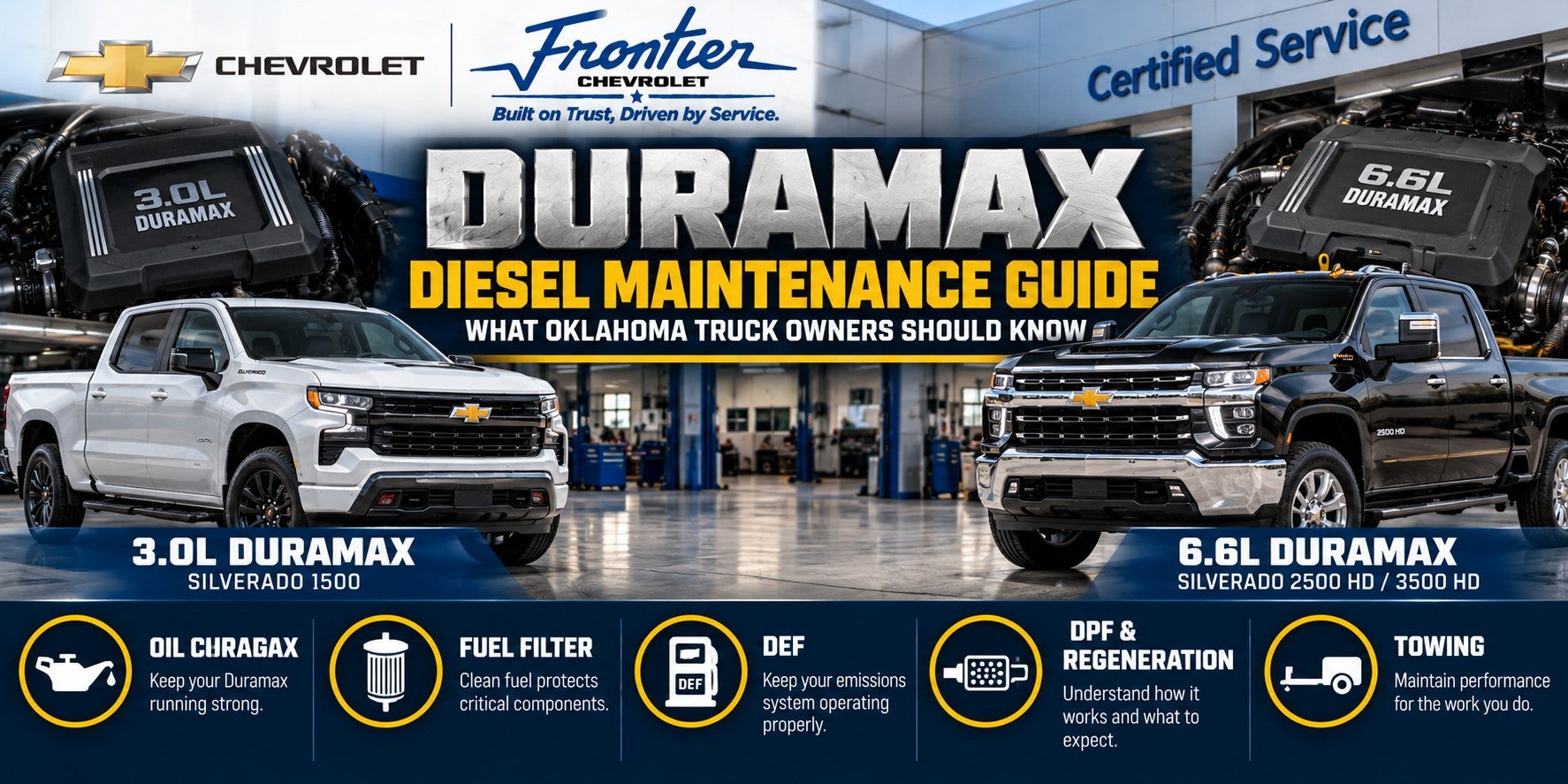
Chevrolet Silverado receiving an oil change at Frontier Chevrolet in El Reno, Oklahoma, with Chevrolet Oil Life Monitor service recommendations

When Does My Chevrolet Need an Oil Change? A Guide for Oklahoma Drivers

When Does My Chevrolet Need an Oil Change? A Guide for Oklahoma Drivers Your Chevrolet doesn't necessarily need an oil change simply because you've reached an old-fashioned mileage interval. Modern Chevrolet vehicles use technology to help determine when engine oil service is actually needed based on how the vehicle is being operated. That's important for Oklahoma drivers because two vehicles traveling the same number of miles may experience very different conditions. A Silverado towing a travel trailer across Oklahoma isn't doing the same work as an Equinox commuting between El Reno and Oklahoma City. A truck spending hours idling on a job site isn't experiencing the same conditions as a Tahoe traveling primarily on the highway. At Frontier Chevrolet in El Reno, Oklahoma, one of the most useful tools for understanding when your Chevrolet needs an oil change may already be built into your vehicle: The Chevrolet Engine Oil Life System. Understanding what that percentage means—and what it doesn't mean—can help you make better maintenance decisions. Quick Answer: When Does My Chevrolet Need an Oil Change? Many modern Chevrolet vehicles use an Engine Oil Life System to calculate when an oil change is needed based on vehicle operation. Rather than relying only on a fixed mileage interval, Chevrolet owners should monitor the remaining oil-life percentage and follow the maintenance recommendations for their specific vehicle. When the system indicates that an oil change is required, the engine oil and filter should be serviced according to the specifications for your Chevrolet. What Does the Chevrolet Oil Life Percentage Mean? Your Chevrolet's oil-life percentage is an estimate of the engine oil's remaining useful life. It is not a measurement of how much oil is physically inside the engine. That's an important distinction. For example: 50% oil life does not mean your engine is half full of oil. Your engine could display significant remaining oil life and still potentially have an oil-level concern that needs attention. Think of the Oil Life Monitor as an estimate of when the oil needs to be changed, not a replacement for checking the actual oil level when appropriate. What Does 20%, 10%, 5% or 0% Oil Life Mean? As the oil-life percentage decreases, your Chevrolet is getting closer to the point at which oil service is required. A practical way to think about it is: Oil Life What You Should Do 100% Oil-life system has typically been reset following an oil change 20% Start planning your next oil change 10% Service is approaching; schedule your oil change soon 5% Oil service should be addressed promptly 0% The system indicates the oil has reached the end of its calculated service life These percentages shouldn't replace the maintenance information for your particular Chevrolet. They are simply a useful way to plan ahead rather than waiting until the last minute to schedule service. Should I Change My Chevrolet's Oil Based on Mileage or Oil Life? For Chevrolet vehicles equipped with an Engine Oil Life System, owners should pay attention to the system and follow the maintenance recommendations for their particular vehicle. The old habit of automatically changing oil at one fixed mileage interval doesn't account for how differently vehicles can be operated. Engine oil life can be affected by operating conditions. For example, a vehicle may experience: Frequent short trips Stop-and-go traffic Extended idling Towing Heavy loads Highway driving Extreme temperatures Other demanding operating conditions Modern oil-life monitoring technology is designed to account for vehicle operation rather than simply functioning as a mileage countdown. Does the Chevrolet Oil Life Monitor Actually Test the Oil? The Oil Life System should not be thought of as a laboratory test of the oil inside your engine. Instead, the system uses information about vehicle operation to calculate remaining oil life. That's why your oil-life percentage may decrease differently depending on how the vehicle is driven. It also explains why two Chevrolet vehicles with similar mileage may display different remaining oil-life percentages. Can I Drive My Chevrolet With 0% Oil Life? A 0% oil-life reading should not be treated as permission to continue delaying service. It indicates that the Oil Life System has calculated that the engine oil has reached the end of its service life. If your Chevrolet reaches 0%, arrange for the oil and filter to be serviced as soon as practical according to the requirements for your vehicle. Planning your appointment before reaching 0% is the better approach. That's why seeing your oil life reach 20%, 10% or 5% can be useful—it gives you time to schedule service before the system reaches the end of its calculated interval. Is Oil Life the Same as Oil Level? No. Oil life and oil level are two different things. Oil life estimates when the oil needs to be replaced. Oil level refers to the amount of oil physically present in the engine. A vehicle can potentially have remaining oil life while still experiencing a low oil level. If your Chevrolet displays an oil-pressure warning, low-oil warning or another engine-related warning, don't assume the oil-life percentage explains the problem. Follow the instructions provided for your vehicle and have the condition inspected when necessary. Does Towing Affect Silverado Oil Life? Towing increases the workload placed on your truck. Depending on trailer weight, terrain, weather and other operating conditions, towing can increase demands on the engine, transmission and cooling system. That's one reason a Silverado owner who regularly tows shouldn't think about maintenance based solely on odometer mileage. Consider two Silverado trucks with 50,000 miles. One has spent most of its life commuting unloaded on the highway. The other regularly pulls a camper, boat or equipment trailer. The odometers may show the same mileage, but the trucks haven't necessarily experienced the same operating conditions. How you use your Silverado matters. Should I Check My Silverado Before a Towing Trip? Yes. An upcoming towing trip is a good reason to check your truck before leaving. Depending on the vehicle and trip, that can include checking: Oil life Engine oil level Tire pressure Tire condition Coolant Brakes Battery Exterior lights Trailer connections Applicable fluids DEF level on a Duramax diesel If your oil life is already low and you're preparing for a long towing trip, taking care of the service before leaving may make more sense than trying to schedule an oil change while traveling. What Oil Does My Chevrolet Need? The correct engine oil depends on the specific Chevrolet, model year and engine. Don't assume every Silverado—or even every Silverado 1500—uses exactly the same oil specification. Chevrolet vehicles can use different engines with different requirements. The correct oil specification for your vehicle should be determined using the information provided for your particular model and engine. This is especially important when comparing gasoline and diesel engines. Using the correct oil specification matters just as much as changing the oil at the appropriate time. Does My 3.0L Duramax Need Different Oil Than a Gas Silverado? The 3.0L Duramax Turbo-Diesel is a diesel engine and has maintenance requirements that differ from Chevrolet's gasoline engines. Owners should follow the oil specification and maintenance information for their particular Duramax-equipped Silverado. Diesel maintenance can also involve other items that gasoline owners don't normally encounter, including: Diesel Exhaust Fluid Diesel fuel filtration Diesel emissions systems Diesel-specific maintenance requirements Don't automatically apply a maintenance routine from a 5.3L or 6.2L gasoline Silverado to a 3.0L Duramax. What About Oil Changes for a 6.6L Duramax Silverado HD? The 6.6L Duramax Turbo-Diesel found in Silverado HD trucks is different from the 3.0L Duramax available in the Silverado 1500. Silverado 2500 HD and 3500 HD trucks may also experience very different workloads. Many HD trucks regularly tow: Fifth-wheel campers Gooseneck trailers Equipment trailers Livestock trailers Commercial trailers Others spend considerable time idling or working under load. Owners should follow the maintenance requirements for their specific HD truck rather than assuming every Duramax uses the same maintenance strategy. Does Oklahoma Heat Affect My Chevrolet's Engine Oil? Operating conditions matter when maintaining any vehicle. Oklahoma drivers can experience summer temperatures well into the 90s and above, extended highway driving, stop-and-go traffic, towing and periods of prolonged idling. Rather than trying to create a separate generic oil-change interval for Oklahoma weather, the better approach is to monitor your Chevrolet's Oil Life System and follow the maintenance requirements for your specific vehicle and operating conditions. Your vehicle knows more about how it has actually been driven than a generic mileage sticker does. Why Did My Chevrolet Oil Life Drop Faster Than Expected? Your oil-life percentage isn't necessarily going to decrease at exactly the same rate every time. Because the system considers vehicle operation, changes in how you use your Chevrolet can affect the calculated remaining oil life. For example, your driving may have recently included more: Towing Stop-and-go driving Short trips Idling Demanding operating conditions That doesn't automatically mean something is wrong with the vehicle. If you're concerned about an unusual change or you're also seeing warning messages, however, it's reasonable to have the vehicle inspected. Should I Rotate My Tires During an Oil Change? An oil-change visit can be a convenient opportunity to evaluate whether your tires are also due for rotation. Regular tire rotation can help promote more even tread wear. It also creates an opportunity to inspect the tires for: Uneven wear Low tread depth Damage Improper inflation Other potential concerns The appropriate rotation schedule depends on your vehicle and tires, so follow the recommendations applicable to your Chevrolet. For Silverado owners who tow or carry heavier loads, tire condition deserves particular attention. What Else Should Be Checked During an Oil Change? An oil change is an opportunity to look beyond the oil itself. Depending on your Chevrolet and the service being performed, it can also be a good time to consider the condition of: Tires Brakes Battery Wiper blades Air filter Fluid levels Exterior lights Visible leaks Other maintenance items That doesn't mean every item needs to be replaced every time the oil is changed. The purpose of an inspection is to understand the condition of the vehicle and identify items that may deserve attention. Should I Reset My Chevrolet Oil Life Monitor After an Oil Change? Yes. After the engine oil and filter have been properly serviced, the Oil Life System should be reset so it can begin calculating the next service interval. If the oil is changed but the system isn't reset, the displayed percentage won't accurately represent the new oil's calculated service life. Likewise, don't reset the Oil Life Monitor simply to make a service reminder disappear if the oil hasn't actually been changed. The reset should correspond with the completed oil service. Why Does My Chevrolet Still Say Change Engine Oil After an Oil Change? If the oil was recently changed but the vehicle continues displaying an oil-change message, the Oil Life System may not have been properly reset. The reset procedure can vary by vehicle and model year. If you're unsure whether the service was completed or whether the monitor was reset correctly, have the vehicle checked rather than simply assuming the warning can be ignored. Do I Need an Oil Change Before a Long Road Trip? That depends on your current oil life and the distance you plan to travel. If your Chevrolet has plenty of remaining calculated oil life, an early oil change may not necessarily be required simply because you're taking a trip. But if your oil life is already approaching the end of its calculated interval, servicing the vehicle before leaving may be the more convenient choice. Before a long trip, it's also worth checking: Tires Battery Brakes Coolant Wipers Exterior lights Applicable fluids For diesel owners, check the DEF level as well. Chevrolet Oil Changes Near El Reno and Oklahoma City Frontier Chevrolet is located in El Reno, Oklahoma, west of the Oklahoma City metro. Our service department works with Chevrolet owners from El Reno and surrounding communities, including Yukon, Mustang, Piedmont, Kingfisher, Weatherford and western Oklahoma City. Whether you drive a Silverado, Tahoe, Suburban, Traverse, Equinox, Trax, Colorado or another Chevrolet, routine oil service is one of the fundamental parts of taking care of your vehicle. And if you're unsure whether your Chevrolet is due for service, start by checking your oil-life percentage. Chevrolet Oil Change FAQs How often should I change the oil in my Chevrolet? Follow the Engine Oil Life System and maintenance information for your specific Chevrolet. Oil-change needs can vary based on vehicle, engine and operating conditions. What does 20% oil life mean on a Chevrolet? It means the system estimates approximately 20% of the engine oil's calculated useful life remains. It's a good time to begin planning your next oil change. What does 5% oil life mean? Your vehicle is approaching the end of its calculated oil-service interval. Schedule your oil change promptly rather than waiting until well after the system reaches 0%. Does 50% oil life mean my engine is half full of oil? No. Oil-life percentage estimates the remaining useful life of the engine oil. It does not measure the amount of oil physically in the engine. Should I change my oil before it reaches 0%? You can schedule service before reaching 0%, particularly when the percentage is low or you're preparing for a long trip. Follow the maintenance recommendations for your particular Chevrolet. Does towing affect Silverado oil changes? Towing increases engine workload and can affect vehicle operating conditions. Silverado owners who tow regularly should pay attention to the Oil Life System and the maintenance recommendations for their truck. Does a Duramax need different oil than a gasoline Silverado? Diesel and gasoline engines can have different oil specifications and maintenance requirements. Follow the specifications for your particular engine. Should I rotate my tires when I get an oil change? An oil-change appointment can be a convenient time to rotate and inspect the tires when rotation is due. Schedule a Chevrolet Oil Change in El Reno, Oklahoma You don't have to guess when your Chevrolet needs an oil change. Start with your vehicle. Check the Oil Life Monitor, pay attention to maintenance messages and consider how the vehicle is actually being used. If your oil life is getting low, you're preparing for a long trip, or you're simply unsure whether your Chevrolet is due for service, the team at Frontier Chevrolet in El Reno can help. Whether you drive a Silverado that works every day, a Tahoe carrying the family, an Equinox commuting to Oklahoma City or a Duramax pulling a trailer across Oklahoma, proper oil service remains one of the foundations of vehicle maintenance. Frontier Chevrolet 1640 E. Highway 66 El Reno, Oklahoma 73036 Built on Trust, Driven by Service. Schedule your Chevrolet oil change today.
Contact Us

Fill out this form below and we'll contact you shortly
*Required Fields