




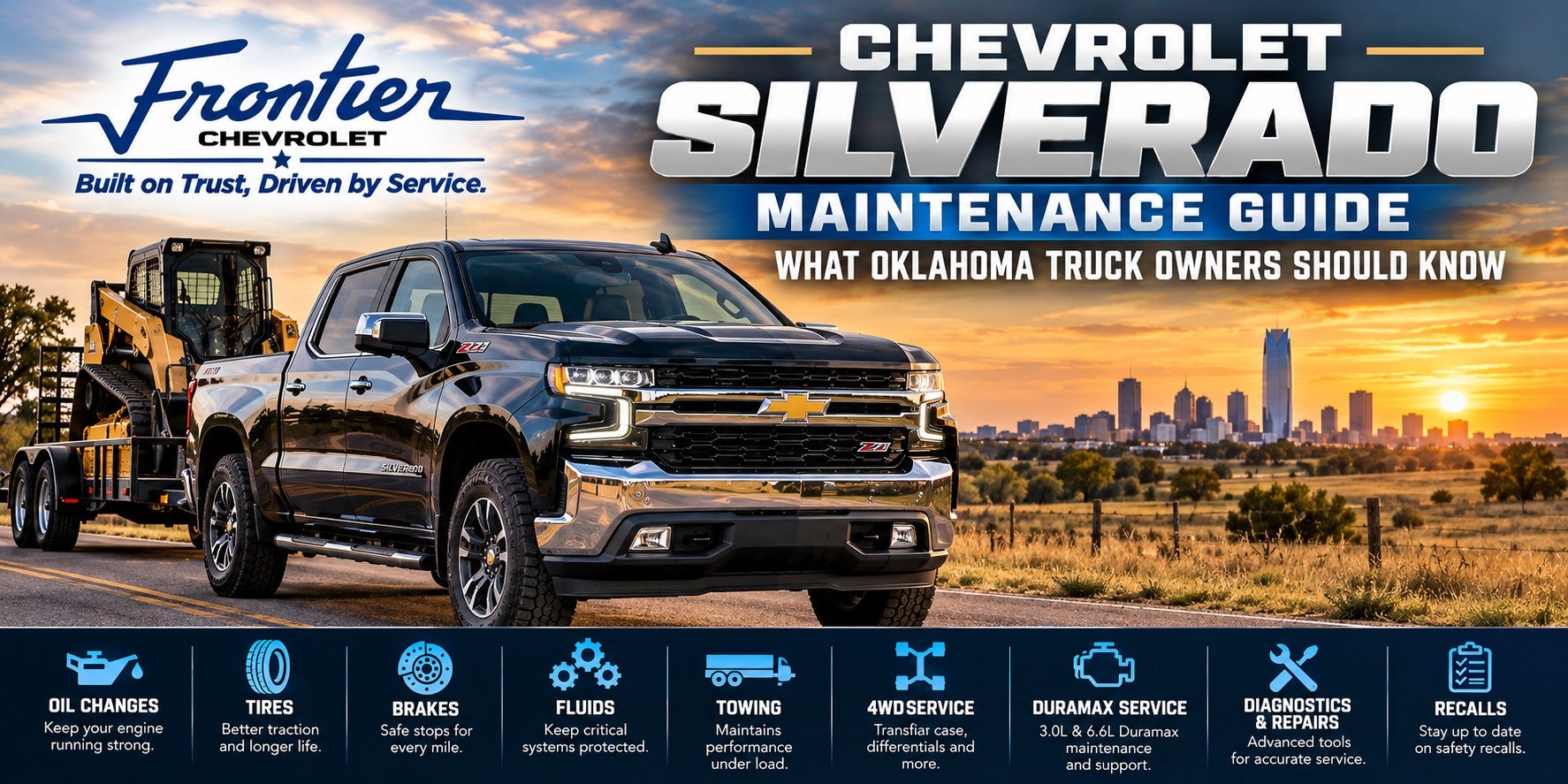
Chevrolet Silverado Maintenance Guide: What Oklahoma Truck Owners Should Know
A Chevrolet Silverado can live a lot of different lives.
One Silverado may spend most of its time commuting between El Reno and Oklahoma City. Another may pull a travel trailer on weekends. Another might haul equipment, spend hours idling on a job site, travel gravel roads, or work every day on a farm or ranch.
That matters when it comes to maintenance.
Two Silverado trucks with the same mileage may have experienced very different operating conditions—and may not have exactly the same maintenance needs.
At Frontier Chevrolet in El Reno, Oklahoma, we believe Silverado maintenance should start with a simple question:
How do you use your truck?
Once you understand that, it's easier to determine which areas of your Silverado deserve the most attention.
What Maintenance Does a Chevrolet Silverado Need?
Quick Answer: Chevrolet Silverado maintenance can include engine oil and filter changes, tire rotations and inspections, brake inspections, fluid checks, battery testing, air and cabin filter replacement, drivetrain maintenance, and other services based on the truck's model year, engine, mileage and operating conditions.
For 4WD, towing and Duramax-equipped trucks, additional components may require attention.
There isn't one universal maintenance schedule that applies to every Silverado.
The best source for specific service intervals is the maintenance schedule for your particular truck.
But there are several areas every Silverado owner should understand.
How Often Should You Change the Oil in a Chevrolet Silverado?
Modern Chevrolet Silverado trucks use an Engine Oil Life System to help owners determine when an oil change is needed.
Instead of relying only on a predetermined mileage interval, the system calculates remaining oil life based on vehicle operation.
When the system indicates that an oil change is necessary, don't simply reset the monitor and continue driving. Have the oil and filter serviced according to the requirements for your Silverado.
Operating conditions matter, too.
A truck that regularly experiences towing, extended idling, frequent short trips, dusty roads or other demanding conditions may operate differently than a Silverado primarily driven on the highway.
The important point: Don't rely solely on an old rule about changing your oil every certain number of miles. Pay attention to your Silverado's Oil Life Monitor and the maintenance requirements for your specific truck.
Does Towing Affect Silverado Maintenance?
Yes. Regular towing can place additional demands on several systems in your Silverado.Towing can increase the workload placed on the:
- Engine
- Transmission
- Cooling system
- Brakes
- Tires
- Suspension
- Differential
- Drivetrain
The heavier the trailer and the more frequently you tow, the more important inspections and proper maintenance become.
This is particularly important for Oklahoma truck owners who regularly pull campers, boats, utility trailers, livestock trailers or equipment.
A Silverado with 60,000 mostly unloaded highway miles has experienced a different workload than a truck with 60,000 miles that regularly pulls a trailer.
Mileage tells part of the story. How the truck accumulated those miles matters too.
What Should I Check on My Silverado Before Towing?
Before hooking up a trailer, several areas deserve attention.
Check your Silverado's:
Tire Pressure and Condition
Inspect both the truck and trailer tires. Look for proper inflation, adequate tread and visible damage.
Brakes
Make sure the truck's brakes are operating normally and that applicable trailer braking equipment is functioning properly.
Fluids
Check applicable fluid levels and address any warning messages.
Lights
Verify brake lights, turn signals, running lights and trailer lighting.
Hitch and Connections
Inspect the hitch, coupler, safety chains, electrical connection and other towing equipment.
Trailer Weight
Know what the trailer actually weighs when loaded—not simply its advertised empty or dry weight.
Your Silverado's towing capacity also varies by configuration.
Engine, drivetrain, cab, bed, axle ratio, equipment and other factors can affect trailering capacity.
Never assume that every Silverado with the same engine can tow the same amount.
How Often Should Silverado Tires Be Rotated?
Tire rotation helps promote more even tread wear and gives your service technician an opportunity to inspect the tires for unusual wear patterns.
The appropriate interval should follow the recommendations for your particular Silverado and tires.
Pay attention to:
- Uneven tread wear
- Low tread depth
- Cracking or damage
- Vibration
- Pulling while driving
- Repeated tire-pressure loss
If the tires are wearing unevenly, simply rotating them may not address the underlying cause.
Alignment, suspension components, tire pressure or other factors may need to be evaluated.
This becomes even more important on a truck that frequently tows or carries heavier loads.
When Should Silverado Brakes Be Inspected?
There's no single mileage at which every Silverado will need new brakes.
Brake wear depends heavily on how the truck is used.
A Silverado that regularly pulls a trailer or operates in stop-and-go traffic may experience different brake wear than a truck driven primarily on open highways.
Warning signs that deserve attention include:
- Squealing
- Grinding
- Vibration while braking
- Longer stopping distances
- A change in brake pedal feel
- Pulling during braking
- Brake warning lights
Because brake wear usually occurs gradually, drivers sometimes adapt to declining performance without realizing it.
Regular inspection helps identify wear before it becomes a larger concern.
What Maintenance Does a 4WD Silverado Need?
Four-wheel-drive Silverado trucks have additional drivetrain components that owners should not overlook.
Depending on the model and configuration, these may include:
- Transfer case
- Front differential
- Rear differential
- Driveshafts
- Axles
- CV components
- 4WD-related electronics and actuators
Fluid requirements and service intervals vary by model year and configuration.
If your Silverado frequently operates in mud, water, dusty environments, on gravel roads or under heavy towing conditions, tell your service advisor how the truck is being used.
That information can help provide context when inspecting the drivetrain.
What Fluids Should Silverado Owners Monitor?
Oil gets most of the attention, but it isn't the only fluid important to your truck.
Depending on the Silverado, owners may need to monitor or maintain:
- Engine oil
- Engine coolant
- Brake fluid
- Transmission fluid
- Front differential fluid
- Rear differential fluid
- Transfer-case fluid on applicable 4WD trucks
- Windshield washer fluid
- Diesel Exhaust Fluid on applicable Duramax diesel trucks
Not every fluid needs to be changed at every service visit.
Follow the requirements for your particular Silverado rather than automatically replacing fluids based on a generic maintenance package.
What Maintenance Does a 3.0L Duramax Silverado Need?
The available 3.0L Duramax Turbo-Diesel gives Silverado 1500 owners a combination of diesel torque, towing capability and highway efficiency.
But diesel ownership also brings some maintenance considerations that gasoline-powered Silverado owners don't encounter.
Depending on mileage, operating conditions and the maintenance schedule, owners should pay attention to areas including:
- Engine oil and filter
- Fuel filter
- Diesel Exhaust Fluid
- Air filtration
- Cooling system
- Diesel emissions system
- Fuel system
- Warning messages
The 3.0L Duramax should not simply be treated like a gasoline engine with diesel fuel added.
Following the maintenance requirements for the diesel engine is important.
Does a Duramax Silverado Require DEF?
Yes. Modern Duramax diesel Silverado trucks use Diesel Exhaust Fluid as part of their emissions-control system.
DEF is stored separately from diesel fuel.
Your Silverado will provide warnings as the DEF level becomes low.
Don't ignore those warnings.
If a DEF or emissions-system message remains after the fluid level has been addressed—or you're receiving a warning that isn't simply related to low DEF—the truck may need diagnosis.
A warning mentioning DEF doesn't automatically mean adding fluid will solve every emissions-related problem.
What Maintenance Does a 6.6L Duramax Silverado HD Need?
The 6.6L Duramax Turbo-Diesel used in Silverado HD trucks is different from the 3.0L Duramax available in the Silverado 1500.
That's an important distinction.
Silverado 2500 HD and 3500 HD trucks are frequently used for heavier work, including:
- Fifth-wheel towing
- Gooseneck towing
- Equipment trailers
- Livestock trailers
- Commercial use
- Farm and ranch work
- Heavy recreational towing
The workload placed on an HD truck can make proper maintenance especially important.
Engine oil, fuel filters, DEF, cooling systems, transmission operation, brakes, tires and drivetrain components all deserve attention based on the truck's use and maintenance requirements.
A 3.0L Duramax Silverado 1500 and a 6.6L Duramax Silverado HD should not automatically be placed on the same maintenance strategy.
Is Short-Trip Driving Hard on a Silverado?
It can be.
Frequent short trips can prevent some vehicle systems from reaching normal operating temperatures for extended periods.
This can be particularly relevant for diesel owners because modern diesel emissions systems operate differently from gasoline-powered vehicles.
That doesn't mean a Duramax can't be driven around town.
It means owners should understand that operating conditions matter.
If nearly all of your driving consists of short trips, discuss your driving habits when determining the appropriate maintenance strategy for your truck.
Does Driving on Oklahoma Gravel Roads Affect Silverado Maintenance?
Oklahoma truck owners know that pavement isn't always part of the trip.
Gravel roads, dirt roads, construction areas and ranch environments can expose a Silverado to additional dust, debris and vibration.
If your truck regularly operates in those environments, areas worth monitoring can include:
- Air filter
- Tires
- Suspension
- Steering
- Brakes
- Undercarriage
- Fluid leaks
- Exterior lighting
This is another reason vehicle use matters just as much as mileage.
What Does the Silverado Oil Life Percentage Mean?
Your Silverado's oil-life percentage is an estimate of remaining engine oil life based on vehicle operation.
As the percentage decreases, the truck is moving closer to the point at which an oil change is required.
It's important to understand that this isn't simply an oil-level gauge.
Oil life and oil level are different things.
A vehicle can potentially have adequate remaining oil life while still requiring attention to the actual oil level.
Owners should follow the procedures in their vehicle's owner's manual for checking oil level and responding to oil-related warnings.
What Does a Check Engine Light Mean on a Silverado?
A Silverado's check engine light can be triggered by many different conditions.
The warning light itself does not identify exactly which component has failed.
A diagnostic scan may retrieve a trouble code, but the code usually identifies the system or condition that requires investigation.
A trouble code is the beginning of diagnosis—not automatically a parts replacement recommendation.
If your check engine light is flashing, the truck is running poorly, losing power, overheating or displaying additional warnings, the condition may require more immediate attention.
How Do I Know if My Silverado Has an Open Recall?
Recall status is tied to your Silverado's Vehicle Identification Number (VIN).
That means two trucks of the same model year may not necessarily have the same open recall campaigns.
If you're unsure whether your Silverado has an open recall, the VIN can be checked to determine whether applicable campaigns are outstanding.
A Chevrolet dealership can then determine the applicable repair procedure and parts requirements for an eligible Chevrolet recall.
Don't assume that an older recall no longer matters simply because you didn't recently receive a notice.
Should I Service My Silverado Before a Long Trip?
If you're preparing for a long road trip—especially one involving a trailer—it's a good time to inspect the truck before leaving.
Consider checking:
- Oil life
- Tires and tire pressure
- Brakes
- Battery
- Coolant
- Exterior lights
- Windshield wipers
- Trailer connections
- Applicable fluids
- DEF level on diesel trucks
Finding a problem in El Reno is usually more convenient than discovering it while towing a camper several hundred miles from home.
Silverado Maintenance for Oklahoma Weather
Oklahoma can expose vehicles to a wide range of conditions.
Summer heat can be hard on batteries, tires and cooling systems.
Winter temperatures can expose a weakening battery.
Spring storms bring heavy rain and changing road conditions.
And Oklahoma wind, dust and rural roads can add another layer of wear.
Seasonal inspections can help identify issues before the weather exposes them at the worst possible time.
Chevrolet Silverado Maintenance FAQs
How often should I service my Silverado?
Follow the maintenance schedule and vehicle information for your specific Silverado. Engine, model year, mileage, driving conditions and vehicle use can all affect maintenance needs.Does towing mean I need to service my Silverado more often?
Towing can place additional demands on the engine, transmission, cooling system, brakes, tires and drivetrain. Follow the maintenance recommendations applicable to your truck and operating conditions.Should I change my Silverado oil based on mileage or oil life?
Modern Silverados use an Engine Oil Life System. Follow the recommendations for your particular vehicle and respond appropriately when the system indicates service is needed.Is 4WD maintenance different from 2WD?
A 4WD Silverado has additional drivetrain components, including a transfer case and front drivetrain components, that may have inspection or maintenance requirements.Does a Duramax Silverado need different maintenance than a gas Silverado?
Yes. Diesel Silverado models have diesel-specific systems and maintenance considerations, including fuel filtration, DEF and emissions-system components.Is the 3.0L Duramax maintained the same way as the 6.6L Duramax?
No. They are different engines used in different Silverado applications. Owners should follow the maintenance information for their specific engine and truck.Can Frontier Chevrolet check my Silverado for open recalls?
Your Silverado's VIN can be checked for applicable open recalls, and the service team can determine what repair procedure applies.Can Frontier Chevrolet service my Silverado if I bought it somewhere else?
Yes. You don't have to have purchased your Silverado from Frontier Chevrolet to request service from our service department.Schedule Chevrolet Silverado Service in El Reno, Oklahoma
Your Silverado may be a commuter, family vehicle, tow vehicle, work truck—or all four in the same week.
That's why proper maintenance isn't just about the number on the odometer.
It's about how you use your truck.
At Frontier Chevrolet in El Reno, our goal is to help Silverado owners understand what their trucks need and address maintenance before smaller concerns have an opportunity to become larger repairs.
Whether you drive a Silverado 1500, Silverado 2500 HD or Silverado 3500 HD, our Chevrolet service team is here to help.
Frontier Chevrolet
1640 E. Highway 66
El Reno, Oklahoma 73036
Built on Trust, Driven by Service.
Schedule your Chevrolet Silverado service appointment today.